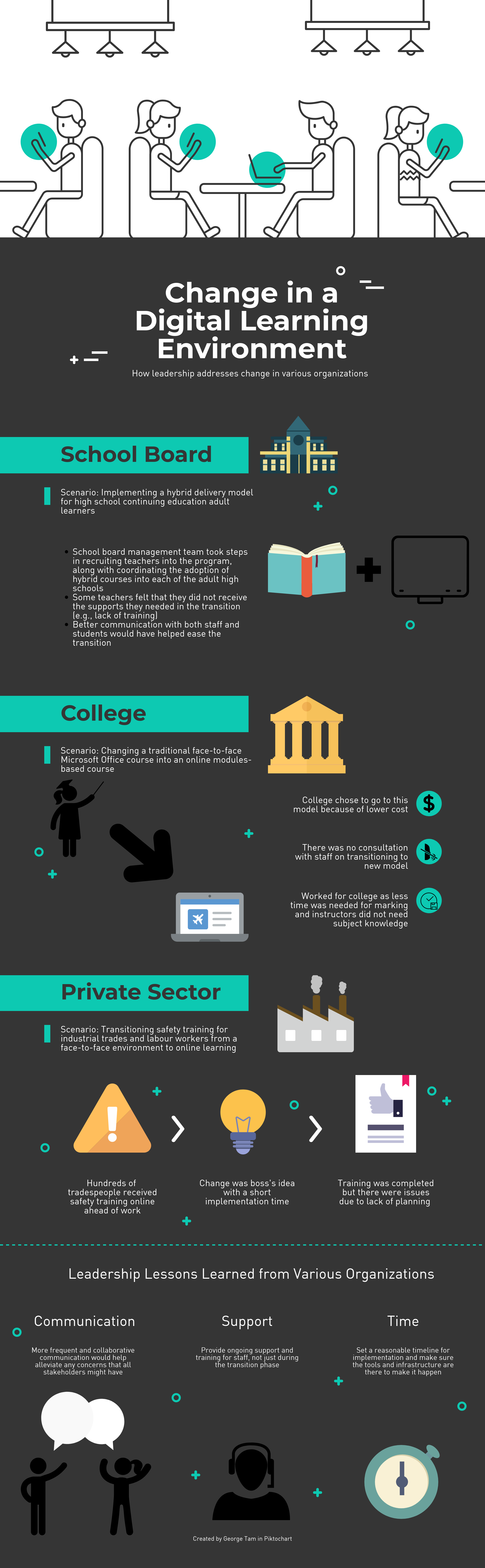
Over the course of my consultations with members of my professional network I was able to explore how leadership approaches change to a digital environment in three different organizational structures. The three organizations I was exposed to were a public school board, private college, and a private sector company in the construction field. While each of these settings were different, they all had similarities, most notably the fact that the decision-making process was top-down with little input from staff. The approach could be described by the power leadership theory where those with the might have all the control (O’Toole, 2008).
At the public school board, input from staff was more difficult due to the sheer size of the organization, but key members of the transition team still felt out of the loop and ill-prepared for the changes that came with transitioning to hybrid learning. Over time, staff and students alike adapted to the process and a system was established albeit more piecemeal than teachers would have liked. More communication and ongoing support was cited as necessary for staff buy-in and would have greatly assisted in a smoother transition. In short, the organizational readiness which includes task demands, resource availability, and also situational factors (Weiner, 2009) were not properly assessed.
The transition to an online modules-based course at the private college was also a process that lacked consultation. The college had decided to go with a course divided into modules that could be completed online, forgoing the in-class teaching delivery model. This was believed to cut costs such as textbooks and training for instructors as instructors would be facilitators versus teachers in this new model. They would only be called upon when there were questions by students. The college was under the assumption that any instructor would be able to assume the role of facilitator as all the material needed for the students would be online. In reality, staff had challenges answering certain questions from students and in turn students had challenges completing the modules. Leadership was not mindful or aware that staff would encounter these issues. The confidence that instructors have in their knowledge needed to be built up by leadership (Castelli, 2015) to support the learning of the students. Over time staff and students adapted to this new model but there likely would have been fewer challenges had staff been consulted on how the new delivery model would be phased in and what was the best way to facilitate the learning for the students.
The company in the construction field had wanted to transition to online safety training. After completing modules online, tradespeople would get their safety accreditation. This decision was made by the owner unilaterally as this was a small company where the boss made most decisions on his own. While the transition was completed, the staff member who was in charge of the transition was saddled with a tight deadline and limited resources to complete such a process. This was coupled with the pushback and resistance from labourers who were less technologically proficient and felt that they were forced to change to this new system. Weller and Anderson (2013) note that change can happen even with resistance, “but it requires strategic direction, leadership and is not done quickly”. More time and planning would have assisted in this process.
My own approach to leadership has been that of shared and adaptive leadership. While it is possible to lead in a manner where those that have the most power dictate what happens, these examples have shown that challenges arise when implementing a major overhaul such as a shift to a digital learning environment. Employees are not motivated and they feel forced to comply when they are not consulted or the rationale has not been explained to them. Each of the organizations could benefit from reflective leadership which allows for a more motivated workforce, renewed interest and effort, and improved performance in working towards the change (Castelli, 2015). Also in each of the situations, there were unexpected outcomes which could have been remedied by an adaptive approach that assesses the changes in environment and manages the situation accordingly (Khan, 2017). The three lessons learned, involving more communication, support and time show adaptive and shared/collaborative leadership which will guide my future leadership endeavours.
References
Castelli, P. (2016). Reflective leadership review: a framework for improving organisational performance. Journal of Management Development, 35(2), 217-236.
Khan, N. (2017). Adaptive or Transactional Leadership in Current Higher Education: A Brief Comparison. The International Review of Research in Open and Distributed Learning, 18(3).
O’Toole, James (2008). Notes Toward a Definition of Values-Based Leadership. The Journal of Values-Based Leadership, 1(1).
Weiner, B. J. (2009). A theory of organizational readiness for change. Implementation Science, 4(67).
Weller, M., & Anderson, T., (2013). Digital Resilience in Higher Education. European Journal of Open Distance and E-Learning, 16(1), 53-66.