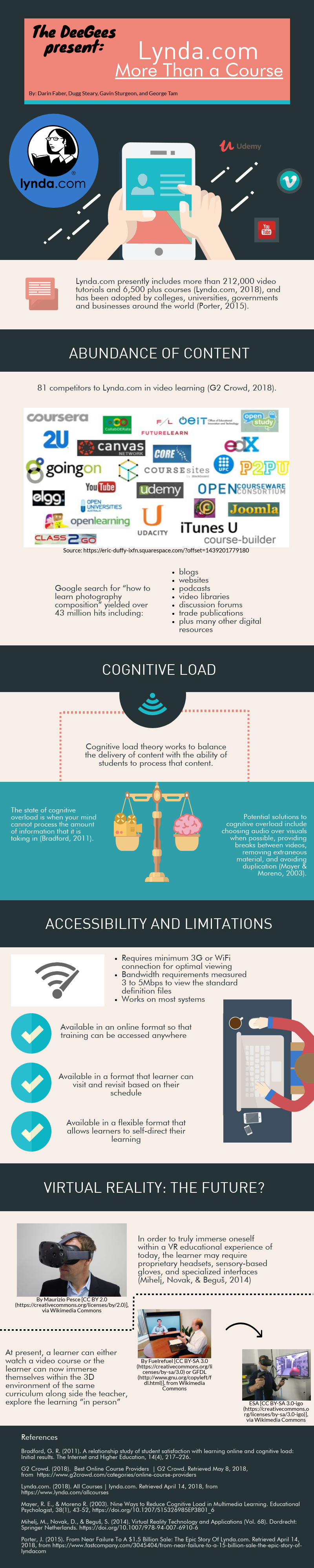
In considering the place of video curated libraries, I have mentioned the usefulness and accessibility of such instances (namely Lynda.com) for learning. I believed it was a good modality for learning something such as photographic composition and the instructor did a fine job of organizing the course into digestible chapters. Microlearning was also brought up in discussions as a very fitting approach which could fully utilize video-based learning, with the convenience of learning at one’s pace when one wants to. This has me thinking of what video curated libraries would not be as suitable for.
Many credential granting institutions now have courses that offer multimedia (usually video) resources. While there are online institutions that will grant some sort of credential for video courses, the general acceptance of the public and employers still has not taken place. Why is this so? It has been brought up in discussions of our MALAT cohort that simply completing a video does not necessarily mean a skill or knowledge has been attained. In fact, there is even the challenge of determining whether the registered learner is the one viewing the content (though some companies are using technology such as facial recognition to overcome this).
From my research thus far, while there are scenarios where video curated libraries are great for learning, such as with procedural knowledge and task-oriented training, I find that for higher order learning and more longer and thorough education, there must be more than just video to ensure that learners are cognitively still following along and still motivated to continue. Video is a great resource, but not the solution to all learning regimens.