Cite, cite, and cite some more

The topic of copyright is very complex and I foresee it to continue to be a complex topic as long as there are no universal guidelines. For me, the biggest takeaway from Melanie Wrobel’s presentation on Copyright was on ownership of work. We’re all familiar with the idea of whoever creates the work has ownership to it, but under copyright or contract law, that may not always be the case. As Wrobel mentions, employees may give up ownership of their work to their employer depending on the contract that the employee has with their employee. I’ll be sure to read the fine print next time I sign a contract.

As my knowledge on the Creative Commons license was limited, the Creative Commons segment of the presentation was also very informative. I think it’s great that we can share information and promote knowledge mobilization while making sure that those who provide the work get due acknowledgement. It also opens doors to collaborations and more exciting new endeavours. For now, I’ll continue to make sure that my work is cited properly, and all credit is given appropriately.


References

Wrobel, M. (2016, June 13). A Guide to Copyright. Podcast retrieved from goo.gl/9KKqZR
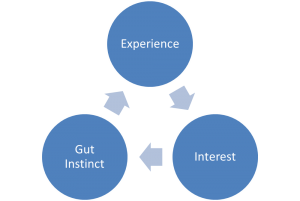
Add a cup of experience, two teaspoons of interest, a dash of gut instinct…and voila!

Hearing Dr. George Veletsianos draw back the curtain to his research experiences was very thought provoking. Seeing his extensive list of research projects, it is obvious that he has a lot of experience doing studies on digital learning environments and the exposure to them. By the end of his podcast, I felt that there were three qualities a researcher should have to do great research. The first being experience. Experts in the field naturally have this experience that they build on. If the formula works, why change the wheel? New research can be built on past findings. The second item that I found was interest. Most researchers I know are deeply interested in their research, which would make sense if they’ve dedicated their careers to it. Lastly for lack of a better term, gut instinct, and it really cycles back to experience. From experience, one can get an idea whether a certain research project is worth pursuing or not.


During the MALAT Research Panel Discussion 2017 at Royal Roads University, both George Veletsianos and Dr. Bill Muirhead note that a lot of research is conducted, but not all of it good research. While we may not all have the experience of experts, we can learn from their teachings and publications. At the very least, I can now confirm that comparing whether online or face-to-face learning is better can be classified as a bad research topic to look into. For more detail on why, check out the panel. In short, it’s been done to death and there’s no conclusive answer. While I have some experience in research, I hope to further embark on my own journey and hopefully have a ‘good’ research question along the way.


References

Veletsianos, G. (2017, August 10). George Veletsianos on Research. Podcast retrieved from https://moodle.royalroads.ca/moodle/mod/page/view.php?id=245247

MALAT Research Panel Discussion 2017 [Video file]. Retrieved from https://livestream.com/accounts/10925877/events/7616831/videos/160653361

What makes a good research question? That is the question

It can take a lot of time to come up with a good research question, involving the conception, revising, and finalizing. While having a general theme of what your research will be about may not be too difficult, creating a research question that hones in on what you are truly trying to find out takes some work. In my option, a good research question should have these factors:

  1. Clear focus and scope – A research question cannot be too broad as it can be difficult to make generalizations with your research project. For example, a study on students should be narrowed down to high school students, adult students, or visa students, etc. Proceeding with the study will be simpler once your subjects of interest are clearly defined.
  2. Be feasible – This is something that seems obvious, but can be easily overlooked. We can all ask good questions, but a good research question needs to be something that is possible be examined with available resources and expertise.
  3. Examines something new – A good research question would ideally lead to new research. New research does not necessarily have to involve new concepts, as a lot of research is built upon previous studies. A lot of research papers conclude with “further research is needed” which is an opening for more study.

Naturally there are many other qualities that a good research question has, which our classmates have posted or will post. Lastly, I think an important thing to remember is one does not have to be limited to one research question. If you are looking to examine multiple theories and ideas, it’s a good idea to have two or three research questions rather than trying to put it all in one question.

My Academic Writing

From looking at everyone’s Padlet responses in Activity 1 I think I can safely say that academic writing on everyone’s mind, for better or worse. I can say that I’m in the same boat since I was never brimming with confidence in my writing either. Admitting this is a bit embarrassing, since I actually work in research! I find I am more confident working on the quantitative side of research, but that is a topic for another time.

Moving on to resources, I see my classmates have recommended some great online resources. I see Purdue OWL coming up quite a bit and it is a favourite of mine as well. I’ll be the odd one out and recommend some print texts.

The first resource is our textbook from LRNT 521: Publication manual for the American Psychological Association (6th ed.). While it’s not the most exciting to read, beyond being an excellent APA resource, there are also sections on writing and style which are clear and helpful.

The second resource is a book I’ve used in the past called Qualitative Research Methods for the Social Sciences (8th ed.) by Bruce L. Berg and Howard Lune (somehow I feel this text will come in handy later as well…). This is a great book for those who want to learn more about qualitative research, but also there is a chapter on writing research with a very fitting title “Sorting the Noodles from the Soup”. It covers everything from how not to plagerize to how to set up a research report.

Unfortunately the second book I recommended isn’t as easily accessible as a web resource, but it should be useful if you can get your hands on it.