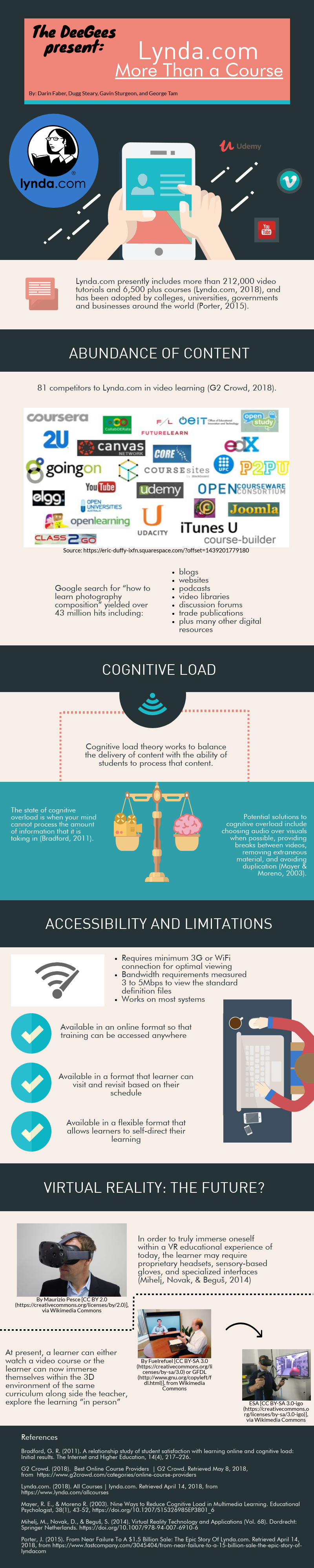
My group the DeeGees chose to explore the modality of video curated libraries through the instance of Lynda.com. It was a great experience to go through a course with not just the mindset of learning the material, but also learning about how the delivery worked as well (or not work). We each focused on our own issues (for myself, cognitive load theory), and set out on our exploration.
Cognitive load in itself is a very complex topic with varied effects due to multimedia. I’ve learned that there are a multitude of combinations of how video learning can be established mixing video, audio, text, animations, frames, points of focus, and many other factors. Each combination can in itself provide a rich learning experience, but have a negative effect on a learner’s cognition.
Key to most successful video and multimedia courses and modules seems to be a few general rules. Some potential solutions to cognitive overload include choosing audio over visuals when possible, providing breaks between videos, removing extraneous material, and avoiding duplication (Mayer & Moreno, 2003).
Of course this is only a sampling of remedies to cognitive load effects. The more I read into cognitive load theory, the more intricate I find how every learning environment will have different cognitive load effects. In short, course design needs to be conscious of the learner and the content being learned. What is the best way to transfer the knowledge? Keeping it simple seems to be an age old saying. There’s no need to be flashy and try to use every visual effect. Sometimes less is more and you know what, the learner may actually remember what the instructor was trying to teach rather than just their floating head.
References
Mayer, R. E., & Moreno R. (2003). Nine Ways to Reduce Cognitive Load in Multimedia Learning. Educational Psychologist, 38(1), 43-52, https://doi.org/10.1207/S15326985EP3801_6