Implications of Abundant Content for Lifelong Learning: Weather Forecasting

Topic

We (Sean and George) decided that we wanted to learn more about weather forecasting and meteorology.

Resources to Help Us Learn About Weather Forecasting

We found that there were many resources online. A sample of the types include:

  • Amateur meteorological blogs
  • Discussion groups, forums, and newsgroups
  • Journal publications
  • Official weather tracking organizations
  • Teaching and learning software

We also found that there are many resources offline such as print books and journals along with communicating with meteorologists or faculty at universities/colleges who teach meteorology.

Is There Abundant Content Around Weather Forecasting to Enable Learning and Is It Enough?

Just from a cursory search of resources, we were able to find a wide variety of tools and writings on the topic of weather forecasting. There were many resources aimed towards teachers for teaching in the middle/high school level. The resources themselves were also varied in that they did not just take the form of a written document. We found modeling software, games, and visuals of various identified weather phenomena to name but a few.

While the resources were abundant, we noticed that a lot of it was not geared towards beginners who wanted to get started in learning how to predict the weather (i.e., with zero knowledge). A lot of the resources for learning were intended to build upon previous knowledge and the amateur blogs expected you to have a baseline of knowledge as well. Based on this focused abundance, learning through sets would be possible since through this method you would be reaching out to those who have an expertise in the field. Of course there is no guarantee that the information is entirely correct and you may run into issues such as crowd stupidity and filter bubbles (Anderson, 2016).

Generally speaking, if one were interested in learning about how to simply predict the weather, the barrier for entry is exceptionally low. At risk of sounding facetious, you only need to guess what you think the weather will be, observe the weather, and determine how accurate you were. Additionally, there are numerous radio, television, and web resources to aid your predictions and compare your results against. However, the challenge comes in selecting resources that will take you beyond this entry level.

With the broad spectrum of options from picture books to Master’s degrees, a learner’s first obstacle in this abundance would be to identify how much they are looking to learn, and which resources might match their abilities and goals. For example, are they interested in becoming a professional meteorologist, or are they looking for a complimentary skill for another activity such as sailing. Ertmer and Newby (2013) identify these resource matching tasks as belonging to those of an instructional designer (p. 43). Is an instructional designer really necessary in this context? Weller (2011) points out that in a pedagogy of abundance, it is the time and attention of the learner that becomes the scarce resource, and that abundant options can be overwhelming and make evaluation difficult (p. 10). In our context with an abundance of content, but dealing with a sharp learning curve, learners with intermediate objectives would benefit greatly from an instructor or facilitator that could assist in identifying materials that can fulfill their learning requirements. This suggests that although the resources for learning may be abundant, the skills of an instructor (or instructional design in general) continue to reside in a paradigm of scarcity. Self-directed learning can only get one so far in this field.

As an example of one possible approach to addressing this issue, our proposed course outline lays out the steps that one would take to learn, incorporating a pedagogy of abundance. It is our intention that the tasks described below will activate the benefits of Resource Based Learning, Constructivism, and Connectivism as described by Weller (2011).

Welcome to Sean & George’s Online Intermediate Meteorology Program

Unit 1: Utilizing the prescribed textbook, learners will conduct their own local weather observations and report their findings in a blog post.

Unit 2: Learners will identify a weather forecasting resource to share with their colleagues. Additionally, each student will make note of a seven day forecast by this resource, then make note of the accuracy of the forecast. Group forum discussions would include overall accuracy; accuracy relative to the number of days in the future; and the differences in local weather between the students.

Unit 3: Selecting from a provided list of weather related blogs and forums, learners will report on the challenges and issues faced by that resource. Group discussion will identify connections and comparisons among these resources, as well as the resources identified in the Unit 2 exercise.

Unit 4: Learners will gain skills in the use of online weather radar technology, and explore the more complex considerations of atmospheric prognostication through the use of WSXIM (a downloadable weather simulator application).

Conclusion

There is sufficient information both online and offline for one to dip their feet in and get a general idea of the theory behind weather patterns and why high or low pressure matters. Although, if one wanted to further their knowledge in these concepts to a more advanced level, formal education would be the best route.

References

Anderson, T. (2016). Chapter 3: Theories for Learning with Emerging Technologies. In Veletsianos, G. (Ed). Emergence and Innovation in Digital Learning: Foundations and Applications. Edmonton, AB: Athabasca University Press.

Ertmer, Peggy A., & Newby, Timothy J. (2013). Behaviorism, Cognitivism, Constructivism: Comparing critical features from an instructional design perspective. Performance Improvement Quarterly, 26(2), 43-71.

Weller, Martin (2011). A pedagogy of abundance. Spanish Journal of Pedagogy, 249 pp. 223–236.
Reflection on my Theoretical and Pedagogical Stance

Ertmer and Newby (2013) do an excellent job of breaking down the structure of behaviourism, cognitivism and constructivism. I believe each of these learning theories have their own merits and validity in suitable situations, hence why we still study them. The authors point to the idea that problems that don’t need much thinking should be best taught through a behavioural lens and problems that require more cognitive ability should be explored via a cognitive or constructivist approach. I find this to be a tad bit of an oversimplification of the theories and downplaying the usefulness of behaviourism.

Constructivism has been a method of choice for many in instructional design as mentioned by the authors. The idea that “humans create meanings as opposed to acquiring it” (p. 55) seems to resonate well, but one cannot forget the fundamentals. In Ontario, the Education Quality and Accountability Office (EQAO) run standardized tests for Grades 3, 6, 9, and 10 students. This year, mathematics results for various grades have either flat-lined or decreased (Education Quality and Accountability Office, 2017). I feel that basic fundamentals in subjects such as mathematics (e.g. multiplication) should be taught under a behavioural lens. It is only when the basics can be recalled, that you can tackle the more complex problems. Working in the K-12 system, I see the demand for newer and better ways for teaching, but there is no one size fits all. Like Ertmer and Newby put it, “it depends” (p. 60).

Merrill (2002) provides support for behaviourism in his analysis of instructional theories that exemplify the first principles of instruction. He identifies the first principles as:

  • Learning is promoted when learners are engaged in solving real-world problems
  • Learning is promoted when existing knowledge is activated as a foundation for new knowledge
  • Learning is promoted when new knowledge is demonstrated to the learner
  • Learning is promoted when new knowledge is applied by the learner
  • Learning is promoted when new knowledge is integrated in the learner’s world.

These are the principles that facilitate learning. Two of the theories, Vanderbilt Learning Technology Center – Star Legacy and McCarthy – 4-MAT both have cyclical phases which in my mind encourages the behaviour of following a certain path to finding the solution (e.g,, generating ideas, followed by research and revision, followed by looking ahead and reflection, etc.).

While technology affords us many more tools to teach, tried fundamentals should not be discarded, especially if the results from the new methods are not to standard. Both constructivism and cognitivism have their place as do most learning theories. With the saturation of e-learning, it’s hard not to tap into online resources that are utilized by many constructivist or cognitive theories. What I hope is that we don’t forget the lessons that need to be taught and not be dazzled by the next shiny object.

This blog post may seem to be a little biased towards behaviourism, but in actual fact I’m an advocate for many and varied learning and instructional theories. I believe there is a time and place for each method, which makes sense in complex learning. What I don’t agree on is the one size fits all model that some feel constructivism can accomplish. Adopting the words of former Prime Minister of Canada William Lyon Mackenzie King a bit, I say ‘Constructivism if necessary, but not necessarily constructivism’.


References

Education Quality and Accountability Office. (2017, September 20). [Provincial Assessment Results 2017] [Infographic]. Retrieved from http://www.eqao.com/en/about_eqao/media_room/communication-docs/infographic-2017-elementary-results.pdf

Ertmer, P., & Newby, T. (2013). Behaviorism, Cognitivism, Constructivism: Comparing critical features from an instructional design perspective. Performance Improvement Quarterly26(2), 43-71.

Merrill, M. D. (2002). First principles of instruction. Educational Technology Research and Development50(3), 43-59.

Cite, cite, and cite some more

The topic of copyright is very complex and I foresee it to continue to be a complex topic as long as there are no universal guidelines. For me, the biggest takeaway from Melanie Wrobel’s presentation on Copyright was on ownership of work. We’re all familiar with the idea of whoever creates the work has ownership to it, but under copyright or contract law, that may not always be the case. As Wrobel mentions, employees may give up ownership of their work to their employer depending on the contract that the employee has with their employee. I’ll be sure to read the fine print next time I sign a contract.

As my knowledge on the Creative Commons license was limited, the Creative Commons segment of the presentation was also very informative. I think it’s great that we can share information and promote knowledge mobilization while making sure that those who provide the work get due acknowledgement. It also opens doors to collaborations and more exciting new endeavours. For now, I’ll continue to make sure that my work is cited properly, and all credit is given appropriately.


References

Wrobel, M. (2016, June 13). A Guide to Copyright. Podcast retrieved from goo.gl/9KKqZR

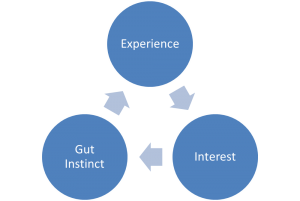
Add a cup of experience, two teaspoons of interest, a dash of gut instinct…and voila!

Hearing Dr. George Veletsianos draw back the curtain to his research experiences was very thought provoking. Seeing his extensive list of research projects, it is obvious that he has a lot of experience doing studies on digital learning environments and the exposure to them. By the end of his podcast, I felt that there were three qualities a researcher should have to do great research. The first being experience. Experts in the field naturally have this experience that they build on. If the formula works, why change the wheel? New research can be built on past findings. The second item that I found was interest. Most researchers I know are deeply interested in their research, which would make sense if they’ve dedicated their careers to it. Lastly for lack of a better term, gut instinct, and it really cycles back to experience. From experience, one can get an idea whether a certain research project is worth pursuing or not.


During the MALAT Research Panel Discussion 2017 at Royal Roads University, both George Veletsianos and Dr. Bill Muirhead note that a lot of research is conducted, but not all of it good research. While we may not all have the experience of experts, we can learn from their teachings and publications. At the very least, I can now confirm that comparing whether online or face-to-face learning is better can be classified as a bad research topic to look into. For more detail on why, check out the panel. In short, it’s been done to death and there’s no conclusive answer. While I have some experience in research, I hope to further embark on my own journey and hopefully have a ‘good’ research question along the way.


References

Veletsianos, G. (2017, August 10). George Veletsianos on Research. Podcast retrieved from https://moodle.royalroads.ca/moodle/mod/page/view.php?id=245247

MALAT Research Panel Discussion 2017 [Video file]. Retrieved from https://livestream.com/accounts/10925877/events/7616831/videos/160653361

What makes a good research question? That is the question

It can take a lot of time to come up with a good research question, involving the conception, revising, and finalizing. While having a general theme of what your research will be about may not be too difficult, creating a research question that hones in on what you are truly trying to find out takes some work. In my option, a good research question should have these factors:

  1. Clear focus and scope – A research question cannot be too broad as it can be difficult to make generalizations with your research project. For example, a study on students should be narrowed down to high school students, adult students, or visa students, etc. Proceeding with the study will be simpler once your subjects of interest are clearly defined.
  2. Be feasible – This is something that seems obvious, but can be easily overlooked. We can all ask good questions, but a good research question needs to be something that is possible be examined with available resources and expertise.
  3. Examines something new – A good research question would ideally lead to new research. New research does not necessarily have to involve new concepts, as a lot of research is built upon previous studies. A lot of research papers conclude with “further research is needed” which is an opening for more study.

Naturally there are many other qualities that a good research question has, which our classmates have posted or will post. Lastly, I think an important thing to remember is one does not have to be limited to one research question. If you are looking to examine multiple theories and ideas, it’s a good idea to have two or three research questions rather than trying to put it all in one question.

My Academic Writing

From looking at everyone’s Padlet responses in Activity 1 I think I can safely say that academic writing on everyone’s mind, for better or worse. I can say that I’m in the same boat since I was never brimming with confidence in my writing either. Admitting this is a bit embarrassing, since I actually work in research! I find I am more confident working on the quantitative side of research, but that is a topic for another time.

Moving on to resources, I see my classmates have recommended some great online resources. I see Purdue OWL coming up quite a bit and it is a favourite of mine as well. I’ll be the odd one out and recommend some print texts.

The first resource is our textbook from LRNT 521: Publication manual for the American Psychological Association (6th ed.). While it’s not the most exciting to read, beyond being an excellent APA resource, there are also sections on writing and style which are clear and helpful.

The second resource is a book I’ve used in the past called Qualitative Research Methods for the Social Sciences (8th ed.) by Bruce L. Berg and Howard Lune (somehow I feel this text will come in handy later as well…). This is a great book for those who want to learn more about qualitative research, but also there is a chapter on writing research with a very fitting title “Sorting the Noodles from the Soup”. It covers everything from how not to plagerize to how to set up a research report.

Unfortunately the second book I recommended isn’t as easily accessible as a web resource, but it should be useful if you can get your hands on it.

Update Time

So here’s an audio recording of me giving an update on my digital presence and identity plan. Sorry, I had a bit of a sore throat, but somehow I rambled to almost 7 minutes…


Here is also the comparison of my LinkedIn connections before and after my plan:

Before                                                       After

http://socilab.com/#home

Groups, Networks, Sets, Collectives, and Everything in Between

Unit 3 exposed us to concepts regarding learning with others. Group-based learning is not only more economical (versus one-to-one interactions), but creates a ‘safe and supportive environment’ for learning to occur (Dron & Anderson, 2014).

The Community of Inquiry model has been brought up many times and I can see why the social, cognitive, and teaching presence are so important to a learning environment. We are all used to teaching presences providing structure and guidance through a course. Learners need to be cognitively present to facilitate actual learning instead of just physically being present. Finally, the social aspect is something I had not thought about a lot before this course, but I now see why it’s important to a more rounded learning experience. As noted by Garrison, Anderson, and Archer (2000), ‘cognitive presence… is more easily sustained when a significant degree of social presence has been established’.

I hope to be more socially present in my networks and groups, which will challenge my introvertedness ways. In Tuckman and Jensen’s five-stage model for group development (1977), one stage is called storming. It’s the stage of discourse and respectful disagreements. I know that for myself, I don’t particularly partake in this stage, even if it might be beneficial to the group. Garrison and Anderson (2003) coin the term “pathological politeness” for this type of behaviour which I guess describes my desire not to step on anyone’s shoes.

Working in networks and groups are more challenging online due to a lack of social cues, but we shouldn’t shy from discourse if it’s constructive and everyone understands it’s for the good of creation. I hope I can be someone who can do a bit of ‘storming’ without seeming aggressive or ‘pathologically rude’.


References

Dron, J., & Anderson, T. (2014). Teaching Crowds. Athabasca University Press.

Garrison, R., Anderson, T., & Archer, W. (2000). Critical inquiry in text based environment: Computer conferencing in higher education. The Internet and Higher Education, 2(2–3), 87–105.

Tuckman, B. W., & Jensen, M. A. C. (1977). Stages of small-group development revisited. Group & Organization Management2(4), 419-27.

Garrison, D. R., & Anderson, T. (2003). E-learning in the 21st century: A framework for research and practice. London: RoutledgeFalmer.