
I am an Electrician by trade and teach at a Polytechnic institute. Nine years ago I left the tools to begin my career as an instructor. One of the requirements of the new position was that I complete my Provincial Instructor’s Diploma. It was during this time that I was introduced to the concepts of Behaviourism, Cognitivism, and Constructivism.
Automatically I found myself drawn to the ideas that surround the theory of Constructivism. Having trained apprentices, and having gone through an apprenticeship myself, I saw the importance of learning how to construct knowledge based on previous experiences. An apprenticeship in the trades means having to learn and build upon earlier concepts while being involved in the construction of something. Trades apprenticeships lend themselves nicely to Constructivism, as Ertmer and Newby (2013) cite Brown et al. (1989), “To be successful, meaningful, and lasting, learning must include all three of these crucial factors: activity (practice), concept (knowledge), and culture (context)” (p. 56). The basis of an apprenticeship is practice, knowledge and context.
Before you think that this post is going to be my love letter to constructivism you need to know that while constructivism will always hold a special place in my heart, I am beginning to see that there is also a place in my practice for Behaviourism and Cognitivism. I was challenged after reading and reflecting on Merrill’s (2002) “First principles of Instructions” and Ertmer and Newby’s (2013) “Behaviorism, Cognitivism, Constructivism: Comparing Critical Features From an Instructional Design Perspective”.
I teach an electrical foundation program. These students come to me having no experience in the industry, no prior knowledge of electrical theory, and most of them have never touched a tool. The first part of the course is a review of basic math principles. We start with the very basics (adding whole numbers, multiplication, fractions) and take them to the point where they can do simple trigonometry. In this part of the course, many are nervous. Math is scary for them, and some have been out of school for a considerable amount of time and are quite intimidated. By adopting a behaviorial model, we can begin to build the necessary skills and confidence needed with flashcards, worksheets, practice quizzes, and the like. We can also increase their confidence by praising and rewarding them for their responses. As Ertmer and Newby (2013) state, “To facilitate the linking of stimulus-response pairs, instruction frequently uses cues and reinforcement” (p.50).
As the students progress into the circuit analysis portion of the course, the focus becomes more complicated. The students learn how to analyze circuits and apply principles of physics. At this point, the methods move from a behavioural approach to more of a cognitive nature. It is no longer just necessary for the students to recite formulas or know the names of tools. They have to learn how to problem solve, build upon previous lessons and make more complex connections. As an instructor it is essential that my methods help the students organize the information I give them, attach some meaning to it and relate it to what they have already learned (Ertmer and Newby, 2013, pg.53)
And now back to my first true love, constructivism. The practical part of the course lends itself to this theory. Up to this point, the class has been working through the theory of electricity and the electrical code. Once the practical part of the program starts, the students leave the classroom and head to the shop to apply the concepts they have learned to real-life scenarios. It now becomes my job to instruct the students on how to create meaning out of what they have learned and to design the shop projects so that real-life scenarios can be experienced (Ertmer and Newby, 2013, p.59). As the students become more familiar with working on the tools, and by working in partnerships with others, the students start assessing and critiquing each other’s work. This process is what Ertmer and Newby refer to as “the collaborate phase” (p.59).
It is hard for me to say that I align myself with just one specific theory as I see particular methods as being necessary for different aspects of the courses I teach. Ertmer and Newby (2013) make the case,
We believe that a critical question instructional designers must ask is not “which is the best theory?” but “which theory is the most effective in fostering mastery of specific tasks by specific learners. (p.61)
As I read through the articles, I was challenged to be much more intentional with my instructional design. While I may have unintentionally aligned with specific theories, it could make my practice much more effective if I start to understand how to use the tools that are at my disposal with each approach. For example in Merrill’s article, he mentions different models that use what he describes as the first principles of instructional design. Using the model of Star Legacy (p.51) I could design a shop project that would present a challenge, have the students generate ideas for solutions, try out and evaluate their theories and reflect on their learnings. This excites me.
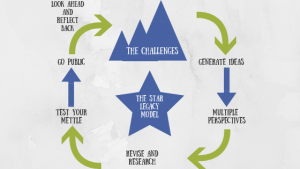
By becoming more intentional with my instructional design, I can help the students build the experiences and lessons that will help them become better electricians in the industry.
References
Ertmer, P., & Newby, T. (2013). Behaviorism, Cognitivism, Constructivism: Comparing critical features from an instructional design perspective. Performance Improvement Quarterly, 26(2), 43-71.
Merrill, M. D. (2002). First principles of instruction. Educational Technology Research and Development, 50(3), 43-59.


September 22, 2018 at 11:05 am
Hi Chad – I really enjoyed reading your post and the connections you made in your teaching experience. Your comment about being “unintentionally aligned with specific theories” in your instructional design, but understanding now that knowledge of these theories could improve one’s practice resonated with me in reflection of my own teaching experience. Like you, I gravitate toward the flexibility in choosing from all the three learning theories, with a special place also reserved for constructivism. In Merrill’s (2002) article he expresses surprise when discussing the application phase of learning that “with [the] almost universal agreement on the importance of applying knowledge to real-world tasks, so much instruction merely includes a few multiple-choice questions that are labeled practice….[and] do little to promote learning” (p. 49). I found Merrill’s observation about this very relatable in today’s setting – such as compliance training in the workplace which often employs heavy use of multiple-choice – and wonder if this is more an example of ease in administering training to the masses because it is cost-effective, or an instructional practice heavily informed by behaviorism…or both?!
September 22, 2018 at 1:01 pm
Hi Chad,
Thanks for your post.
The techniques and strategies shared with us in demonstrating the use of three paradigms of learning (behaviorism, cognitivism, and constructivism) with your electrical students resonated well with me. I too found that each learning theory builds on the other and not one particular theory is most effective. Having read Merrill’s article which speaks about the five principles of instruction, it allows for greater insight as to various approaches I can take into designing classes for students.
Cheers,
Phyz
September 23, 2018 at 7:55 pm
Chad, when we started this activity I was excited to read your post. I have the pleasure of working with faculty who teach in our skilled trades programs and from reviewing their course material and hearing their experiences in the classroom, I expected it to be a mixture of behaviorism, cognitivism, and constructivism, with more emphasis on constructivism. From previous conversations with faculty, skilled trades courses seem to relate to real-world scenarios and building upon previous experiences. Our teaching and learning centre has assisted faculty in creating learning objects such as a multimeter. This allows the learner to test in a real-world scenario while having the safety of performing the exercise on their computer, without the chance of being injured. Has your institution started developing or using OER options for this form of experiential learning?
September 24, 2018 at 8:37 am
Hi Brandon. We have actually dipped our toe into OER recently. There are a few departments that have developed some OER and recently I just finished up an OER textbook on AC generation.