
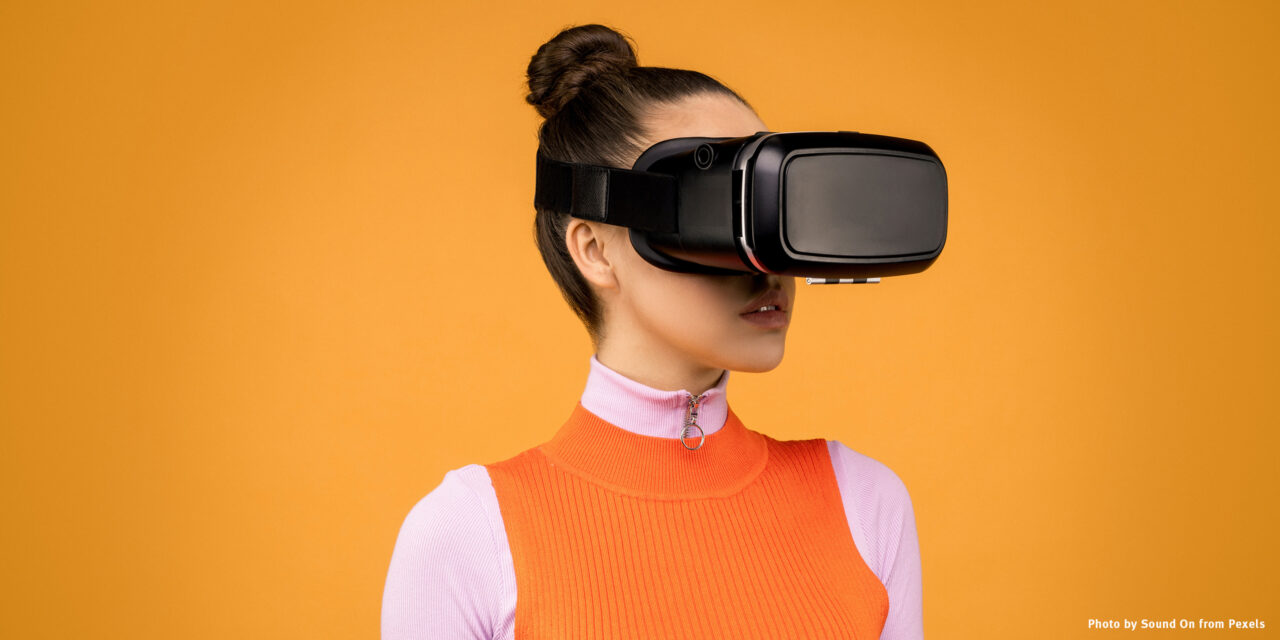
I was excited when our group selected virtual reality (VR) as our technology for this course. It’s something I have had minimal experience with, know little about, and therefore it offers enormous potential for me to learn and grow in my understanding of it. The little experience I do have with VR is only within the context of gaming and general time-wasting, though our project team recently met to explore the use of VR within a creative and interpretive educational context. This changed my perspective on potential uses for VR to include the creative expression of unique contextual meaning from one’s learning. I’m also intrigued by its potential to do more than just entertain thanks to the almost endless ways it can provide students with the experience, practice, and exploration in ways that could be prohibitively difficult or expensive otherwise. But with these possibilities comes the need to address the ethical issues that arise when private corporations control the hardware and software behind our educational technology. What are the risks when companies that focus data gathering, such as Facebook or Google, are behind the VR equipment run in a classroom? Even in our own team’s learning experience, Michael had to share our final product through Google since the software used was also created by Google. In this context, couldn’t there be a more secure way for students to share their creations?
Though the uses for VR in my own educational sphere appear to be limited at present, I have young children who will be directly affected by these ethical issues. Though I have not been privy to the decision-making processes, the COVID-19 pandemic has given me the impression schools may select a tool that is simply the easiest to implement rather than the one that cares about the security of the student. The process of developing custom educational applications for VR can be complex and expensive, but what are the long-term implications of allowing a private company to potentially track the movement, facial expressions, and other data of every student using the software?
I would love to hear about different experiences this MALAT group has had with VR in an educational context; both the good and the bad. What are your concerns around having private companies behind educational technology? What about future potential for schools to gather sensitive data from VR use? Do you think open, untracked, and private VR is possible before the technology has developed and grown to a degree that is as ubiquitous as the other educational technology we use (e.g., computers, smartphones, online apps/games, etc? What about the idea that the benefits the technology can bring to education outweighs the potential risks of having a corporation gather data through its use? I welcome all discussion on this topic as it is still quite new to me and your input will help me better understand how to approach my research.




David! I am so glad you and your team are exploring the topic of VR. It is my personal interest, however, I have not had the opportunity and time to exploring deeply. You have raised some critical questions and ethical issues that are in alignment with my concerns as well. Looking forward to your team’s presentation to learn more.
Thanks for the comment, Vanessa! Since it is a personal interest of yours, I’d love to hear your own thoughts on the potential ethical issues that might arise from having private companies behind the VR equipment and software our school’s are using.
My concern is not really if private companies will collect data because I think FOIPPA rules protect our students. When I think of VR, I think of the “haves” and the “have nots. BC private schools often have state-of-the-art gyms, playing fields, modern classrooms, learning labs, ice rinks, swimming pools, and performing arts centers. My school sits right between two of these private schools. Will VR penetrate more of our private schools and leave the public schools in the dust?
I agree that there is a huge issue around VR and the separation of those with funds and those without. I probably should have gone with that issue, but for some reason I decided to go with the data security side. Your comment actually raises a really good issue around this since you’ve mentioned “I think FOIPPA rules protect our students.” Interestingly, they don’t. The Freedom of Information and Protection of Privacy Act applies to public bodies (https://www.bclaws.gov.bc.ca/civix/document/id/complete/statreg/96165_07) but not private companies. it is an educator’s responsibility to check that the tools students use protect the privacy of the student. For example, if you have your students interact on Twitter you can’t keep Twitter from using your students’ data however they want. Now consider that the Oculus VR headgear (owned by Facebook) requires you sign in with your Facebook account. Their reasoning is that it makes “easier for people to find and connect with friends”, but it also means they can tie any data they gather from VR usage to the data they have from your FB profile. Whether the student is using hardware from Google, Microsoft, Valve, Facebook, etc., they will all, at the very least, be gathering, storing, and attempting to monetize data on that student. Because FIPPA doesn’t apply to private companies, the company’s Privacy Policy will dictate what data they can gather and how they can use it. Sorry if I got a little intense, but I’m interested to hear if knowing FIPPA doesn’t protect student privacy outside of the school impacts your opinions around VR and data privacy? As an aside, I found this interesting little tool from UVic on using technology in the classroom: https://hlsvod.uvic.ca/vod/DTIL/Privacy-Interactive-Flowchart/Privacy-Interactive-Flowchart/story_html5.html
Really interesting, Dave… a much more concerning topic that I realized. I agree with your assessment that the easiest technology typically gets chosen rather than the safest and most secure… but I don’t think that’s necessarily a bad thing. The safest technology is, in my experience, rarely the most effective. A great example is Zoom. Despite the privacy concerns that became apparent early during the pandemic (https://www.forbes.com/sites/kateoflahertyuk/2020/06/05/zooms-security-nightmare-just-got-worse-but-heres-the-reality/?sh=3a0b03132131) it still came out as the favourite tool for most. It’s easy of use and reliability outweighed the privacy concerns for most. I think we’re in the situation now where relinquishing some control over data in exchange for access to powerful tools is a reality… whether we like it or not. We certainly need to be concerned about how data is being gathered and used (especially after the Cambridge Analytica fiasco)… but at the same time, would we be putting our children at a disadvantage if we avoided these powerful learning tools in an attempt to protect their privacy? I think it’s a difficult balancing act.
Christopher.
Very well said, Christopher. I was actually just writing about this for my learning plan (you may just get a reference!). Every tool we use has risk and data is always being gathered. If the security risk lives in a continuum, where might we be able to place VR in that continuum? Do the benefits outweigh the risks? Users often care very little about those security risks; should educators care more? Love your questions and really appreciate the ideas around it being a balancing act.
Thanks for the response, Dave. VR is an incredibly powerful tool, and while it may be cost prohibitive… it’s certainly has the potential, in time, to revolutionize education. Any educator would be wise to look for an option that reduces risk in terms data privacy… but should weigh that against what value it brings to the classroom. Worth the risk, in my humble opinion.
I do believe this is a fascinating field of study. I will comment on the other end of the age scale if you don’t mind, only because my father has recently expressed interest in purchasing a couple of VR sets for the senior’s community he lives in. He is 75 and feels this technology will be a great benefit for seniors in a few areas. Physiotherapy for various ailments – especially during COVID (although I did mention that video physiotherapy would probably suffice), travel to all areas of the globe for those who are not mobile anymore, and mediation. He even figured that of few of “those old ****, would probably like those silly job simulator things”. My dad can be colourful. At any rate, I thought it might be interesting to think about the learning that can happen for people of all ages. On the privacy issue, my dad did say; “we got two types; the paranoid-Joe who thinks they are so important that the government might be tracking them through their laptop webcam or free-for-all-Willy who thinks they are so old that they don’t give two **** about who sees what about them”. Ya… did I mention the colourful part?
Lol! Sounds a lot like my grandfather. I think those two viewpoints are likely echoed across much of the population. Some people are of the opinion that they are being watched and monitored all the time while others feel they aren’t doing anything interesting enough to care. I typically sit on the side of “what do I care if someone monitors me”, but then I think about how much I care about someone monitoring my children. Within the context of education, we have to weigh what happens when we don’t give students a choice. Some educational VR experiences aren’t really going to matter much (like a standalone VR platform for exploring world landmarks), but if a student needs to connect their Facebook account so they can log in to an Oculus headset to submit a VR-based assessment then we’re looking at bit more data gathering and there may be some concern.