I had one last quick opportunity to work in a team as a student in the MALAT program at Royal Roads University. My esteemed teammates were Kristin Beeby and Sandra Norum. Together, we explored the impact digital learning has had on teachers in recent history. To present our findings, we developed the above Genial.ly presentation. To learn more about each subject, click on the plus icon next to a given title… and don’t forget to check our references… there’s some gold in there!
I’d love to hear your thoughts on what we’ve included. Have an awesome day!
I will soon be coming to the end of my time with Royal Roads University (RRU), and so I’m beginning to look at the next stage of my learning journey. With that in mind, my goal is to build my own learning network, contribute content, and exert a positive influence in that space.
I was exceptionally nervous about starting a master’s program, but the whole experience has been outstanding. Difficult… and stressful… but also extremely rewarding. The whole experience has rekindled my love of learning and I’m looking to continue. Since Garrison et al. (1999) argued that a community of learners is valuable for higher order thinking, I aim to develop one of my own to both contribute to and benefit from.
Following a series of readings this week, I’ve come to the conclusion that the platform upon which this network exists is less important than the people who make it up. Anderson and Dron (2014) asserted that learning networks are defined by the needs of the participants such as “task performance, learning, advice, or interpersonal support” (p. 149) rather the physical or virtual space. So, what matters to me is the way in which I interact with people and communicate, and less about where those interactions occur. This idea reminds me to stay on brand with communications no matter the platform and be mindful of how the individuals in my network perceive my contributions.
Finally, I was inspired to participate in the conversation online, despite some of my misgivings regarding possible negative consequences of that interaction. I’ve been reading a lot of content from my classmates recently about backing away from platforms they find toxic, and I completely respect their point of view. But, Cormier (ALT, 2019) made an extremely good point when he presented the idea that if reasonable people turn away from the internet as a result of their fatigue with the culture, then the quality of the culture of the internet will only diminish as a result of their absence. Now, it’s a little arrogant of me to argue that my content will be a positive influence on the culture of the internet, but that certainly is my goal. Whether I achieve it or not, I suppose, remains to be seen.
References
Anderson, T., & Dron, J. (2014). Teaching Crowds: Learning and Social Media. In Teaching Crowds: Learning and Social Media. Athabasca University Press. https://doi.org/10.15215/aupress/9781927356807.01
Association for Learning Technology [ALT]. (2019, April 24). #OER: The participatory open: Can we build a pro-social / pro-societal web? [Video]. YouTube. https://www.youtube.com/watch?v=1D4tg1FnE_s&t=1223s
Garrison, D. R., Anderson, T., & Archer, W. (1999). Critical inquiry in a text-based environment: Computer conferencing in higher education. The Internet and Higher Education, 2(2–3), 87–105. https://doi.org/10.1016/S1096-7516(00)00016-6
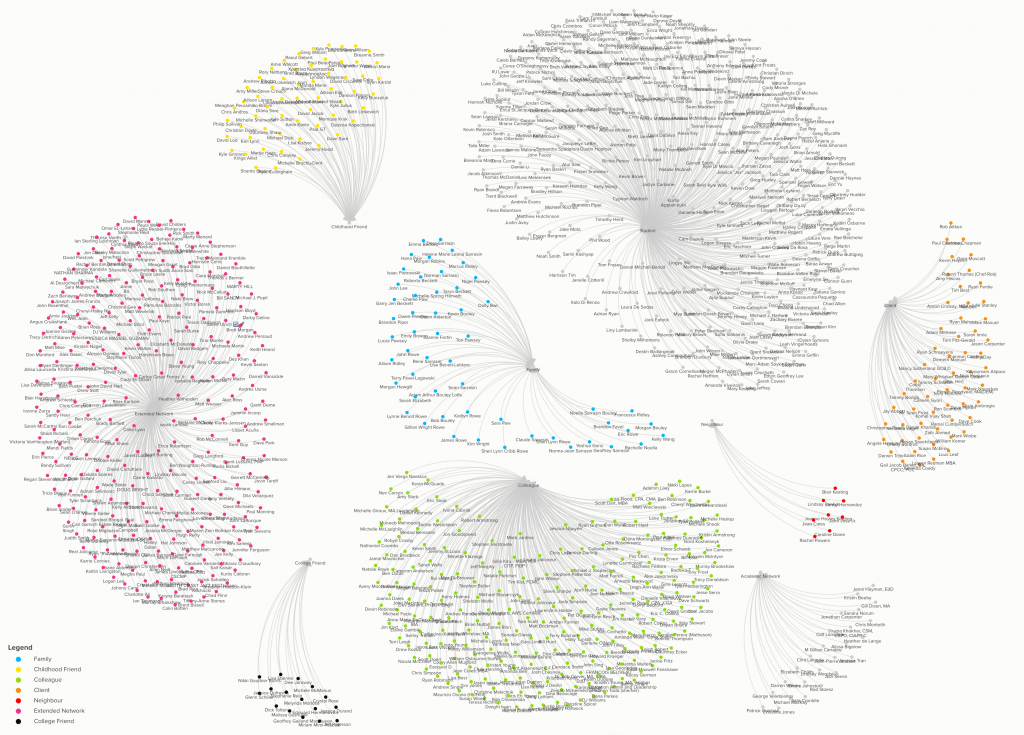
The graphic above is a visualization of my personal network. It’s a relatively simple visualization and doesn’t represent the interconnectedness of these various networks. In order to keep the time associated with developing this graphic manageable, each connection is limited to a single type. In reality however, the majority of these individuals would fall into several categories and there is a significant amount of overlap in their connections. However, I do like the way this is represented, to show the networked resources at my disposal, depending on the need at any given time.
It’s a fairly large group of people, representing an immense wealth of knowledge and experience. As I’ve mentioned on this platform before, I haven’t spent much time or energy leveraging this network or being an active contributor to the pool of knowledge, but I look to change that in the near future. Over my time in the learning and technology program at Royal Roads University, I’ve developed a self directed approach to learning. This acquisition of meta-learning is what Anderson and Dron (2014) observed as an essential skill for networked learning. As I continue to learn on my own, post-graduation, in an ill-structured environment, it will fall to me to cut through the significant noise online to pursue truth.
I look forward to the experience, and hope to bring you with me!
Reference
Anderson, T., & Dron, J. (2014). Teaching Crowds: Learning and Social Media. In Teaching Crowds: Learning and Social Media. Athabasca University Press. https://doi.org/10.15215/aupress/9781927356807.01
As I approach the end of my time in the MALAT program at Royal Roads University, I’ve begun to think about the next step. Over the past couple of years, much to my surprise, I’ve enjoyed blogging from an academic perspective. As a result, I plan to continue to do it following my completion of the program. I look forward to developing a professional digital presence following my time at Royal Roads as it can benefit my continued learning and career, but I need to be cautious of how it will be interpreted by the community who consumes it.
Why Should I Continue to Contribute?
My experience writing blog posts during my time with Royal Roads has given me confidence to contribute to the academic community. As Watters (2015) described, providing students with their own digital space provides them with an opportunity to have more control over how they present themselves to the world. Now, moving forward, I look to engage with the larger community and build my reputation as a source for valuable insight on the topic of educational technology. During my professional career, I’ve developed what Boyd (2010) labeled a networked public, described in their own words as “the imagined collective that emerges as a result of the intersection of people, technology, and practice” (p. 1). However, up to this point, I’ve done little to contribute to that network outside of the occasional pleasantries.
Now, with my newfound confidence, I plan to be more active in the discourse amongst like-minded people to continue my own learning and develop a more impactful digital presence. I hope to share my own thoughts and in return, learn from those people in the community who also contribute. To describe this reciprocity of contributions, Jenkins used an analogy of a group coming together to create a quilt (Edutopia, 2013). In this group, there is no leader or expert, but everyone comes together to share their knowledge in what he described as “a social mode of production” (1:47). I’ve always considered myself a life-long learner and look forward to continuing in that regard.
In addition to my continued learning, I also look to build my reputation with a hope of having my participation lead to a positive impact on my professional career. To do this I will need to post relatively frequently and draw attention to my contributions. Anderson and Dron (2014) argued that those people who contribute the most “see their contributions giving them authority and prestige within that community and across their networks” (p. 19). However, to benefit from any potential authority and prestige, I’ll need to encourage my network to consume my content.
How Will I Spread the Word?
The good news is, that drawing attention to things is a strength of mine. I’ve been working in the media and marketing industry for the majority of my professional career and know a thing or two about promoting content in a digital environment. Without going into too much detail here, lest this post become far too long, my plan will involve developing a digital identity based in consistency. Consistency in rhetoric, consistency in frequency of posts, and consistency of subject. This consistency is required to develop loyalty in an audience and develop an expectation of content delivery. I plan to support this content delivery with promotional material driving traffic to my blog on platforms such as LinkedIn, Twitter, Instagram, and Tik Tok. This is the part of the process that concerns me the least, as I can rely on my strengths for success. I will track the analytics on all of the platforms in addition to WordPress and make adjustments to my plan based on that feedback.
I’m not too concerned at the moment regarding determining a specific threshold that would indicated success. Right now, my main objective is to contribute to the greater learning community and benefit my own learning. Perhaps, in the future, I may develop more quantitative goals, but that is not currently a priority for me.
Long Term Impact
What does concern me, however, are the possible implications of my content creation in the long term. The content that I post online will likely outlive me and I should keep its long term impact in mind and how that might reflect on me and my family. White and Le Cornu (2011) brought attention to the fact that the online artifacts developed by content creators continue to impact their audiences long after the creators move on. As described by Boyd (2010), the persistence of online content can outlive the context in which it was written. Additionally, as I will likely have only tenuous connections with the majority of people who read my content online, I need to be wary of possible misinterpretations due to a difference in perspective and context. This combination of temporal and perspective context shift can lead to misinterpretations of the content I’ve written. While there’s little I can do about most of these possible misinterpretations, I suspect I’ll be able to prevent some percentage if I’m cognitive of the possibility of its occurrence.
Regardless of any long term negative implications, I think it’s most likely that the good will outweigh the bad. And besides, I’ll enjoy it.
References
Anderson, T., & Dron, J. (2014). Teaching Crowds: Learning and Social Media. In Teaching Crowds: Learning and Social Media. Athabasca University Press. https://doi.org/10.15215/aupress/9781927356807.01
Boyd, D. (2010). Social network sites as networked publics: Affordances, dynamics, and implications. In Z. Papacharissi (Ed.), A Networked Self: Identity, Community, and Culture on Social Network Sites (pp. 39–58). Routledge. https://doi.org/10.4324/9780203876527-8
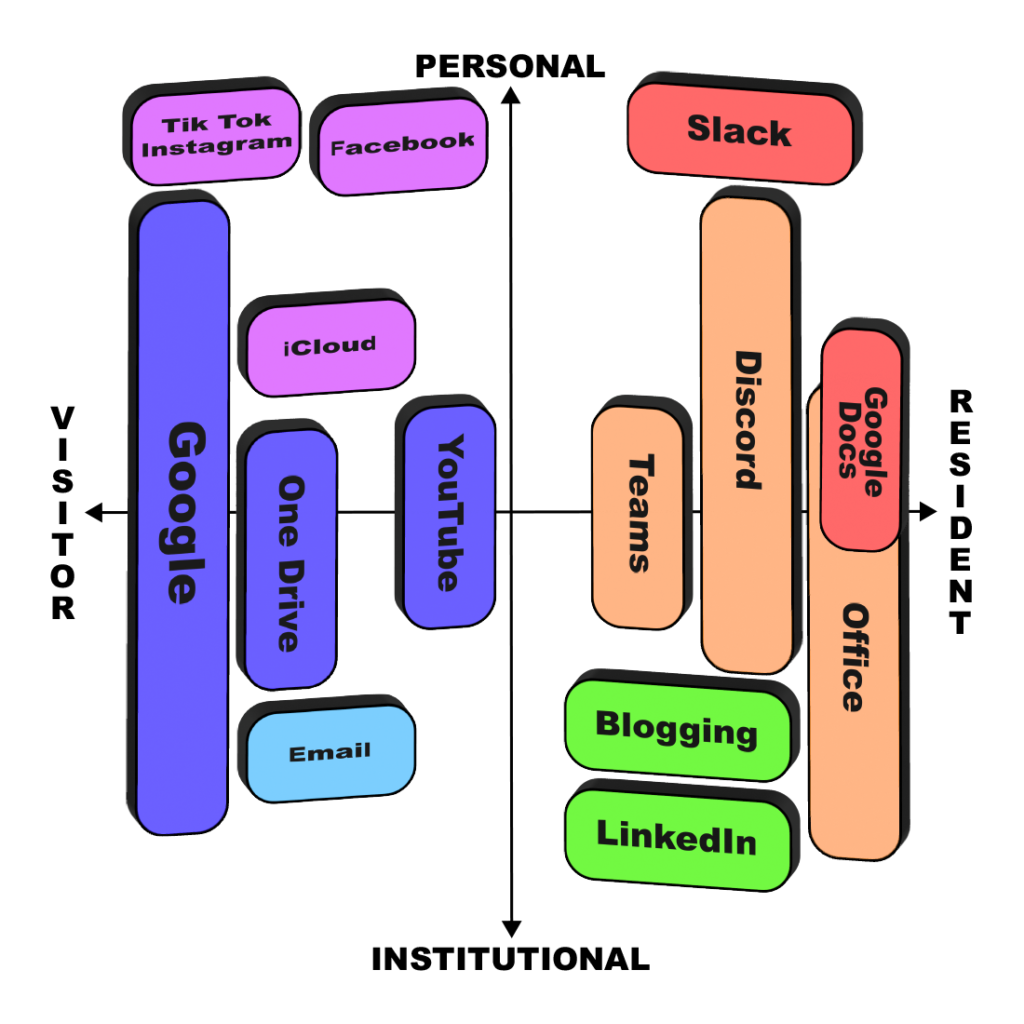
I was recently asked to develop a map that represents my digital presence in terms of visibility and motivation. The method that resulted in the grid you see above was presented to me in a video posted on YouTube by Dave White (2013). The grid represents a cross-section of continua. Those entries on the far right, labeled “resident”, represent the platforms upon which I’ve left some kind of evidence accessible to others… those on the far left, labeled “visitor” are those platforms I use frequently but have not added to the publicly available content. The vertical continuum, represents the difference between those platforms I use for my own motivations, labeled “personal”, and those I use either for work or my digital academic identity, labeled “institutional”.
After completing this activity I was surprised by the number of platforms upon which I create content quite frequently. I don’t really think of myself as someone who has much of a digital footprint. While I make use of social media quite often, I treat it more as a source of entertainment than as a method of interacting with people. However, I do see that if one were to make an effort to look for evidence of my interactions online, there would be a fairly significant footprint. With that in mind, I’m more motivated to consciously manage my identity online and to present a more consistent image to the public.
Recently I was fortunate enough to participate in Royal Roads’ Virtual Symposium where students, faculty, and guest speakers discussed the impact of ed tech and instructional design in today’s education industry. There were a ton of great talks and the sharing of some fascinating research projects. It was a thrill to learn with and from these brilliant people.
I was particularly struck by the ingenuity of my classmate, Patrick Guichon, as he navigated the ethical challenges presented by his thesis project (Childs, 2022). Patrick has recently completed data gathering in a research project where his own students are the participants. This presents a significant ethical dilemma in what the Tri-Council Policy Statement refers to as a dual role (Canadian Institutes of Health Research, Natural Sciences and Engineering Research Council of Canada, & Social Sciences and Humanities Research Council of Canada, 2018), meaning, in Patrick’s case that he is acting as both the research and the instructor for these participants. This dual role presents a conflict of interest that has the potential to “create conflicts, undue influences, power imbalances or coercion” (Canadian Institutes of Health Research et al., 2018, p. 96). With this in mind, Patrick was careful to create an environment in which he was in no way privy to the identities of his participants and was not physically present when the data collection occurred. This would have required significant planning in advance and coordination with collaborators in his organization to make the research possible. Patrick’s efforts are commendable and I look forward to seeing the results of his analysis.
Another presentation that I enjoyed was that of Christina Jones (2022), as they described their process in the execution of their applied research project. The was a particular aspect of the research that I hadn’t considered before and found surprising. Christina’s research is focused on the use of simulation to improve learning, particularly in a military context. When I’ve thought about the benefits of simulation in the past, I’ve mostly considered safety as the paramount, but Christina shared additional benefits. Particularly in a navy application and the training of the navigation of large warships, one of the main challenges is the replication of a particular set of conditions. Warships are exceptionally complex. The navigator has to consider the unique crew and weather patterns which are near impossible to replicate. In a simulation, however, all these conditions are easily repeatable, allowing trainers to put their learners into very specific conditions to test their learning. This was eye opening for me and presented a benefit of the application of simulation training I hadn’t previously considered.
Finally, a presentation I found particularly engaging was a panel discussion on the nature of instructional design in a post-COVID-19 environment (Royal Roads University, 2021). Panel members Elizabeth Childs, Irwin DeVries, Melanie Meyers, and George Veletsianos discussed how the recent global pandemic has influenced how educators value instructional design in an online environment and how this will impact its role in the future. I completely agree with DeVries position that instructional designer should have a more influential position in education moving forward. Now that most educators in Canada have been exposed to the nature of online learning, I hope that there’s a newfound respect for the uniqueness of online pedagogy, the challenges it presents, and the need for specialized training to make the most of the platform. I hope for greater collaboration between educators and instructional designers going forward and that this partnership becomes routine, with a hope of developing more effective learning spaces for our students.
References
Canadian Institutes of Health Research, Natural Sciences and Engineering Research Council of Canada, and Social Sciences and Humanities Research Council of Canada, Tri-Council Policy Statement: Ethical Conduct for Research Involving Humans, December 2018. https://ethics.gc.ca/eng/documents/tcps2-2018-en-interactive-final.pdf
As I prepare to begin researching for the literature review associated with my Applied Research Project (ARP), my first task was to identify a theoretical framework to focus my studies. After considering a series of frameworks that would have been appropriate, I’ve chosen to settle on Malcolm Knowles’ (1973) Adult Learning Theory (ALT). Since the topic of my research concerns the orientation and training of novice part-time faculty in higher education, a group that will likely be exclusively adults, so this seemed to me like a reasonable choice. Throughout this post I plan to provide a description of the theory and summarize the five main elements.
Adult Learning Theory
In a nutshell, ALT assumes that adult learners are self-directed and intrinsically motivated individuals and should be treated as collaborators in both the planning and execution of their own learning. Knowles (1973) observed that as we mature from infancy to adulthood, we grow increasingly independent and our need to have our learning directed from external forces decreases. He went on to note that as a result, as learners mature, they should be allowed to have more and more control over their own education, but that this is frequently not the case. The increasing disparity represented by the maturation of the learner and their infantilization through externally imposed pedagogy “produces tension, resistance, resentment, and often rebellion in the individual” (Knowles, 1973, p. 45). Therefore we must be sure to include the adult learner in the planning and execution of their learning wherever possible. Additionally, Darden (2014) asserted that the adult learner is motivated intrinsically by real world goals. They have a tendency to seek out new skills and knowledge when presented with obstacles in life which they need to overcome. As a result, adults take courses to fulfill an immediate need, as opposed to children, who typically learn under the assumption of delayed utility. With this in mind, we need to be working with adults to assist them in the development of learning outcomes that meet their immediate needs.
5 Elements of ALT
In her article on the application of ALT to distance learning, Maria Garavani (2015) outlined five main elements associated with the theory. I look to summarize them in the paragraphs to follow.
Planning
A crucial element of ALT is that learners be included in the planning process of any learning activity in which they expect to take part. Associated with this idea, Gravani (2015) noted “that people tend to feel uncommitted to any decision or activity that they feel is imposed on them without having a chance to influence it” (p. 178). So, in an effort to get an adult’s buy-in on an educational undertaking, they should be included in the conversation right from the very beginning of the instructional design process.
Needs Diagnosis
As individuals mature, the learning they undertake is increasingly motivated by their social needs (Knowles, 1973). That is to say that they’re learning is directed by real-life needs, such as a new task at work or a new hobby. Therefore, coming into a learning experience, adults typically already have a strong understanding of the nature of their own needs, so it makes sense for an educator to consult with that individual to get a sense of their perspective. Gravani (2015) went on to differentiate between Felt Needs, those needs that the learner believes they require, and Ascribed Needs, those needs that the learners’ organization believes they require.
Design
As educators and/or instructional designers look to develop learning activities that align with ALT, they should assume that adults will have a significant level of responsibility for their own learning, and should build activities “around the concept of self-directed learning” (Gravani, 2015, p. 179). At the same time, Knowles (1973) pointed out that unlike children, adults are individuals with a wealth of experience and knowledge. Their learning should be done in such a way that leverages that experience and analyzes the way in which it influences the new knowledge they seek to acquire.
Climate
Gravani (2015) argued that the setting of an environment that’s conducive to learning is probably the most impactful element associated with ALT. In that context, Knowles (1973) differentiated between the physical and psychological environments. The physical environment consists of factors such as the availability of a well lit and ventilated work space, a comfortable seat, and any other such provision to make the learner comfortable. Additionally, learners should be provided with easy access to learning resources, both technical and human. The psychological environment on the other hand consists of such considerations as a supportive learning group built on trust, honesty, integrity, and mutual respect. As a learner’s physical and psychological needs are met, they’re free to focus their attention on their learning.
Evaluation
Finally, Gravani (2015) outlined four levels of evaluation to be considered.
Reaction Evaluation – An analysis of the learner’s experience with the program as they are experiencing it.
Learning Evaluation – an analysis of the new knowledge of skill the learner has acquired as a result of being exposed to the program.
Behaviour Evaluation – An analysis of the changes made to the learner’s actions as a result of exposure to the program.
Results Evaluation – Data gathered from the course and maintained by the organization.
References
Darden, D. C. (2014). Relevance of the Knowles theory in distance education. Creative Education, 05(10), 809–812. https://doi.org/10.4236/ce.2014.510094
Gravani, M. N. (2015). Adult learning in a distance education context: theoretical and methodological challenges. International Journal of Lifelong Education, 34(2), 172–193. https://doi.org/10.1080/02601370.2014.982728
The purpose of this post is to consider how I will disseminate the results of my upcoming Advanced Research Project (ARP) once I’ve completed the work. This is an important topic, as the determination of the audience for my message will absolutely have an impact on how I compose the document and will also provide direction on the nature of the research.
As a quick overview, the objective of my ARP is to explore the literature on the onboarding process of novice part-time faculty for online and blended learning in higher education and their preparedness to perform that task effectively, then to provide recommendations on the improvement of that system. With this in mind, the immediate audience for my research are the Human Resource and subsequently the Organizational Development and Learning (ODL) department at various post-secondary institutions. The latter department varies in name depending on the institution, but the goal is to communicate with those people who are responsible for the on-boarding and training of newly hired part-time faculty.
In order to communicate with this group, I will begin by conversing directly with the people responsible for this task at the college at which I’m currently employed. I have an existing relationship with the department and have already informed them of the nature of my upcoming project and they’ve expressed interest in hearing the results. So, this should be a fairly simple process of arranging a meeting and presenting the ARP to them once it’s been completed. In terms of communicating with other institutions, there are a number of avenues I might pursue to build a larger audience. There is the annual Higher Education Summit and the Canada International Conference on Education. These are two examples of high profile gatherings of respected, innovative, and forward thinking educators who are invested in the improvement of teaching practices. For both of these examples, I would need to apply to be included as a speaker at these events, requiring me to develop a presentation that is both concise and compelling.
Another organization with which I could communicate is eCampusOntario, a respected provincial organization dedicated to the improvement of online education in Ontario, the province in which I reside. Again, I have an existing relationship with this organization as an Empowered Educator, a certification obtained through the completion of course work developed by that group. eCampusOntario has contacts with ODL departments throughout the province and this would be an excellent resource for gaining access to decision makers in the onboarding process for part-time faculty.
This is just an early look at how I might disseminate the results of my ARP. As I explore the topic, avenues I haven’t considered may present themselves and they’ll need to be evaluated on their own merit on whether a shift in my topic, or my audience would benefit my objective or not. We’ll see!
As I come to the end of this course focused on online course facilitation, I can’t help but look back at the post I wrote at the beginning, to consider what I’ve learned and see if my perspective on any of those topics has changed. In that initial post, I covered three topics. First, what are the three most critical elements of online course facilitation. Second, what are two questions about course facilitation in an online learning environment I would like answered. And third, I described a photo that I found which I thought represented the philosophy of effective online course facilitation. Let’s revisit those topics now.
Three Initial Thoughts
In the original post, I described the importance of course design, teaching presence, and the educator’s social presence. I don’t think my position on those elements has changed, but I don’t think my understanding of them has matured. How does an educator build a environment to meet the needs of all students in a course? All of my experience teaching has been in a media program. As a result, the students I’ve been exposed to all have relatively advanced technical prowess and adapt well to a digital environment. Recently, however, I’ve had time to work in a new position that’s exposed me to learners with a great deal more variation in technical skill. This has been an eye opening experience and has changed my perspective on course design. The educator cannot assume that students will be able to navigate a course with ease; jumping from content, to the gradebook, then to a synchronous session without clear and unambiguous design. Even the most seemingly simple design element needs to be evaluated with a beginner’s mind. This is a difficult task and one that requires practice and exposure to learners who struggle in these environments. So, my position on the importance of course design is more firmly set than ever.
Teaching presence is also a critical element of online course facilitation. In this context, I’m referring to how learners are made to understand that their instructor is available, willing, and capable of providing assistance when the need arises. This is a position that the instructor can only achieve by proving in practice through the demonstration of those qualities. This can be developed partially through course design, the setting of clear response time expectations, and the inclusion of content produced from the educator’s perspective, but at the end of the day, when learners need help, the educator must be there to provide it.
Finally, the instructor’s social presence is of critical importance. Learners need to feel like they have a personal connection with the instructor; that they recognize that this is a real person, with real human experience, passions, and a life of their own. This can be accomplished through the inclusion of personal touches from the educator, peppered through the course material both in asynchronous and synchronous content alike. The inclusion of humour is vital to developing a human environment, lightening the mood, and reducing stress. It also sets the tone for the course, and encourages learners to share a piece of themselves in similar fashion, which in turn acts as a catalyst for the development of a strong learning community.
Two Questions
Of the two questions I asked in my initial post, one I’ve come closer to answering, the other… not so much. The one I understand a little better is the one concerning how an educator should know when to reach out to a learner to check on them, to assess their need for assistance. Now having given this some thought, I’ve come to the conclusion that you won’t know. The conclusion that I’ve drawn was partially informed by my experience teaching sales. In sales, I frequently tell my students that you should never assume you know why a particular prospective client isn’t communicating with you. We have a tendency to think the worst. They’re not interested. They’re tired of hearing from me. They’ve chosen my competitor. The truth is, though, you have no idea why they’re not reaching out… so you should continue to until told otherwise. I think this is equally true for an educator trying to glean why a particular student might not be engaging in a course. You can study all the analytics you want, but you can never know why they’re not engaging unless you ask. My group and I (including Kristin Beeby, Jean-Pierre Joubert, and Sandra Norum) facilitated a learning module during this course and noticed three learners who were not engaging. When we reached out to them to offer a helping hand, we got back three entirely different explanations as to why they weren’t participating. The takeaway for me is that we can use the analytics to identify learners who may benefit from direct communication, but to reserve judgement on why until we’ve had an opportunity to speak to those people and hear it from their own perspective. Only then can we intervene, if appropriate, to offer assistance.
The second question, which explored how an educator can facilitate an ideal online course without the mountain of responsibilities consuming their life, remains a mystery. I have a tendency to attribute a high degree of value to most elements of course design and presence, and so I find myself dedicating a significant amount of time to facilitating my courses. This continues to be true. I still need to learn to prioritize the work and focus my attention on those elements that are critically important, and be more comfortable relaxing on those that are not. This is a challenge I’m going to have to continue to work on.
One Analogy
I’m still quite partial to the image at the top of this post. I continue to appreciate the focus on the learner. I like that the learner has his hands on the knowledge he’s acquiring and the mentor is in the background, attentive and ready to assist, but far enough away as to not impede on the experience. It’s a delicate balance. I also love wood working and the idea of a young person getting covered in sawdust brings me joy.
Kristin Beeby, Jean-Pierre Joubert, Sandra Norum, and myself have spent the last few weeks working on the development of a week-long learning module focusing on managing student conflict in an online learning environment. Our most recent task was the development of a facilitation plan that would encourage our learners to engage with one another with a goal of deep and meaningful learning. We’ve planned to use Adobe Spark as the hub for our learning module and have created a series of pages to direct our learners’ attention between web-based resources, a discussion forum conducted on Mattermost, and a synchronous session in Collaborate.
Learning Outcomes
Our resource has one main learning outcome with a series of sub-outcomes which include the following…
Describe and reflect on best practices for managing conflict in online learning environments.
Identify strategies for preventing student-to-student conflict online.
Describe strategies to manage existing conflict
Recognize and foster healthy conflict
Community of Inquiry
In addition to the learning outcomes, our plan looks to encourage the development of the three presences in a Community of Inquiry in the following ways…
Social Presence
Introduction email to be sent to the group on the Sunday leading into the resource.
Introduction video to be presented to learners at the beginning of the module.
A discussion forum on Mattermost which will include an initial post and responses with a focus on acknowledgement, reinforcement, and challenges.
A synchronous discussion and debrief hosted on Collaborate.
Cognitive Presence
Accessing the content available in the provided resources.
Engaging in the perspectives of co-learners through initial posts and responding.
Reflection on the content through the week and revisiting case studies by applying new knowledge.
Teaching Presence
Introduction videos and team bios provide learners with an understanding of the personas of the facilitators
Providing course expectations and a behaviour policy provide structure and targets for learners.
Asynchronous discussion facilitation on Mattermost allow facilitators to engage with learners and support the discourse to direct learning toward the outcomes.
A synchronous session hosted on Collaborate provides facilitators an opportunity to engage with learners with a goal of encouraging the communication of reflection.
Facilitation Plan
Attached below is a draft plan for how we look to interact with learners throughout the week using a combination of tools including Adobe Spark, Mattermost, and Collaborate. We look forward to continuing to develop our plan leading up to the launch of our facilitation week, beginning September 27.
Day
Goal
Facilitator Task
Learner Task
DAY 1
(Sept. 26)
Asynchronous
Introduction to module through email
Read the email and familiarize yourself with the resource and confirm access to Mattermost discussion forum.
DAY 2
(Sept. 27) All
(Spark page Kristin)
Asynchronous
Land Acknowledgment
Outline Expectations/ Plan
Course navigation
Introduction (recorded introduction, discussion)
Present case studies
Initiate Mattermost discussion
Adhere to expectations for discussion post on Mattermost
View page/content on Spark
Prompts:
What was the nature of the conflict?
How could it have been prevented?
How could it be addressed?
DAY 3
(Sept. 28) Christopher
Asynchronous
Present Prevention Methods
Respond and recognize Mattermost discussion
Complete initial discussion post, outlining how you would respond to one of the four case studies as an educator
View page/content on Spark
DAY 4
(Sept. 29) Sandra
Asynchronous
Present types of Conflict and Causes
(Video examples)Respond and recognize Mattermost discussionScaffolding prompt to reignite and redirect the discourse however necessaryRemind learners to prepare for the synchronous discussion
View page/content on Spark
DAY 5
(Sept. 30) Jean-Pierre
Asynchronous
Addressing conflicts
Respond and recognize Mattermost discussion
View page/content on Spark
Prepare to share learning in a synchronous session
DAY 6
(Oct. 1) All
Synchronous on Collaborate
5pm PT
Case study 1 (post) and reflections
Respond and recognize Mattermost discussion
View page/content on Spark
Complete response to a minimum of one of your classmates’ initial posts
Participate in synchronous session
DAY 7
(Oct. 2) Kristin
Asynchronous
Provide follow-up resources and other activities
Provide recap
Offer gratitude for participation
View page/content on Spark
Extend learning as desired
Synchronous Session Lesson Plan (5pm Pacific Time, October 1)
In order to make the most of our learners’ time during our synchronous session on Collaborate, we plan to follow through with the lesson plan attached below.
Time
What
How
Details
5 minutes
Greetings / Check-in
Synchronous conversation with teacher presence
Greet students as they enter Collaborate room
Ask for feedback of the week
2 min
Land acknowledgment
Stated
Anishinaabe, Haudenoshaunee, and Lenape peoples of Southwestern Ontario
Katzie First Nation and the Kwantien First Nation of the Fraser Valley
Wolastoqiylk (Maliseet) and Mi’kmaq peoples
Syilx people of the Okanagan
2 min
Outline plan for the session
Stated/slide
1 min
Break / transition
5 min
Review key ideas
Slide / discussion
Share one or two highlights from each day/topic
Ask for feedback on what was most valuable learning for students
30 min
Check for understanding
Discuss each case student.
Offer best practices
Possible discussion questions:
What was the nature of the conflict?
Describe how you would change your initial approach… and if not, why?
What lessons did you take away from your co-learners’ posts?
What could we add to our “tips” and “resources”?
(Call on learners who addressed the case study for Mattermost discussion)
If limited for time: Ask learners which case study was the most challenging and discuss that one