
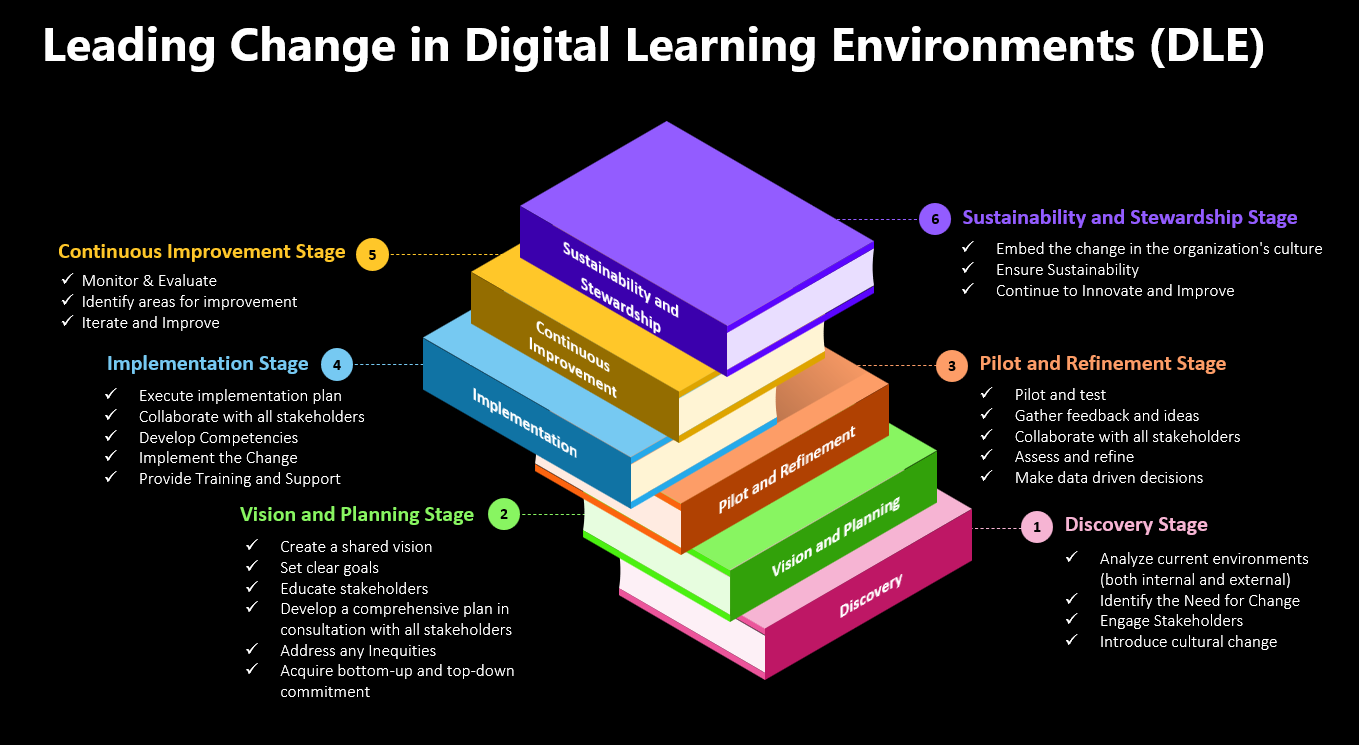
Figure 1. Proposed Six-Stage Model for Leading Change in Digital Learning Environments
Leading Change in Digital Learning Environments: A Six-Stage Model
As Leon C. Megginson once said, “It is not the strongest of the species that survive, nor the most intelligent, but the one most responsive to change” (as cited in Lynch, 2018, p. 32). Change is happening at an unprecedented pace worldwide, particularly in digital learning environments. For example, the COVID-19 pandemic forced many institutions to move to remote learning, and educators and administrators had to adapt quickly to new technologies. As digital learning environments continue to evolve, leaders must be equipped with the right tools and strategies to address change and promote growth. According to Al-Haddad and Kotnour (2015), effective change management requires a systematic approach that integrates critical organizational change theories and provides a roadmap for leaders to navigate the complex change process.
As part of this assignment, I interviewed two colleagues in my learning network to gain insights into their experiences in leading change. I conducted my first interview with Mariyam Azher, Human Resources Manager at Milton Keynes College. M. Azher (personal communication, February 15, 2023) shared her experiences implementing a professional development program called “Transform” for their employees. I conducted my second interview with Afshan Malik, MD, a multiple myeloma specialist who runs a multiple myeloma education platform in New York City. A. Malik (personal communication, February 15, 2023) discussed her experiences with managing change in a healthcare setting. Based on my readings on leadership and change management, consultation with my colleagues, and personal experiences, I created a proposed six-stage model for leading change in digital learning environments, as displayed in the infographic (Figure 1). I took the adaptive leadership approach, which looks at the “holistic view” and helps institutions navigate the complex and rapidly changing digital learning landscape by considering leader-follower relationships and the external environment (Khan, 2017). A. Malik (personal communication, February 15, 2023) also uses adaptive leadership to spot trends, think holistically, and embrace change, whereas M. Azher (personal communication, February 15, 2023) employs adaptive and reflective leadership approaches in different contexts.
The adaptive leadership approach also aligns with the open systems theory of organizational development, which states that organizations exist in a dynamic environment (Al-Haddad & Kotnour, 2015). Therefore, they should be able to adapt their internal processes in response to changes in the external environment, as seen during the Covid-19 pandemic when many institutions shifted rapidly to virtual learning. Therefore, success in today’s rapidly evolving world requires educational institutions to adapt to change (Shenigner, 2019; Weiner, 2009), resulting in continuous improvement and a culture of innovation. Underpinning my proposed model is the change management theory “O” (organizational capabilities) which “aims to create higher performance by fostering a powerful culture and capable workforce” (Biech, 2007). In alignment with theory O, in my proposed model (Figure 1), I have embedded stakeholder education, training, engagement and collaboration in various stages to create a robust culture and capable workforce.
My proposed model (Figure 1) also draws from Lewin’s change management model, “Unfreeze, Act and move, Refreeze” (Al-Haddad & Kotnour, 2015) and the Canada Health Infoway Change Management Framework which comprises of six core components for managing a change, which includes governance and leadership, stakeholder engagement, communications, workflow analysis and integration, education and training and monitoring and evaluation (Antwi & Kale, 2014). A. Malik (personal communication, February 15, 2023) shared her experience using Kotter’s 8-step model to create a sense of urgency and build a strong coalition of support for change. Meanwhile, M. Azher (personal communication, February 15, 2023) emphasized the importance of using Lewin’s 3-step model to unfreeze old habits and create a shared vision for change. These interviews provided valuable insights into the practical strategies and challenges of leading change in diverse organizational contexts. M. Azher (personal communication, February 15, 2023) shared her experiences implementing a large-scale professional development program and discussed the importance of effective communication and stakeholder engagement in the change process. A. Malik (personal communication, February 15, 2023) spoke about the importance of building a support community and fostering a culture of continuous learning in the context of a specialized medical education platform. I have embedded these core elements, such as stakeholder engagement, communication and support, that enable change in my proposed model in various stages (Figure 1). These elements are crucial when leading change in DLE in a healthcare setting.
In conclusion, leading change in digital learning environments (DLE) can be complex and challenging, but it can be managed effectively with the right tools and strategies (Al-Haddad & Kotnour, 2015). My proposed six-stage model (Figure 1) draws on adaptive leadership, Lewin’s change management model, and the Canada Health Infoway Change Management Framework to provide a comprehensive approach to leading change in DLE. Through careful analysis, planning, testing, implementation, continuous improvement, and sustainability efforts, educational institutions and healthcare organizations can successfully navigate the changing landscape of digital learning. In addition, by engaging stakeholders, promoting cultural change, and fostering a data-driven approach to decision-making, leaders can help their organizations thrive in today’s rapidly evolving world (Biech, 2007). As the digital learning environment continues to evolve, it will be critical for leaders to adapt and embrace change to ensure the success of their organizations.
References:
Al-Haddad, S., & Kotnour, T. (2015). Integrating the organizational change literature: a model for successful change. Journal of Organizational Change Management, 28(2), 234-262. https://doi.org/10.1108/jocm-11-2013-0215
Antwi, M., & Kale, M. (2014). Change management in healthcare: literature review. Monieson Centre for Business Research in Healthcare, Queen’s University, Ottawa, Ontario: Canadian Electronic Library.
Biech, E. (2007). Thriving Through Change: A Leader’s Practical Guide to Change Mastery. Association for Talent Development.
Khan, N. (2017). Adaptive or Transactional Leadership in Current Higher Education: A Brief Comparison. The International Review of Research in Open and Distributed Learning, 18(3). https://doi.org/10.19173/irrodl.v18i3.3294
Lynch, L. G. R. R., & Dagostino, M. (2013). Adapt or die: Leadership principles from an American general. Baker Books.
Sheninger, E. (2019, December 19). Pillars of digital leadership. International Centre for Leadership in Education. http://www.leadered.com/pdf/LeadingintheDigitalAge_11.14.pdf
Weiner, B. J. (2009). A theory of organizational readiness for change. Implementation Science, 4(1), 67. https://doi.org/10.1186/1748-5908-4-67