
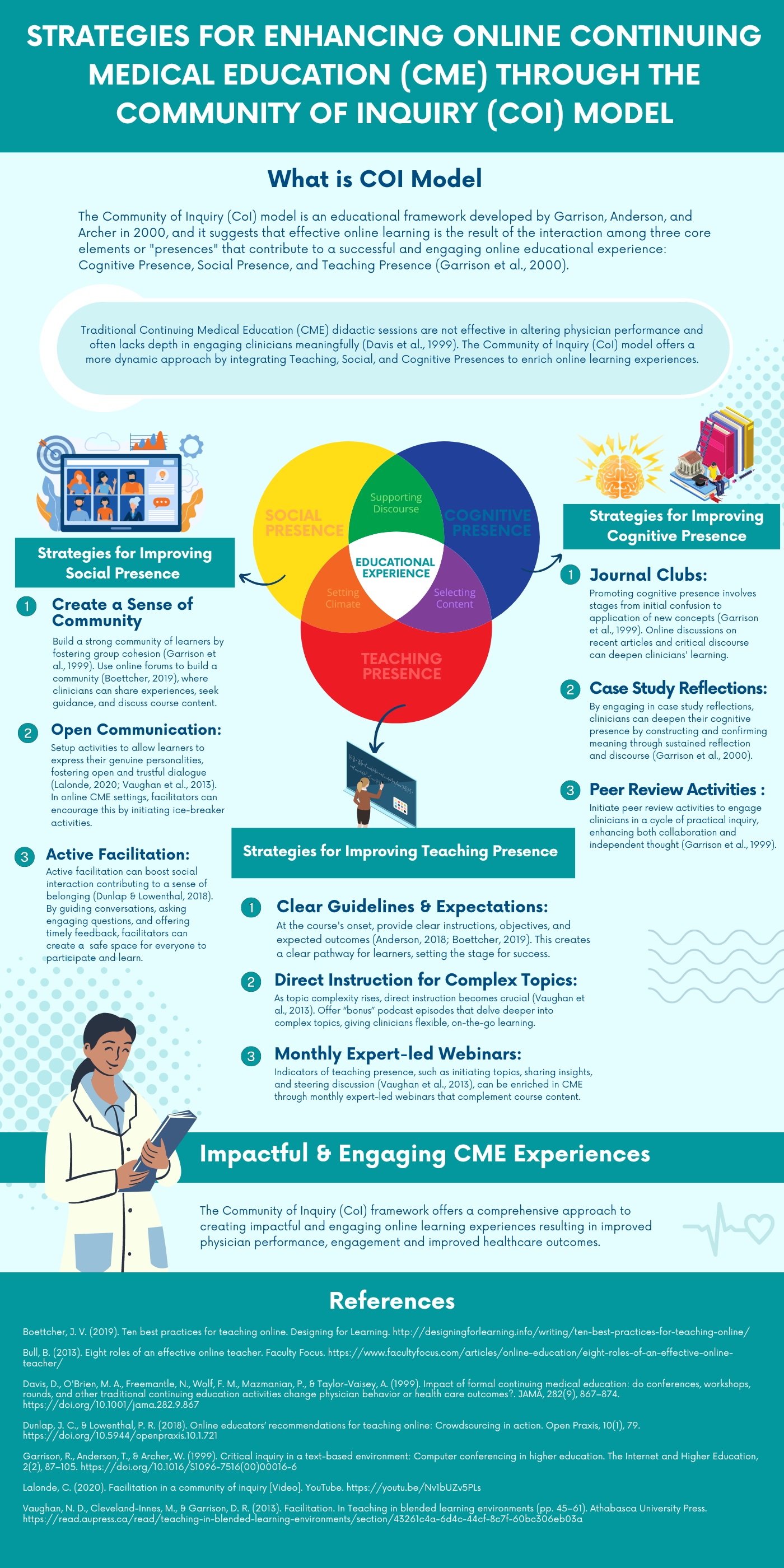
Enhancing Continuing Medical Education (CME) through the CoI Model
In today’s rapidly evolving healthcare landscape, Continuing Medical Education (CME) is more important than ever to stay current with the latest advancements, innovations and evidence based best practices. CME not only helps healthcare professionals enhance their knowledge and skills, but also ensures that they provide the highest quality of care to their patients. However, traditional CME often falls short in engaging clinicians deeply in the learning process (Davis et al., 1999). This is where the Community of Inquiry (CoI) model comes in, providing a holistic framework to foster meaningful educational experiences in online settings. Furthermore, it allows clinicians to network with peers, exchange ideas, and collaborate on innovative solutions to improve patient outcomes. In this infographic, I’ve highlighted the three essential COI elements, which include teaching presence, social presence, and cognitive presence, and illustrated how this model can be applied to CME.
Teaching Presence:
Teaching Presence involves coordinating cognitive and social activities to achieve meaningful and educationally relevant learning outcomes (Garrison et al., 2000). This includes designing instruction and guiding learners throughout their educational journey. It’s worth noting that Teaching Presence isn’t limited to instructors, as other members of the CoI can also contribute (Vaughan et al., 2013). This can improve the learning environment and increase learner satisfaction. The main goal of Teaching Presence, according to Lalonde (2020), is to help learners achieve personally significant and educationally valuable learning outcomes. In Continuing Medical Education (CME), Teaching Presence is especially important for facilitating effective learning experiences. It involves the design and organization of educational activities, as well as the guidance and support provided to learners. Additionally, teaching presence helps foster a collaborative learning environment where learners can interact with each other and with the instructor, enhancing their understanding of complex medical concepts and promoting critical thinking skills.
Social Presence
In the context of a COI, social presence pertains to learners’ capacity to portray their genuine personalities and remain authentic (Lalonde, 2020). Such authenticity fosters purposeful communication in an environment of trust, facilitating the growth of interpersonal relationships and enhancing a sense of belonging within the community (Lake & Atkins, 2021). A CME environment that prioritizes social presence can foster this essential trust, allowing clinicians to discuss cases openly, seek advice, and share expertise without the fear of judgment.
Cognitive Presence:
Cognitive Presence in the Community of Inquiry (CoI) framework refers to the extent to which learners are able to construct and confirm meaning through sustained reflection and discourse (Garrison et al., 2000).It aims to take learners through a cycle of inquiry that includes triggering events, exploration, integration, and resolution, thereby facilitating a meaningful learning experience. In the realm of Continuing Medical Education (CME), this presence is particularly vital as clinicians often encounter complex medical scenarios that demand a robust blend of critical thinking, reflection, and collaboration, ensuring they remain at the forefront of medical advancements and provide the best patient care.
References:
Boettcher, J. V. (2019). Ten best practices for teaching online. Designing for Learning. http://designingforlearning.info/writing/ten-best-practices-for-teaching-online/
Bull, B. (2013). Eight roles of an effective online teacher. Faculty Focus. https://www.facultyfocus.com/articles/online-education/eight-roles-of-an-effective-online-teacher/
Davis, D., O’Brien, M. A., Freemantle, N., Wolf, F. M., Mazmanian, P., & Taylor-Vaisey, A. (1999). Impact of formal continuing medical education: do conferences, workshops, rounds, and other traditional continuing education activities change physician behavior or health care outcomes?. JAMA, 282(9), 867–874. https://doi.org/10.1001/jama.282.9.867
Dunlap, J. C., & Lowenthal, P. R. (2018). Online educators’ recommendations for teaching online: Crowdsourcing in action. Open Praxis, 10(1), 79. https://doi.org/10.5944/openpraxis.10.1.721
Garrison, R., Anderson, T., & Archer, W. (1999). Critical inquiry in a text-based environment: Computer conferencing in higher education. The Internet and Higher Education, 2(2), 87–105. https://doi.org/10.1016/S1096-7516(00)00016-6
Garrison, D., Anderson, T., & Archer, W. (2000). Critical inquiry in a text-based environment: Computer conferencing in higher education. The Internet and Higher Education, 2(2-3), 87–105. https://doi.org/10.1016/s1096-7516(00)00016-6
Lake, J., & Atkins, H. (2021). Facilitating online learning with the 5R’s: Embedding Indigenous pedagogy into the online space. Pressbooks. https://pressbooks.bccampus.ca/the5rsonline/
Lalonde, C. (2020). Facilitation in a community of inquiry [Video]. YouTube. https://youtu.be/Nv1bUZv5PLs
Vaughan, N. D., Cleveland-Innes, M., & Garrison, D. R. (2013). Facilitation. In Teaching in blended learning environments (pp. 45–61). Athabasca University Press. https://read.aupress.ca/read/teaching-in-blended-learning-environments/section/43261c4a-6d4c-44cf-8c7f-60bc306eb03a
Hi Shazia,
Great infographic. It was very informative while also being extremely visually appealing. I also enjoyed your written summary. I especially resonated with, “traditional CME often falls short in engaging clinicians deeply in the learning process”. In creating a sense of community by using online forums, do you think just setting up a forum is enough to generate engagement and participation, or do you think there needs to be another motivating factor to get physicians to contribute in the forum?
Hi Rebecca,
I’m glad you found the infographic informative and visually appealing! You raised an important question about engagement and participation in online CME forums. I’ve found that creating a forum doesn’t guarantee active, high-quality participation. However, active facilitation plays a crucial role in steering the discussion and encouraging participation. Upvoting, peer recognition, badges, and other incentives, as well as CME credits for participation in the forums, can also influence participation and increase engagement in CME forums. Have you come across any particularly effective strategies for engaging clinicians that you believe could be especially useful in online CME forums?
Hi Shazia,
Thanks for sharing your infographic! First of all, do you mind if I ask which tool you’ve used for your infographic? 😊 The resolution is excellent, and everything is nicely presented. Great work! I like the idea of journal clubs. We have done something similar in our team. We shared an idea from the project management resources at our monthly meetings to deepen our knowledge and skills that we can apply to our daily work. Is CME an optional training for physicians at their own time? Do you think this could be one of the causes for less engagement? What is the biggest difference you see between the traditional CME and online CME that makes the learning experience impactful?
Thank you,
Megan
Hi Megan,
Thanks for your kind words about the infographic! I used Canva to create this infographic. I used to work in photoshop extensively but I’ve moved to Canva for most of social media infographic and even video stuff. I find I can create digital content much faster in Canva than photoshop. sharing project management resources during monthly meetings is a wonderful idea. It’s great that your team also values knowledge sharing. For physicians, earning CME credits each year is a mandatory requirement in Ontario. Time constraints and hectic schedules for clinicians make it challenging for them to engage in CME courses. Online CME’s flexibility makes it easy for doctors to learn credits at their own pace. The most significant difference between traditional CME and online CME that enhances the learning experience is flexibility and the ability to learn on the go such as physicians can listen to podcasts while driving or while at the gym. Do you have any mandatory courses that your learners have to complete each year?
A visually pleasing and informative infographic Shazia!
Your strategies were clearly connected to each CoI category, making this easy to follow.
I am wondering about the peer review strategy you have for Improving Cognitive presence; what motivation/instruction could you offer to encourage participation with this? I struggle with meaningful peer review in my area, albeit my learners are quite a bit younger!
Excellent infographic Shazia. Network through peer clinicians sounds terrific to learn from others while offering valuable information.