Leading Change in Digital Learning Environments

Leading change in digital learning environments can be a complex process and should be considered and addressed carefully and holistically to increase the probability of success. Reflecting on the literature and the lived experiences of myself, people who lead or have led digital change, and a colleague who has experienced digital change, I have developed a model for leading change in digital learning environments, as depicted in figure 1 and described in further detail below. 

Figure 1
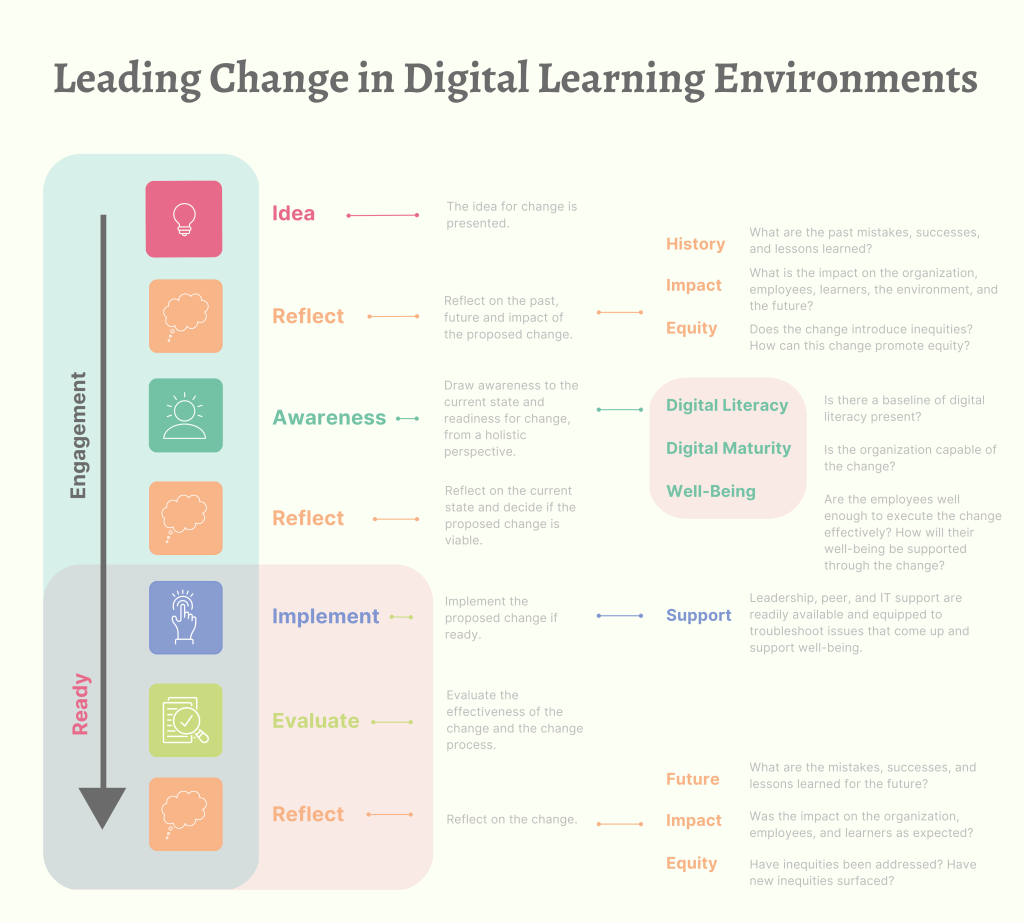
To view figure 1 larger, click here.

Throughout the process of leading change, engagement and reflection are embedded from start to finish. These are important overarching themes reflect good leadership practice, including the ability of the leader to continuously reflect, drawing awareness to behaviours, situations, and consequences in an effort to improve organizational outcomes (Castelli, 2016). Participatory Action Research, in which the people who are involved and impacted by the change are included in the process and their perspectives and lived experiences are heard, can lead to culture change and improved success (Al-Haddad & Kotnour, 2015). Moreover, Jones (n.d.) of Race Rocks 3D suggests that the inclusion of everyone’s voice can create an atmosphere of collaboration, contributing to successful change, whereas A. Fox (personal communication, February 12, 2023) describes a sense of community and connection leading to motivation when everyone is included in the process of change. This method of change is reflected in my proposed model as ‘engagement’ and can (and should) involve employees as well as the greater community, depending on the change being implemented and who is being impacted. Furthermore, engagement throughout the process considers Indigenous perspectives on leadership that promote connecting as opposed to dividing as a central concept of leadership in a flexible, non-hierarchal structure (Julien et al., 2010). This alternative perspective on leadership is something that I wanted to consider when thinking about a model for successful change with digital learning and is also relevant during reflection, where the past and future implications are considered early in the process. 

Equity is an important issue that needs to be addressed when facilitating change in digital learning environments. Introducing new technology can introduce inequities due to a lack of access, support, and digital literacy (Boyce, n.d.; Jones, n.d.; Norum, n.d.). Seeking to understand how the proposed change could contribute to inequity and developing strategies to promote equity is an important part of the reflective process and should be addressed before moving on to the implementation stage. 

Awareness in my proposed model reflects mindfulness and being aware of team and individual needs (Castelli, 2016), while also drawing awareness to the current state or readiness for change. Weiner (2009) describes readiness for change as being a multi-faceted and multi-level construct. Taking this into consideration, I propose that readiness for change in digital learning environments includes digital literacy, digital maturity, and the well-being of those involved. Boyce (n.d.) of Fraser Health describes digital literacy as a significant issue when facilitating digital change and the need for supporting education pathways to establish a baseline of digital literacy to build upon. A. Fox (personal communication, February 12, 2023) also describes the need for support with digital literacy to learn new technology effectively. Digital maturity, described as an “organization’s capability to recognize and utilize the opportunities provided by the development of digital technology and the ability to carry out strategies to execute the vision” (Larjovuori et al., 2016, p. 1144), is an important precursor to implementation, signifying readiness for change. Lastly, well-being is an essential element to successful change in digital learning environments as techno-stress, which can be characterized by feelings of anxiety, fatigue, and tension, can have a negative impact on employee well-being (Larjovuori et al., 2016). Employee well-being can be enhanced through effective leadership, ongoing participatory engagement, and support through the implementation stage of change. Both Boyce (n.d.) and A. Fox (personal communication, February 12, 2023) cite psychological safety as an area of focus during change and uncertainty, which is reflected in the inclusion of well-being as a precursor to implementation. 

Finally, evaluation is included in my proposed model as an important step to help understand the impact of the change. Both quantitative and qualitative feedback provide important information feeding into the final reflection, where successes, mistakes, and lessons learned are considered for adapting the current state and planning future opportunities for change. Overall, my proposed model takes a holistic and human-centred approach and an integrated method to systematically deal with change in digital learning environments (Al-Haddad & Kotnour, 2015). 

References

Al-Haddad, S., & Kotnour, T. (2015). Integrating the organizational change literature: a model for successful change. Journal of Organizational Change Management, 28(2), 234-262. https://doi.org/10.1108/JOCM-11-2013-0215 

Boyce, C. (n.d.). Voices of leadership [Audio recording]. Royal Roads University. https://malat-coursesite.royalroads.ca/lrnt525/schedule/voices/ 

Castelli, P. (2016). Reflective leadership review: a framework for improving organisational performance. Journal of Management Development, 35(2), 217-236. https://doi.org/10.1108/JMD-08-2015-0112 

Jones, C. (n.d.). Voices of leadership [Audio recording]. Royal Roads University. https://malat-coursesite.royalroads.ca/lrnt525/schedule/voices/ 

Julien, M.H., Wright, B., & Zinni, D.M. (2010). Stories from the circle: Leadership lessons learned from aboriginal leaders. Leadership Quarterly, 21, 114-126. https://doi.org/10.1016/j.leaqua.2009.10.009  

Larjovuori, R., Bordi, L., Mäkiniemi, J., Heikkilä-Tammi, K. (2016). The role of leadership and employee well-being in organizational digitalization. In T. Russo-Spena & C. Mele (Eds.), What’s Ahead in service research? New perspectives for business and society (pp. 1141-1154). European Association for Research on Services. https://www.researchgate.net/profile/Milena_Jael_Silva-Morales/publication/308033532_Changes_in_the_intellectual_structure_of_service_innovation_and_service_system_research_in_the_digital_age_a_bibliometric_analysis_from_1986_to_2015/links/5b1844000f7e9b68b4245425/Changes-in-the-intellectual-structure-of-service-innovation-and-service-system-research-in-the-digital-age-a-bibliometric-analysis-from-1986-to-2015.pdf 

Norum, S. (n.d.). Voices of leadership [Audio recording]. Royal Roads University. https://malat-coursesite.royalroads.ca/lrnt525/schedule/voices/  

Weiner, B. J. (2009). A theory of organizational readiness for change. Implementation Science, 4(67). https://doi.org/10.1186/1748-5908-4-67 

Reflections on Leadership

As I reflect on leadership as we begin LRNT 525, I am learning more about what I admire in a leader and how my top-ranked leadership qualities align with my personal values. After completing a leadership characteristic ranking exercise, my top characteristics were inspiring, honest, supportive, caring, and competent. Most of these characteristics embody a human-centric approach to leadership which I can relate to my desire to be known and supported holistically, beyond who I am in a professional role. 

The readings for this unit have given me insight into effective leadership practices while also providing a framework and language that reflect what I value in leadership. In particular, reflective leadership, in which self-awareness, mindfulness, and personal wisdom are integral to leading change and developing a culture of inclusion, safety, and trust, supports followers’ professional and personal development (Castelli, 2016). This approach to leadership resonated with me and is something I hope to explore and consider further. 

‘Digital’ Leadership 

I believe an adaptive leadership approach is necessary to be a ‘digital’ leader in a world where technology is ubiquitous and continuously influencing the way we live, work, and play. An adaptive leadership approach not only considers the changing environment but also the unique needs of individuals or followers, seeking to understand, support and motivate them to reach individual goals (Khan, 2017). As new technology emerges, a leader should be able to learn and adapt while including and supporting each follower in their learning and integration of new technology in their work. Not assuming digital literacy is important when adopting new technology or digital processes. Taking the time to introduce, train, and offer learning support is essential for successful adoption and effective use of time. In my own experience adopting new technology in my work setting, I have wasted many hours of my workday trying to figure out how to use new technology without formal instruction or support. This lack of training reduced my productivity while affecting my confidence to do my job effectively. 

As technology is changing rapidly, a distributed leadership approach could also be beneficial to support effective digital learning and change in an organization. Although a distributed leadership approach assumes a level of risk, it can help build individual and organizational capacity (Huggins, 2017). For example, if there are people on a team with good digital literacy and an interest in developing their leadership skills, allowing them to help support their peers in adopting new technology would take the pressure off the leader while supporting leadership development and capacity in followers. 

A good digital leader leans into innovation and sees the potential of new technology. The introduction of ChatGPT is an excellent example of a new technology that has many people wary. George Veletsianos looks at the reality of a technological innovation that is here to stay and encourages everyone to look at its opportunities and find ways to use it ethically and responsibly (CBC News, 2023). In my opinion, this example is the essence of good digital leadership. 

Alternative Perspectives on Leadership 

Lastly, I would like to draw attention to an alternative perspective on leadership. Indigenous perspectives offer a holistic and non-hierarchical approach to leadership that considers the past and the future when making decisions (Julien et al., 2010). We can learn a lot from this approach. It is crucial, concerning issues such as climate change, to consider how our decisions will impact future generations, not just those immediately impacted. I hope to learn more about this approach and how we can work together with the Indigenous community to make good decisions that consider history, future generations, and the interconnectedness of our systems. 

References

Castelli, P. (2016) Reflective leadership review: a framework for improving organisational performance. Journal of Management Development, 35(2), 217-236. https://doi.org/10.1108/JMD-08-2015-0112 

CBC News. (2023, January 30). ChatGPT could help rather than hinder student learning, says B.C. professor. https://www.cbc.ca/amp/1.6731105  

Julien, M.H., Wright, B., & Zinni, D.M. (2010). Stories from the circle: Leadership lessons learned from aboriginal leaders. Leadership Quarterly, 21, 114-126. https://doi.org/10.1016/j.leaqua.2009.10.009 

Huggins, K. S. (2017). Developing leadership capacity in others: An examination of high school principals’ personal capacities for fostering leadership. International Journal of Education Policy and Leadership, 12(1). https://doi.org/10.22230/ijepl.2017v12n1a670 

Khan, N. (2017). Adaptive or transactional leadership in current higher education: A brief comparison. International Review of Research in Open and Distance Learning, 18(3), 178–183. https://doi.org/10.19173/irrodl.v18i3.3294 

6 Design Principles to Support Well-Being in a Virtual Learning Environment

In our latest assignment for LRNT 524, we were asked to use a design thinking process to emphasize, ideate, and determine a possible solution for a design problem that we encounter in the real world. My partner, Jessica Gemella, and I looked at how we could create learning environments that minimize stress and anxiety due to rigid structures and policies and exacerbated by collective trauma resulting from the Covid-19 pandemic. As a follow-up to that process and assignment, I have been considering how I might use some of these learnings, such as design for well-being, to create design principles that can be applied to my own context where I facilitate professional learning and collaboration concerning comprehensive school health for educators in the K-12 system. 

Considering the context around comprehensive school health, a collaborative learning environment in which well-being is valued, supported, and modelled is a natural extension of the learning content. As such, the following design principles can help guide the creation of synchronous learning environments that foster and reflect well-being while minimizing stress and anxiety, specifically in a virtual setting. 

Don’t Assume Digital Literacy 

Not understanding how to use technology can result in an inability to cope and can negatively impact the learner’s mental health and learning outcomes (Biggins & Holley, 2022; Bondanini et al., 2020). Support digital literacy by providing an orientation to the platform and tools that will be used in the learning environment and provide technical support as needed. 

Foster a Sense of Belonging  

Fostering a sense of belonging can be supported by including and valuing diverse perspectives and worldviews, ways of knowing and thinking, and culturally sensitive and responsive design practices (Adams et al., 2021; DeLorme, 2018; Gunawardena, 2020). A sense of belonging can help learners feel more comfortable and open to sharing knowledge while creating space for diverse meaning-making. 

Be Flexible  

Designing for flexibility in a virtual synchronous learning environment means creating opportunities for participation, allowing for spontaneous discussions, the use of chat and mic features for communication, representing content in a variety of ways, and offering options for self-directed learning pathways (Racheva, 2018; Yamagata-Lynch, 2014). Flexibility can increase motivation and engagement of learners and can help improve their overall learning experience and outcomes. 

Build Social Presence 

Social connection is an essential dimension of a learning environment that supports well-being. Using a social-constructivist framework to inform learning design can help develop social presence, enhance well-being, and positively affect learning outcomes (Mäkelä, 2018). Moreover, taking time for informal sharing helps to build trust among learners and can lead to more open knowledge sharing and collaboration (Holton, 2021). 

Be Clear 

Adult learners are goal orientated and like to know why what they are learning is important to them (Merriam & Bierema, 2014). Being explicit about the value of the learning material to the learner’s context, developing and sharing meaningful learning outcomes, using simple language, and providing clear instruction can help provide clarity and direction for the learner while limiting confusion and stress. 

Promote Self-Care & Mindfulness 

Opportunities to practice self-care and mindfulness in the learning environment can enhance well-being while modelling best practice for learning design that reflects and supports well-being. Incorporating mindfulness activities can create an inviting learning environment that is open and flexible, helps learners feel connected and cared for, develops strong self-regulation skills, and benefits learners experiencing psychological distress (Palalas, 2020; Roddey et al., 2017).

References

Adams, S., Bali, M., Eder, Z., Fladd, L., Garrett, K., Garth-McCullough, R., Gibson, A. M., Gunder, A., Iuzzini, J., Knott, J. L., Rafferty, J. & Weber, N. L. (2021). Caring for students playbook: Getting started with key terms and challenges. Every Learner Everywhere. https://www.everylearnereverywhere.org/resources/ 

Biggins, D., & Holley, D. (2022). Student wellbeing and technostress: critical learning design factors. Journal of Learning Development in Higher Education (25). https://doi.org/10.47408/jldhe.vi25.985 

Bondanini, G., Giorgi, G., Ariza-Montes, A., Vega-Muñoz, A., & Andreucci-Annunziata, P. (2020). Technostress dark side of technology in the workplace: A scientometric analysis. International Journal of Environmental Research and Public Health, 17(21), 8013. https://doi.org/10.3390/ijerph17218013 

DeLorme, C. M. (2018). Quilting a journey: Decolonizing instructional design. AlterNative: An International Journal of Indigenous Peoples, 14(2), 164–172. https://doi.org/10.1177/1177180118769068 

Gemella, J., Yardley L. (2023, January 8). Design challenges in a post-pandemic world [Video]. Canva. https://www.canva.com/design/DAFWuaVFBoc/EEUDFFvkYimI53ZhbDuEJQ/watch?utm_content=DAFWuaVFBoc&utm_campaign=designshare&utm_medium=link&utm_source=publishsharelink

Holton, J.A. (2001). Building trust and collaboration in a virtual team. Team Performance Management, 7(3), 36-47. https://doi.org/10.1108/13527590110395621 

Joint Consortium for School Health. (2023). What is comprehensive school health? http://www.jcsh-cces.ca/en/concepts/comprehensive-school-health/

Mäkelä, T.E. (2018). A design framework and principles for co-designing learning environments fostering learning and wellbeing. Jyväskylä Studies in Education, Psychology and Social Research. https://www.jyu.fi/edupsy/fi/tohtorikoulu/kasvatustieteiden-tohtoriohjelma/valmistuneet-vaitoskirjat/makela_tiina_vaitoskirja.pdf 

Merriam, S.B., & Bierema, L.L. (2014). Adult learning: Linking theory and practice. Jossey-Bass. 

Palalas, A., Mavraki, A., Drampala, K., Krassa, A., & Karakanta, C. (2020). Mindfulness practices in online learning: Supporting learner self-regulation. The Journal of Contemplative Inquiry, 7(1). https://journal.contemplativeinquiry.org/index.php/joci/article/view/222 

Racheva, V. (2018). Social aspects of synchronous virtual learning environments. AIP Conference Proceedings, 2048(1), 020032. https://doi.org/10.1063/1.5082050  

Roddy, C., Amiet, D.L., Chung, J., Holt, C.J., Shaw, L.K., Mckenzie, S., Garivaldis, F.J., Lodge, J.M., & Mundy, M. (2017). Applying best practice online learning, teaching, and support to intensive online environments: An integrative review. Frontiers in Education, 2(59). https://doi.org/10.3389/feduc.2017.00059 

Yamagata-Lynch, L.C. (2014). Blending online asynchronous and synchronous learning. The International Review of Research in Open and Distributed Learning, 15(2), 189-212. https://doi.org/10.19173/irrodl.v15i2.1778 

Deep Learning Technology: Impact on Human Learning

In a recent assignment for LRNT 524, I was asked to research and evaluate an instructional or learning design innovation. I chose to focus on a learning design innovation known as adapted learning in which technology is used to provide customized learning experiences for learners based on the needs of the individual by creating unique pathways and progression of learning material and activities (Leaders, 2022). As part of this discussion, I shared how artificial intelligence (AI) has progressed adapted learning, introducing tools such as ones that can detect the learners cognitive state based on conversational elements which it uses to guide the learner through productive conversations to enhance learning (Capuano & Caballé, 2020). 

As a follow up blog post, I have been asked to explore a learning innovation and discuss it’s impact. Upon further research in adapted learning, I discovered deep learning which is a AI-based technology that attempts to mimic the human brain through image or object detection using a multi-layererd approach to make intelligent decisions (Han & Xu, 2020; IBM, n.d.). Deep learning is a tool that can enhance adapted learning through a complex analysis of objects that goes beyond a linear process of adaptation, similar to neural connections and processing in the human brain. After an initial exploration of the literature, I found that there were many interpretations of what deep learning is and that the term is often used interchangeably with machine learning and deep neural networks. Kavlakoglu (2020) at IBM contends that deep learning is a subset of machine learning with deep neural networks making up its algorithms. The lack of common language and understanding in the literature of what deep learning is made my research on this topic more difficult. 

Furthermore, there does not seem to be a lot of literature about the use of deep learning technology in the context of learning in formal education. Deep learning is most known for its use in other sectors and innovations such as driverless cars where a car must learn how to detect a stop sign (Venkateswaran et al., 2021), a true focus on machine learning rather than human learning. However, I do see that deep learning can have a large impact on human learning, but perhaps in more of an ‘unlearning’ way. As deep learning technology advances in an effort to simulate processes of the human brain, less effort is required from humans to learn and complete tasks. This exclusive reliance on technology to make decisions and problem solve could be problematic for two reasons. Firstly, AI technology, including deep learning is still far from matching human intelligence, making outputs not always accurate (McClelland & Botvinick, 2020). And secondly, (and this is my own pondering) I am left wondering if the long-term use of AI, including deep learning technology, will change the architecture and performance of the human brain over time. With the use of AI driven deep neural networks, are we losing the opportunity to be develop our own neural networks in our own brains through problem solving? 

I see some potential for deep learning technology in creating more meaningful learning experiences for culturally diverse learners. For example, this technology could adapt learning content and images to represent the culture and worldview of the learner while still meeting the learning outcomes. In that case, this could lead to greater inclusion and sense-making according to diverse worldviews. However, there could still be bias present as there is a wide range of diversity within a culture, which will have to be considered in the design and data collection for deep learning technology. 

References

Baker, C. (2022, June 3). What is adaptive learning and can It work for business? Leaders. https://leaders.com/articles/innovation/adaptive-learning/ 

Capuano, N., & Caballé, S. (2020). Adaptive learning technologies. AI Magazine, 41(2), 96-98. https://doi.org/10.1609/aimag.v41i2.5317  

Han, Z., & Xu, A. (2020). Ecological evolution path of smart education platform based on deep learning and image detection. Microprocessors and Microsystems, 80, 103343. https://doi.org/10.1016/j.micpro.2020.103343 

IBM (n.d.). What is deep learning? https://www.ibm.com/topics/deep-learning 

Kavlakoglu, E. (2022, May 27). AI vs. machine learning vs. deep learning vs. neural networks: What’s the difference? IBM. https://www.ibm.com/cloud/blog/ai-vs-machine-learning-vs-deep-learning-vs-neural-networks  

McClelland, J. L., & Botvinick, M. M. (2020). Deep learning: Implications for human learning and memory. PsyArXiv. https://doi.org/10.31234/osf.io/3m5sb 

Venkateswaran, C., Amudha, M., Ramachandran, M., Saravanan, V., Vennila, T. (2021). A study on artificial intelligence with machine learning and deep learning techniques. Data Analytics and Artificial Intelligence 1(1). https://secureservercdn.net/50.62.90.29/d8a.8cf.myftpupload.com/wp-content/uploads/2022/01/A-Study-on-Artificial-intelligence-with-Machine-learning-and-Deep-Learning-Techniques.pdf 

Exploring Instructional Design Models

The beginning of LRNT 524 had us exploring popular design models in an effort to understand the landscape of instructional design (ID). What became a prevalent theme throughout the readings is that there is no ‘one size fits all’ approach to ID and that many factors may lead to the use of one design model over another – or perhaps a blend of several. Assuming one ID model to inform all course design is a disservice to the learner and the model or process used should be appropriate and well-suited to the learning context. 

When considering instructional or learning design, an important distinction to make is between an ID model and an ID process. Dousay (2018) describes the ID process as steps taken to achieve the end result whereas the ID model takes a more specific representation of a process. The ADDIE process (assessment, design, develop, implement, evaluate) can be viewed as an overarching framework for informing ID, regardless of the model used. 

Another distinction to make is between the design for instruction and the design for learning. This has been a distinction I have been reflecting on a lot since the beginning of the MALAT program and as I learn more, the more I feel compelled to prioritize a learning design approach. Universal Design for Learning (UDL) takes a learner or user-centred approach focusing on learner engagement and developing ‘expert learners’ in which learners are “purposeful, motivated, resourceful, knowledgeable, strategic and goal-orientated” (Takacs et al., 2021, p. 31). In my opinion, the notion of developing learners in this way is a more holistic approach to learning and also demonstrates the need for careful, thoughtful and purposeful design. 

An area that I would like to learn more about is cultural inclusion in learning and instructional design. Although many popular ID models and processes reflect the consideration of diverse learners, there remains a gap in guidance for creating learning environments that embrace and reflect cultural diversity and inclusion (Heaster-Ekholm, 2020). In a time where we are making efforts to foster decolonization many of our systems and processes, learning that supports and reflects cultural inclusion is of utmost importance. 

Parchoma et al. (2020) introduce the idea of designing for learning in the yellow house. The yellow house, referencing Van Gogh’s Yellow House painting, is a place where there exists a metaphorical third place or room where instructional design and learning design can come together in an effort tto support growth, creativity and change (2020). This yellow house analogy has created space in my mind and professional practice to consider the possibilities of learning design while granting me permission to get creative. I look forward to learning more as we progress through this course.

References

Dousay, T. A. (2018). Instructional Design Models. In West, R (Ed.), Foundations of learning and instructional design technology: The past, present, and future of learning and instructional design technology. EdTech Books. https://edtechbooks.org/lidtfoundations/instructional_design_models 

Heaster-Ekholm, K. L. (2020). Popular instructional design models: Their theoretical roots and cultural considerations. International Journal of Education and Development Using Information and Communication Technology, 16(3), 50–65. https://files.eric.ed.gov/fulltext/EJ1275582.pdf 

Parchoma, G., Koole, M., Morrison, D., Nelson, D., & Dreaver-Charles, K. (2020). Designing for learning in the Yellow House: A comparison of instructional and learning design origins and practices. Higher Education Research & Development, 39(5), 997–1012. https://doi.org/10.1080/07294360.2019.1704693 

Takacs, S, Zhang, J., Lee, H., Truong, L., & Smulders, D. (2021). A comprehensive guide to applying Universal Design for Learning. Justice Institute of British Columbia. https://pressbooks.bccampus.ca/jibcudl/  

Educational Technology in 2030: A Speculative Tale of Two Children and a Whale

Under the guise of environmentally friendly paperless classrooms and commuteless classroom attendance lays a deep environmental crisis rooted in technology itself. Unbeknownst to many, technology comes with a significant carbon footprint. With the rapid digitalization as a result of the Covid-19 pandemic, the carbon impact is accelerating at a significant rate with recent estimates of the internet’s carbon dioxide equivalent emissions coming in at 1.7 billion tonnes in the year 2020 alone (Jisc, 2022). Moreover, 53.6 million tonnes of e-waste were generated worldwide in 2019 (World Health Organization, 2021). 

As we live through a so-called technological or digital revolution, each year that passes brings with it exceptional advances in technology and the way that we operate within society. The advancement is fast with innovation dictating a seamlessly never-ending cycle of production and consumption while sidestepping the reality of finite resources and inadequate digital recycling processes. The world of Ed Tech is very much a forward-looking field in which innovation and transformation are the focus, with less time spent on the present and learning from failures of the past (Selwyn, Panrazio, et al., 2019). Meanwhile, as we embrace each new technology, many of which are packaged in a new device or tool, our e-waste grows. Selwyn (2021) points out that recycling devices is often simply dumping them in some of the poorest regions in the world contributing to increased levels of pollution, contamination and toxic waste. This is concerning and a warning to us all.

Fast forward to 2030, a mere eight years from now where Sophia, a 9-year-old girl in Alberta, Canada, is enrolled in grade four at her local community school. Her school is digitally driven and prides itself on only using the latest and most advanced technology to enhance learning in order to provide the best education possible. In an effort to reduce travel-related carbon emissions, Sophia’s classroom has stopped taking a yearly field trip to the nearby mountains to study the local ecosystem and instead uses a virtual reality application to provide an immersive learning experience allowing them to simulate exploring an area that they would not be able to if they were there on foot (Adžgauskaitė et al., 2020). Sophia wonders what the trees smell like and imagines going there one day, in real life. However, she doesn’t realize that that same forested area would be destroyed in a fire the following year as hot and dry conditions have persisted over the last decade. Sophia is used to summers with smoke-filled skies due to the increasing prevalence of forest fires. It is all she has known. To her, it is normal and she doesn’t think about it all that often. She doesn’t visit or spend time in forests, at least not in real life, and doesn’t feel personally connected to them in any way. Always striving to keep up with the latest advances in educational technology, Sophia’s school invests a considerable amount of money into upgrading devices and software each year and ensures each student has access to their own personal computing devices, including a laptop and a tablet. The school prioritizes the recycling of devices upon upgrading and has them delivered to an electronic recycling management program in an effort to dispose of them responsibly. 

As predicted by the World Health Organization (2021), the amount of e-waste has grown to 74.7 million tonnes, overwhelming landfills in low and middle-income countries. There are now 109 million jobs in waste management, up 70% from 2019, with many of these jobs managing e-waste. 9-year-old, Avi has been working informally in a landfill in Seelampur, India since he was 5. He collects parts from digital devices shipped from high-income countries to be dumped as e-waste. Avi is having a hard time breathing as of late and is often coughing and wheezing throughout the day and night. As a child, Avi has a faster breathing rate and smaller lungs compared to adults, making it easier to absorb and harder to metabolize the pollutants he breathes in each day (World Health Organization, 2021). Avi doesn’t attend school as he has to work full-time to contribute to his family’s income to buy food and meet their basic needs. 

Back in Canada, on a shore near Bamfield on Vancouver Island, a killer whale lies lifeless. This is the second one to wash ashore in weeks. The Southern Resident Killer Whale, classified as endangered in Canada and the United States of America since 2003, has seen its population reduced from 73 to 64 since 2021 (Government of Canada, 2021). These killer whales are some of the most contaminated marine animals in the world (Garrett & Ross, 2010) and the impact of toxins entering the oceans from e-waste landfills through seepage and acid rain, affecting their food source, has continued to grow in recent years (Belmont Trading, 2017). Without significant intervention, these killer whales, along with many other species of marine life will face extinction. 

Returning to the present time, it is important to note that these speculative stories are not based solely on the result of e-waste, but rather as part of a complex system contributing harm to life on earth and thus illustrating the need for systems thinking approach when considering the future. This story also illustrates the interconnectedness of the world with the impact of e-waste returning to Canada through the ocean ecosystem. In an interview discussing decolonizing design, design anthropologist Dori Tunstall (2019) shares the concept of designing ourselves back into the environment in a way that human-centred design is decentralized and humans become part of the larger ecosystem in a relational model. We need to be accountable to the earth – to the trees, the water, the soil, the air – and consider the most vulnerable as we design, produce and consume technology with a do no harm approach. This includes sourcing more sustainable, renewable materials to create and sustain electronic and technological devices, improving the longevity of device use, corporate responsibility for product end-life, and effective recycling practices (Selwyn, 2021). Specifically, within the field of educational technology, consideration needs to be given to educational provision and practice with ecological responsibility prioritized (Selwyn, Hillman, et al., 2019).  Furthermore, a shift in beliefs and attitudes is warranted to slow down innovation and live, work, and learn within planetary limits, finding contention within an adequate teaching and learning framework.  Understanding and considering ‘all our relations’ in the decision-making and planning process is an ethical approach we must take across all sectors, not just educational technology, for a healthy and sustainable future for all. 

References

Adžgauskaitė, M., Abhari, K., & Pesavento, M. (2020). How virtual reality is changing the future of learning in K-12 and beyond using needs-affordances-features perspective. In HCI International Late Breaking Papers: Cognition, Learning and Games: Lecture Notes in Computer Science (pp.279-298). Springer. https://doi.org/10.1007/978-3-030-60128-7_22

Belmont Trading. (2017, January 30). Examining the impact of ewaste on marine life. https://www.belmont-trading.com/2017/01/examining-the-impact-of-ewaste-on-marine-life/

Garret, C. & Ross, P. (2010). Recovering resident killer whales: a guide to contaminant sources, mitigation, and regulations in British Columbia. https://www.arlis.org/docs/vol1/D/690987332.pdf

Government of Canada. (2021). Killer whale (orcinus orca), northeast pacific southern resident population. https://species-registry.canada.ca/index-en.html#/species/699-5

Jisc. (2020). Exploring digital carbon footprints. https://repository.jisc.ac.uk/8782/1/exploring-digital-carbon-footprints-report.pdf

Selwyn, N., Hillman, T., Eynon, R., Ferreira, G., Knox, J., Macgilchrist, F., & Sancho-Gil, J. M. (2019). What’s next for ed-tech? critical hopes and concerns for the 2020s. Learning, Media & Technology45(1), 1-6. https://doi.org/10.1080/17439884.2020.1694945

Selwyn, N., Pangrazio, L., Nemorin, S., & Perrotta, C. (2019). What might the school of 2030 be like? an exercise in social science fiction. Learning, Media and Technology, 45(1), 90–106. https://doi.org/10.1080/17439884.2020.1694944 

Selwyn, N. (2021). Ed-tech within limits: anticipating educational technology in times of environmental crisis. E-Learning and Digital Media, 18(5), 496–510. https://doi.org/10.1177/20427530211022951 

Tunstall, D. (2019, January 31). Respecting our relations: Dori Tunstall on decolonizing design [Interview transcript]. The Jacobs Institute. https://jacobsdesigncal.medium.com/respecting-our-relations-dori-tunstall-on-decolonizing-design-d894df4c2ed2

World Health Organization. (2021). Children and digital dumpsites: e-waste exposure and child health. https://apps.who.int/iris/bitstream/handle/10665/341718/9789240023901-eng.pdf

Death by Innovation? An Introduction to a Speculative Essay

The year 2030 is less than 8 years away and yet within a so-called technological revolution, each year that passes brings with it exceptional advances in technology and the way that we operate within society. The advancement is fast. Innovation dictates how we can continuously do things better. But where is the limit? Will we ever reach or be satisfied with ‘good enough’? What is the impact, in particular on the environment, of continuous innovation? 

The world of Ed Tech is very much a forward-looking field in which innovation and transformation are the focus, with less time spent on the present and learning from failures of the past (Selwyn et al., 2019). Meanwhile, as we embrace each new technology, many of which are packaged in a new device or tool, our e-waste grows. Selwyn (2021) points out that recycling devices is often simply dumping them in some of the poorest regions in the world contributing to increased levels of pollution, contamination and toxic waste. This is concerning and a warning to us all.

Although the year 2030 may bring with it exciting and transformative innovations to improve education and learning, we must consider the cost of this innovation by looking at the impact on the environment and the survival of humans on earth. Does continuous innovation bring us closer to our devices and reliance on technology while simultaneously facilitating a lost connection to our roots and our land? As the gap in connection to the land grows, do we care about it less?

I look forward to digging deeper into these questions and considering the future of Ed Tech from a sustainability perspective as I write my final essay for LRNT 523.

References

Selwyn, N., Pangrazio, L., Nemorin, S., & Perrotta, C. (2019). What might the school of 2030 be like? an exercise in social science fiction. Learning, Media and Technology, 45(1), 90–106. https://doi.org/10.1080/17439884.2020.1694944 

Selwyn, N. (2021). Ed-tech within limits: anticipating educational technology in times of environmental crisis. E-Learning and Digital Media, 18(5), 496–510. https://doi.org/10.1177/20427530211022951 

People From the Field of Ed Tech – Introducing Dr. Judith Pete

Dr. Judith Pete is a lecturer and project coordinator at Tangaza University College in Kenya, Africa. I chose to highlight Dr. Pete after listening to her speak in the 25 Years of Ed Tech Between the Chapters (2021) podcast on Open Educational Resources (OER), and getting a sense of her deep passion and commitment to improving access to quality education in Africa. Pete grew up in a village in Kenya where she struggled to gain access to education, however, she eventually received a scholarship to pursue post-secondary studies where she began to explore how education could be accessible and affordable for marginalized communities (Pete, 2014).

Reflecting on her educational journey during the podcast with Pasquini (2021), Pete describes herself as a “transformed person who is also out, ready to transform others” (25:19). Her educational experience led her to discover OER and see its great potential for increasing access to education in Africa, while also recognizing the criticality of this access within the global community to prevent further divide from the ‘North’ (Pete, 2014). Pete’s PhD research focused on the role of OER in increasing access to University education among the marginalized communities in Kenya and she has since been involved in several studies looking at the impact of OER and online education within the African context. Pete belongs to the Global OER Graduate Network (GO-GN), a global network of PhD candidates whose research focuses on OER, where she led a Diversity, Equity, and Inclusion (EDI) project looking at how open research communities could be more diverse, equitable and inclusive (Farrow, 2109). More recently, Pete has been advocating for the open use of data to counter the impact of climate change in Africa. Pete is an incredible advocate for OER while also serving as an inspirational role model for young girls in Africa. I believe that this is just the beginning of her story and impact on access to quality education in Africa. 

References

Farrow, R. (2019, March 12). Diversity, equity and inclusion project. Global OER Graduate Network. https://go-gn.net/research/diversity-equity-and-inclusion-project/ 

Global OER Graduate Network. (n.d.). GO-GN. https://go-gn.net/ 

Open Data Day. (2020, April 21). Opening up data to counter climate change in Kenya: Open data day 2020 report. Open Knowledge Foundation. https://blog.okfn.org/2020/04/21/opening-up-data-to-counter-climate-change-in-kenya-open-data-day-2020-report/ 

Pasquini, L. (Host). (2021, January 21). Between the chapters: Sharing about OER & our open practices (No. 11) [Audio podcast episode]. In 25 Years of Ed Tech. Transistor. https://25years.opened.ca/2021/01/27/between-the-chapters-oer/ 

Pete, J. (n.d.). Dr. Judith Pete. Google Scholar [Profile]. https://scholar.google.ca/citations?user=kJPx3lsAAAAJ&hl=en&oi=ao 

Pete, J. (2014, June 23). The role of OER in increasing access to University education among the marginalized communities in Kenya [Video]. Video Lectures. http://videolectures.net/ocwc2014_pete_marginalized_communities/ 

Reflecting on 25 Years of Ed Tech (2002 – 2011)

After reading the second third of 25 Years of Ed Tech, I am again reflecting on the history of many innovations in Ed Tech and my interaction (or lack of) with each. As time has advanced in the book, I see my personal history intertwined with each passing chapter. The chapters I have read this week have been less surprising, however interesting to learn of the origins, success, and failures of innovations in Ed Tech. 

Weller (2020) describes the introduction of social media, in particular Twitter, as being a revolutionary way to make connections globally and engage in meaningful discussions across disciplines. The democratization of the academic space through the use of social media has increased the importance of establishing an online identity. Weller (2020) uses the example of keynote speakers often being those with a solid online identity rather than a lengthy list of publications. I believe this to be the case across many, if not all sectors. In our current time, to amplify your voice, you likely need to have an established online identity with frequent and meaningful contributions to content and dialogue. 


In the chapter on Open Educational Resources (OER), Weller (2020) identifies the value of OER while also indicating the role that privilege can play in open education. In the Between the Chapters podcast, Laura Pasquini (2021) describes open education as being focused on “access and equity” (28:28). Although I wholeheartedly agree with this statement and the concept of open education and OER, I come from 15 years of work in community education in the not-for-profit sector and offer a different perspective. Managing an underfunded organization with limited opportunities to fundraise meant having to charge for much of our resources and education. In my heart, I wanted to be able to offer everything for free, yet the systems in place meant I could not. Many of our partner organizations with more robust funding could provide more resources at no cost and this was frustrating. From a not-for-profit perspective, funding can lead to privilege. When considering OER and open education, equity and access should be considered across the whole system, not just from the user perspective.

References

Pasquini, L. (Host). (2021, January 21). Between the chapters: Sharing about OER & our open practices (No. 11) [Audio podcast episode]. In 25 Years of Ed Tech. Transistor. https://25years.opened.ca/2021/01/27/between-the-chapters-oer/ 

Weller, M. (2020). 25 years of ed tech. Athabasca University Press. https://doi.org/10.15215/aupress/9781771993050.01 

Reflecting on 25 Years of Ed Tech (1994-2001)

After reading the first 8 chapters of 25 Years of Ed Tech, I feel that I have been living under a rock in many ways. The overall history of Ed tech is surprising to me because it dates further back than I had previously thought. In 1998, I was signing up for my first email address and unbeknownst to me, the first fully online undergraduate course would be developed in 1999 (Weller, 2020). I am left feeling fascinated at what was growing in the field of Ed Tech that I was completely unaware of. 

Reading these chapters lead me to reflect on my own experience and beliefs concerning Ed Tech. Weller (2020) discussed the creation and relevance of Wikipedia as one of the biggest successes of wikis. Weller describes Wikipedia as a useful tool in higher education and one with very few errors (2020). This immediately confronted my distrust in Wikipedia and caused me to navigate back to my undergraduate years as the source of this distrust. During this time, I remember being explicitly told not to use Wikipedia as it was not a reliable source of information. I took this instruction as a golden rule and have not looked back until enrolling in the MALAT program and found myself surprised when an instructor offered an idea, linking to further reading from Wikipedia. This was a moment that opened my eyes to the world and possibilities beyond a textbook in a formal education setting. Reading Weller’s (2020) chapter on wikis has, in a sense, granted me permission to trust Wikipedia and has reminded me that I likely have much to unlearn from my instructivist experience in my undergraduate years as I embrace the constructivist learning environment afforded in the MALAT program. 

References

Weller, M. (2020). 25 years of ed tech. Athabasca University Press. https://doi.org/10.15215/aupress/9781771993050.01