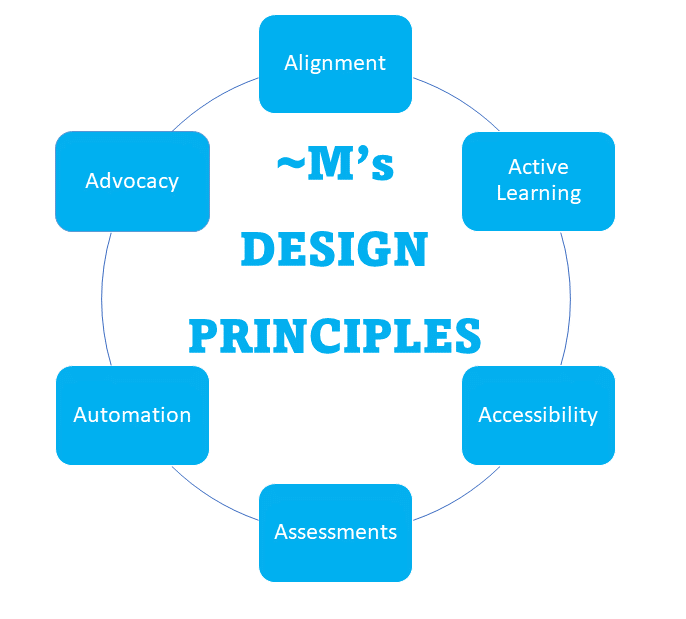
Infographic: Russell, 2024
After reflecting on the design thinking process and receiving feedback from assignment 2a, I developed six design principles for my college context. As part of my brainstorming process for assignment 2b, I initially sketched out principles that immediately came to mind from the digital literacy design thinking process (Morris, 2020). Coincidentally, all six of these principles began with the letter A, which was unplanned. I also reviewed the Design Principles open source collection to help with ideation (Brignell, 2021). As a result, the following six principles were created to guide the design of an inclusive learning environment:
Alignment
As a crucial design principle, alignment unites all components of a learning environment cohesively to achieve the desired learning outcomes. The learning outcomes, instructional activities, and assessments should be aligned to produce quality learning (Biggs, 2003). Using the Backward Design approach at my college will help align the learning outcomes with the instructional activities and assessment methods (Wiggins & McTighe, 2005).
Active Learning
For the active learning design principle, I have authentic learning with applying “real-world tasks” in mind (Dabbagh et al., 2019, p. 9). This design principle intends to provide guidance that promotes active engagement in creating learning experiences that require learners to actively participate, think critically, and apply their knowledge and skills. Moving beyond the “sage on the stage” lecturing is paramount in this learning environment (Kosslyn, 2021, p. 6).
Accessibility
By incorporating accessibility as a principle, the need to create inclusive and equitable learning experiences is at the forefront of design. The learning environment should prioritize usability for all learners (Lidwell et al., 2015). Implementing Universal Design for Learning (UDL) as a guide is instrumental when designing to ensure that the instructional approach provides multiple means of “representation, engagement, and action and expression” for learners (Novak, 2022, p. 36).
Assessments
The need for more emphasis on formative assessments was identified during the design thinking process. Using assessments as a design principle, formative assessments would be implemented throughout courses to check for understanding and provide timely feedback for improvement without grading. This ongoing feedback helps learners identify their strengths and weaknesses and informs instructors on design improvements (Hillman & Stalets, 2021).
Automation
As a design principle, automation refers to streamlining instructional activities, materials, and digital learning assessments through technology. One aspiration is to allow instructors more time to focus on teaching and interacting with students. When designing with technology, the learning management system can be organized to automate course announcements, assignment submissions, grading, and more. The design thinking process emphasized the importance of instructors requiring training on using this automated educational technology effectively (Bates & Poole, 2003).
Advocacy
Advocacy as a design principle might seem unconventional; however, I felt strongly about incorporating and being its champion. As Equity, Diversity, and Inclusion (EDI) practices are integral to my college in supporting learners, I thought this advocacy principle could be a way to ensure that learners, regardless of their background, identity, or abilities, have access to inclusive learning experiences. As an advocate, I will strive to be empathetic in incorporating diverse perspectives, cultures, and experiences into learning design to create more enriching and inclusive learning environments (Katz, 2012).
For my next steps, I am eager to share these design principles with team members as I am curious if these six design principles for our college context also resonate with them.
References
Bates, A. W., & Poole, G. (2003). Effective teaching with technology in higher education. Jossey-Bass.
Biggs, J. (2003). Aligning teaching for constructing learning. The Higher Education Academy. http://egusdsecondaryed.pbworks.com/f/aligning_teaching_for_constructing_learning.pdf
Brignell, B. (2021). Design principles: An open source collection of design and methods. https://principles.design/#what-are-design-principles
Dabbagh, N., Marra, R. M., & Howland, J. L. (2019). Meaningful online learning: Integrating strategies, activities, and learning technologies for effective designs. Routledge.
Hillman, G., & Stalets, M. (2021). Assessment as a catalyst for learning: Creating a responsive and fluid process to inspire all students. Solution Tree Press.
Katz, J. (2012). Teaching to diversity: The three-block model of universal design for learning. Portage & Main Press.
Kosslyn, S. M. (2021). Active learning online: Five principles that make online courses come alive. Alinea Learning.
Lidwell, W., Holden, K., & Butler, J. (2015). The pocket universal principles of design. Rockport Publishers, Inc.
Morris, M. (2020). Design thinking workbook. The Innovation Mastery Library.
Novak, K. (2022). UDL now: A teacher’s guide to applying Universal Design for Learning. CAST.
Russell, M. (2024). ~M’s design principles [Infographic].
Wiggins, G., & McTighe, J. (2005). Understanding by design. ASCD.