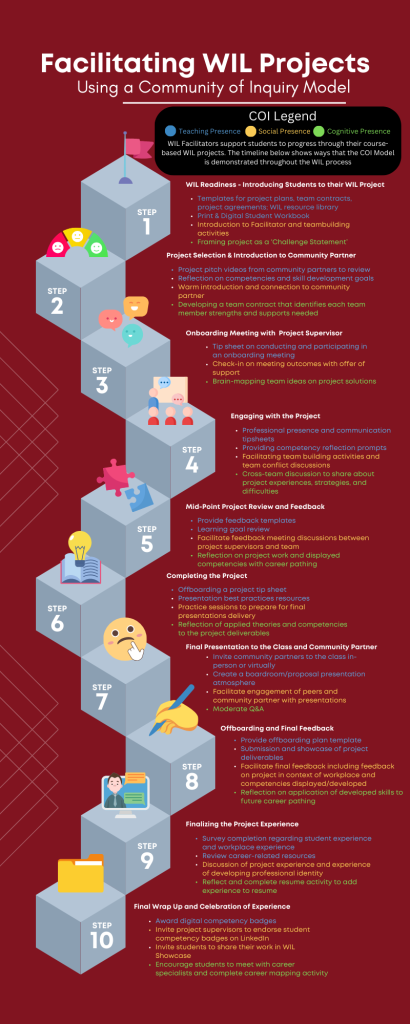
In my team we support and facilitate various work-integrated learning (WIL) experiences, including Readiness for WIL workshops, placement-based WIL, and course-based WIL. Within course-based WIL, students complete a project with a community partner organization within the context of a course for their program where they apply the theoretical learning of the course to complete a deliverable that is realistic to the workplace environment. The infographic presented demonstrates the typical project roadmap students would follow to complete their WIL project experience. Each step lists colour-coded examples of the 3 types of presence in the community of inquiry models that are incorporated at that step of the process.
Teaching Presence
Teaching presence in the context of these WIL projects would focus on unifying the academic and workplace/career-related lenses and outcomes that are important to the WIL environment. This will include the content and resources that support students in connecting their course theory within a workplace context, as well as linking to their overall career development and outlook.
Social Presence
Social presence in this context has to include the unique aspect within WIL of including a community partner, who can be viewed as a potential future employer into the learning community alongside the students, WIL facilitator and instructor. Social presence is generated by facilitating trust and relationship building between student teams as well as their community partner project supervisor and addressing factors that can impact trust and relationship such as real and perceived power imbalances and experiences of imposter syndrome.
Cognitive Presence
Cognitive presence within WIL projects involves constructing experiences where the students are able to construct and confirm meaning not only about the course theory, but about the application of that theory in the context of career-related and workplace-related outcomes. Various points of reflection, critical discussion, and mind-mapping can help achieve this in the WIL project experience.
References
Boettcher, J. V. (n.d.). Ten Best Practices for Teaching Online. Design for Learning.
Bull, B. (2013). Eight Roles of an Effective Online Teacher. Faculty Focus.
Clint Lalonde. (2020, August 22). Facilitation in a Community of Inquiry. YouTube. https://www.youtube.com/watch?v=Nv1bUZv5PLs
CoI Framework | CoI. (2013). Athabascau.ca. https://coi.athabascau.ca/coi-model/
Higher Education Quality Council of Ontario. (2016). A practical guide for work-integrated learning: Effective practices to enhance the educational quality of structured work experiences offered through colleges and universities. Queen’s Printer for Ontario.
Vaughan, N. D., Cleveland-Innes, M., & Garrison, D. R. (2013). Teaching in blended learning environments: Creating and sustaining communities of inquiry. Athabasca University Press. Chapter 3: Facilitation (pp. 45-61)
Leave a Reply