
“Technology is best when it brings people together”
Matt Mullenweg – Social media entrepreneur
This week’s blog post turned out to be more challenging than anticipated. Due to technical issues with Kumu, I had to redo the graphics at the last minute. Nevertheless, this setback gave me an opportunity to refocus on the primary goal: mapping out my Network Topology to gain a deeper understanding of my connections across various spheres.
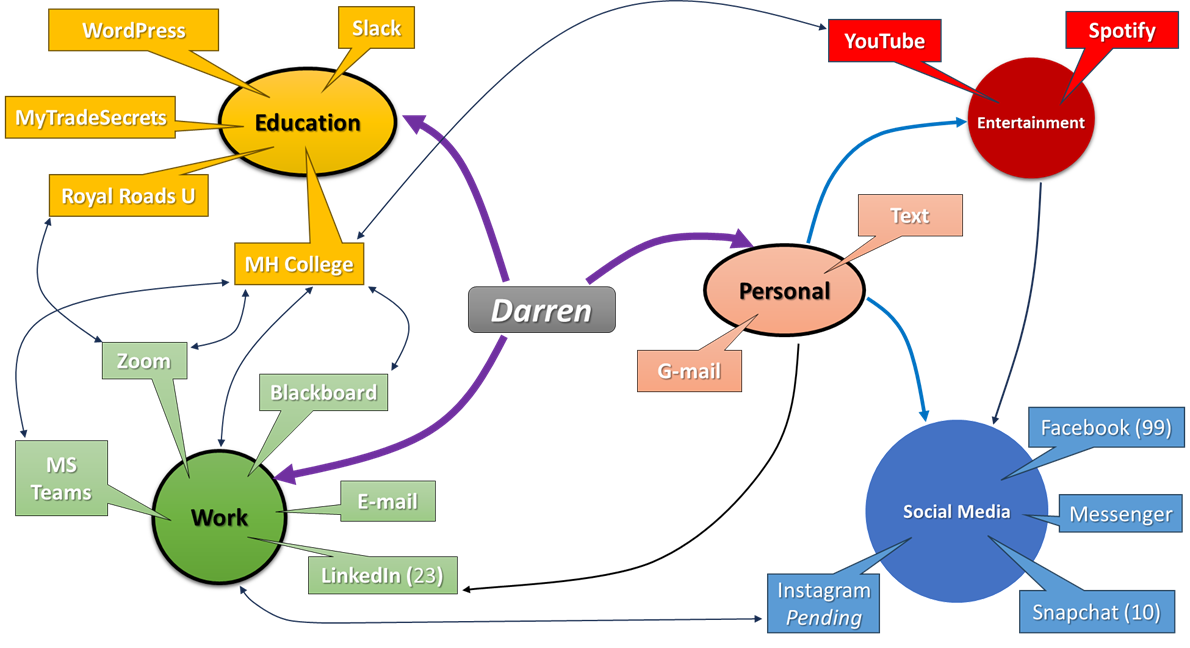
Mapping out our own networks is an enlightening project. It allows us to see ourselves amidst our connections, providing a visual representation of how our information flows within and between our social circles. This project has been particularly insightful, helping me to better understand the dynamics of my personal and professional interactions.
My exploration revealed distinct separations and connections within my networks. My Personal network, illustrated in pink, includes a smaller Entertainment network shown in red, and my Social Media network in blue. These are largely isolated from my Work and Education networks. However, there’s a notable bi-directional link between my Work network and YouTube. This platform serves dual purposes: it houses my instructional video library for work in my Channel and is also my go-to for other instructional and personal interest videos. Previously, this was the sole link between my professional and personal life until I recently rebooted my LinkedIn profile. Soon, I’ll be adding a new Instagram account as I outlined in my Digital Identity Development Plan (DIDP), which I anticipate will bridge these two worlds more significantly.
The map also highlights potential areas of overlap that could benefit from streamlined software usage between Work and Education sectors. These overlaps might also reveal opportunities for career advancement or research areas worth exploring.
Mapping our networks not only clarifies our current connections but also directs us towards potential improvements and expansions in our social and professional lives.
A final addition here,… just because it made me laugh.
As I continue to play with graphic generation and AI, this was what came up while blending Old and New Networking with Tools that are forever Evolutionary. I did not not tell it to use a handsome bald guy. lol
I also love how many phone cords there are, and where they all go…?… 😉
Image by ChatGPT

Good thoughts, Darren. I agree that this mapping exercise is a great way to take a systematic look at how our various roles intersect (or not) in online spaces. Coming to such understanding can help us to be intentional in our next steps in developing our DIDP.
The quote you shared in this post was of interest to me.
“Technology is best when it brings people together”
I’ve been thinking and reading a bit this week about the paradox that seems to exist in the world right now. We are more connected and in tighter communication than ever before in human history–and yet, we are seeing a rather shocking divergence in values and decrease in tolerance. Is technology bringing us together or pushing us apart? What role can we play in creating positive outcomes as information technology continues to expand rapidly?
I came across the article linked below and found it a useful jumping off point for thinking more deeply on this topic and would love to hear others thoughts on this challenge.
Globalization was supposed to align the world’s values. Instead, they’re diverging. (2024, May 2). Big Think. https://bigthink.com/the-present/worlds-values-diverging/
Thank you, Russ.
I resonate with the quote, in that technology truly excels and is therefore at It’s Best when used to connect people to knowledge and learning. However, I also feel it’s frequently utilized for less admirable purposes, such as creating divisions and market groups, solely to generate sales with no further concern for future secondary outcomes, after the sale is over. I wonder if one such secondary outcome , on a much larger scale, could be tied to the cultural shift in Westernized society itself. The article you mention seems to confirm this cultural value shift over time and I agree with you, as it seems to me as well, that there is a general lack of tolerance, as you mention.
This brings to mind another phrase I heard many times growing up, to just “Agree to Disagree”, as my Grandmother would say when my older brother and I would fight. The Origin of which I looked up the source of; the original quote being:
“After all, those who wish to live in peace must agree to disagree on many things with their fellow laborers and not let small differences divide them.”
Whitefield, 1750
I’d say, It has definitely stood the test of time…
and will for some time yet, I’d suppose.