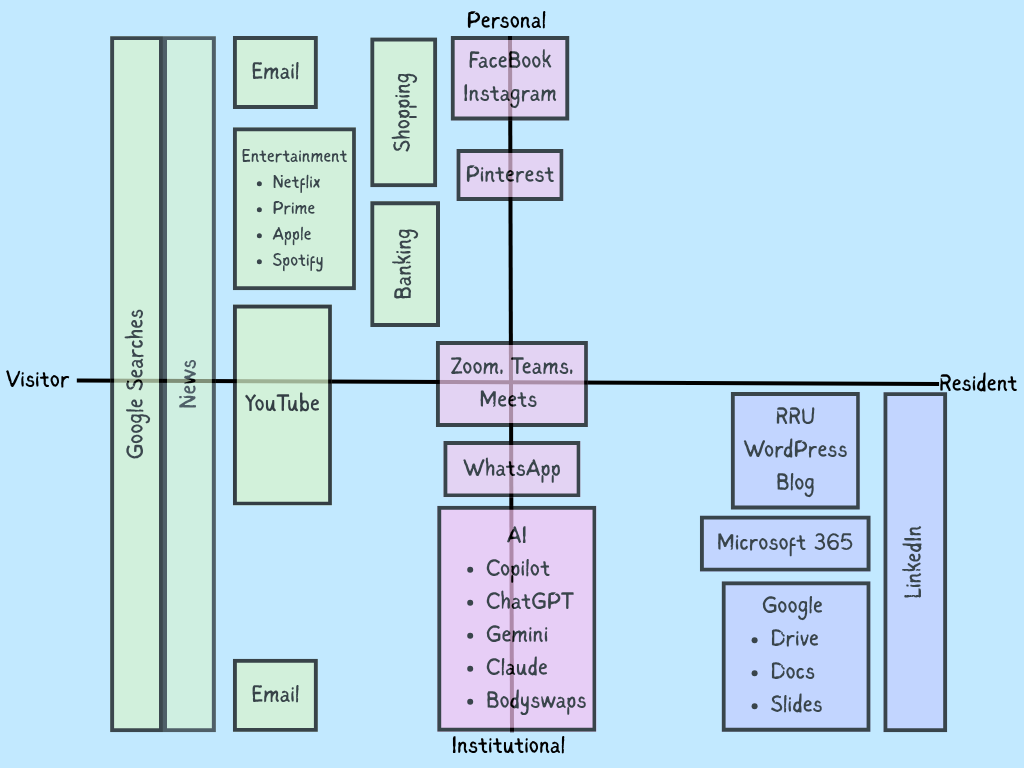
Using White and Le Cornu’s Visitor-Resident typology to map my digital practices provided me with a useful framework for understanding how I engage with different tools and online spaces. Their model positions digital activity along a continuum: visitor use is typically task-focused, temporary, and largely invisible, while resident use involves a more sustained presence where participation contributes to the formation of a digital identity and ongoing interaction with others (White & Le Cornu, 2011). While this distinction between visitor and resident initially appears clear, applying it to my own practices revealed how fluid and interconnected these categories can be in everyday use.
On the visitor-personal side, I primarily use platforms such as Google, news websites, and YouTube with a defined purpose in mind: to find information and then move on, leaving little to no visible trace of my activity. Similarly, my use of streaming services such as Netflix, Prime, Apple, and Spotify reflects a more consumptive mode of engagement, where content is selected and accessed without sustained interaction.
However, as I move across my map, the boundaries between visitor and resident begin to blur. My engagement with social media platforms such as Facebook, Instagram, Pinterest and LinkedIn demonstrate more resident-oriented practices. While much of my activity involves passively scrolling through and consuming content created by others, I also intermittently contribute through posting, liking, sharing, and commenting. These actions, though limited, still represent an ongoing and recognizable presence within these digital spaces. Furthermore, the distinction between visitor and resident becomes even less clear when I consider the data traces generated through my everyday use. My seemingly passive interactions with tools such as Google, YouTube, and social media platforms still contribute to algorithmic profiling and the creation of persistent digital footprints, regardless of intent or visibility (Boyd, 2011)
Cromier (2018) suggests the use of alternative tensions pairs to support a more nuanced understanding of how and when we use various tools and online spaces. Applying this concept supported a deeper understanding of my digital practices. It highlighted the importance of viewing my digital practice as an ongoing negotiation rather than an effort to sort information into fixed categories. Through Cromier’s lens, I can see that my engagement with various tools and online spaces is shaped by tensions between visibility and privacy, consumption and creation, and efficiency and connection. Rather than shifting neatly between visitor and resident modes, my practices are better understood as being fluid and relational, shaped by changing contexts and competing priorities.
References
Boyd, D. (2011). Social Network Sites as Networked Publics: Affordances, Dynamics, and Implications. In Z. Papacharissi (Ed.), A Networked Self (pp. 39–58). New York, NY: Rutledge. https://doi.org/10.4324/9780203876527-8
Cromier, D. (2018, March 25). Digital Practices Mapping – Intro activity for digital literacies course – Dave’s Educational Blog. https://davecormier.com/edblog/2018/03/31/digital-practices-mapping-intro-activity-for-digital-literacies-course/
White, D. S., & Le Cornu, A. (2011). Visitors and residents: A new typology for online engagement. First Monday, 16(9). https://doi.org/10.5210/fm.v16i9.3171
3 May 2026 at 9:55 am
Hi Celine,
I really liked how you described the fluidity between visitor and resident roles. It made the typology feel more real in practice. Your point about passive use still contributing to a digital footprint really stood out too.
I also thought your connection to Cormier’s idea of alternative tension pairs added a lot of depth. The balance between things like visibility vs. privacy and consumption vs. creation really helps explain why our online behavior does not fit neatly into one category.
Overall, your reflection shows that digital engagement is more of a spectrum than a fixed label.
I am curious, do you see yourself wanting to shift more toward creation, or are you comfortable staying in that balance?
Kelly