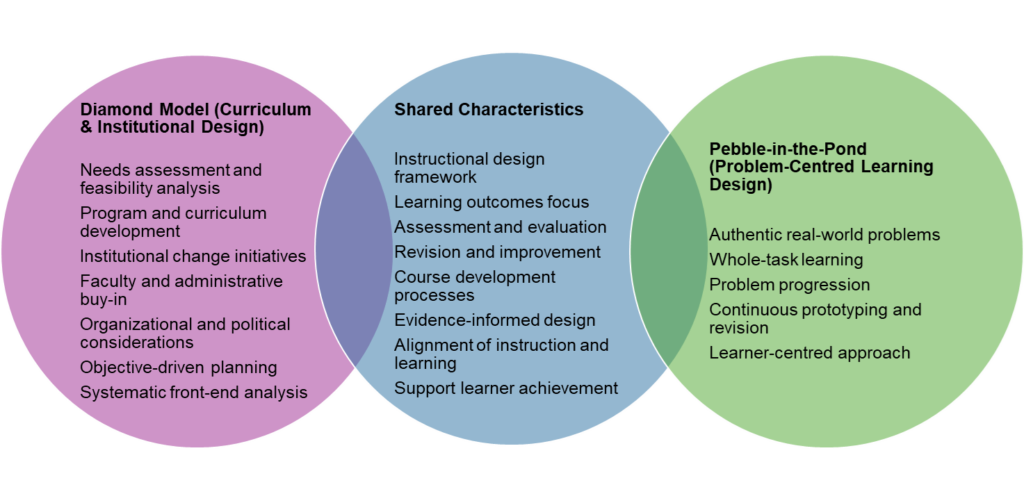
Analysis
There are many similarities between the Diamond Model and the Pebble-in-the-Pond Model. Both models prioritize meaningful performance outcomes grounded in learner needs and authentic contexts. Diamond (2008) argues that curriculum development should begin with an analysis of learner needs, societal demands, and educational goals before selecting instructional strategies, while Merrill (2002) emphasizes that instruction should be organized around authentic, real-world problems. Both models reject purely abstract or content-first approaches and instead focus on meaningful performance outcomes.
In addition, both models employ a systematic design process that guides educators through curriculum development in a structured sequence. Diamond’s model organizes development into two major phases: project selection and design, followed by production, implementation, and evaluation (Diamond, 2008). Similarly, Merrill’s (2002) Pebble-in-the-Pond model follows a progression that begins with identifying a real-world problem and expands outward through demonstrations, applications, and instructional components. Although the specific stages differ, both models provide a logical framework for moving from broad instructional goals to detailed learning experiences.
Another significant similarity is the close alignment between assessment and instruction. Diamond (2008) explicitly incorporates the design of evaluation instruments alongside instructional planning, ensuring that assessment measures the intended learning outcomes. Likewise, Merrill (2002) maintains that assessments should be derived directly from the real-world tasks learners are expected to perform. Consequently, both models integrate assessment into the design process rather than treating it as an afterthought.
Despite these similarities, the models differ substantially in their implementation. Diamond’s model reflects a structured instructional systems design approach emphasizing planning, resource allocation, implementation, and evaluation (Diamond, 2008). In contrast, Merrill’s model is problem-centred and iterative supporting ongoing refinement through authentic tasks (Merrill, 2002). As a higher education educator, I view these approaches as complementary. Diamond supports curriculum and program development requiring institutional alignment, while Pebble-in-the-Pond strengthens course-level design through authentic experiences. This comparison reinforced the importance of balancing strategic curriculum planning with learner-centred design that prepares students for professional practice.
References
Diamond, R. M. (2008). Designing and assessing courses and curricula. https://studio.courseware.epfl.ch/assets/courseware/v1/4cb0d5986a88fef34855fb2eb1282aaf/asset-v1:EPFL+DEMO+2020+type@asset+block/epdf.pub_designing-and-assessing-courses-and-curricula-a-pr.pdf
Diamond, R. M. (1989, November 30). Designing and improving courses and curricula in higher education: A systematic approach. ERIC. https://eric.ed.gov/?id=ED304056
Merrill, M.D. (2002), A pebble-in-the-pond model for instructional design. Perf. Improv., 41: pp. 41 – 46. https://doi.org/10.1002/pfi.4140410709
Merrill, M. D. (2002, September). First principles of instruction – educational technology research and development. SpringerLink. https://link.springer.com/article/10.1007/BF02505024