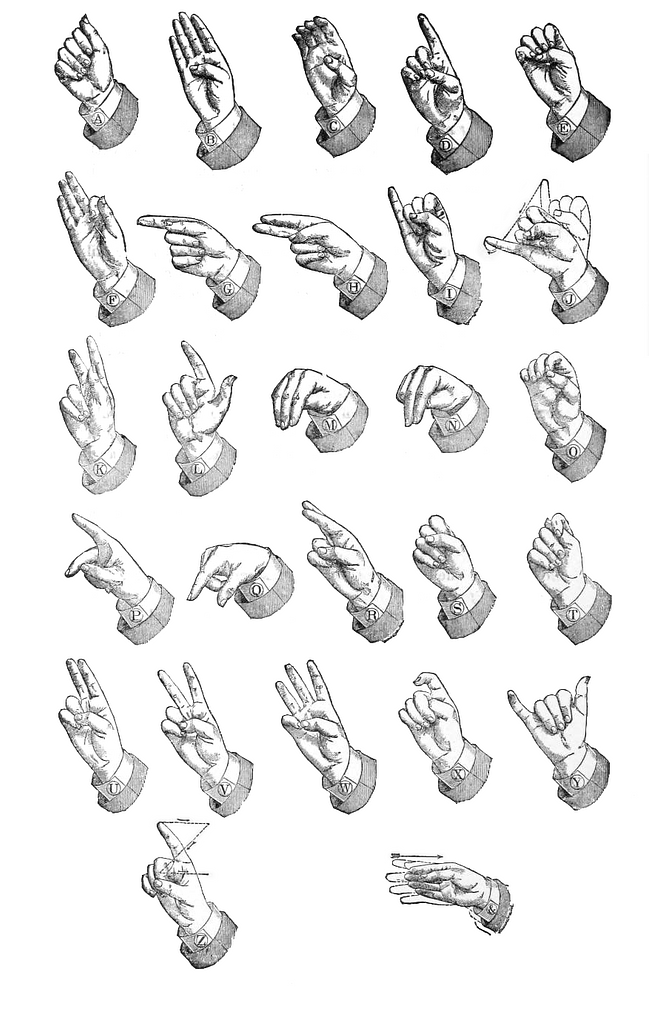
Melissa Malzkuhn (n.d.) describes herself as “a Deaf creative and product leader, narrative strategist, and education innovator…[who] builds ecosystems” (para. 1). She is a storyteller through and through and through as a third-generation Deaf person; she was born into a family where her parents and grandparents are also Deaf. In her RIT | NTID ASL Lecture within the first three minutes Melissa introduces herself and shows a short clip of her Deaf grandfather’s literary competition entry, an American Sign Language (ASL) translation of Lewis Carroll’s “Jabberwocky”, which is amusing as Melissa herself points out. It’s amusing because written English does not translate easily to ASL so his creative and exuberant personality shines through his performance as he uses his body to describe the weird and wonderous characters in Carroll’s poem.
I know first-hand (pun intended!) how it’s challenging to translate spoken, or written, English into ASL because I am a Child of Deaf Adults (CODA) and have been translating my whole life…navigating life between Hearing and Deaf cultures. Deaf culture is steeped in storytelling, and technology has the capacity to strengthen or weaken Deaf connection, community, and culture.
World Federation of the Deaf (WFD, n.d.) shared data gathered from the World Health Organization that there is approximately “70 million deaf people belong to signing deaf communities” (para. 1), but like many marginalized languages, it takes effort and work to ensure the lineage of the language and culture continues.
Melissa works at Gallaudet University, a unique bilingual institute where it holds historical, contemporary, and enduring significance. She is the founder and director of Gallaudet’s Motion Light Lab and co-director of Gallaudet’s Visual Language and Visual Learning (VL2) center that holds important research resources for parents and educators alike. Through these two, and many more initiatives, she shines a light on Deaf culture and education.
More of Melissa Malzkuhn’s work:
Computers & Education: X Reality 4 (2024) 100059
References
Malzkuhn, M. (n.d.). Melissa Malzkuhn. https://mezmalz.com/
World Federation of the Deaf. (n.d.). Frequently asked questions. https://wfdeaf.org/contact/faqs/
Hi Tara. Thanks for sharing Melissa Malzkuhn’s work. I noticed your post is showing as “Uncategorized,” so you may want to select LRNT523 so it appears in the Student Posts feed. This statement particularly resonated with me: “Deaf culture is steeped in storytelling, and technology has the capacity to strengthen or weaken Deaf connection, community, and culture.” It reminded me of why I selected Maha Bali for my own post. Both Malzkuhn and Bali seem to challenge us to think beyond what technology can do and instead ask how technology can serve humanity, foster inclusion, and create greater equity. I appreciate how Melissa’s work demonstrates that educational technology should not only increase access but also support the preservation and flourishing of culture, community, and human connection. Thank you for introducing me to her work.
Thank you for reading and commenting on my post Zubeida! I hope my post is fixed now from “Uncategorized” to “LRNT523”. Can you confirm please. I’m looking forward to reading about Maha Bali…
Hi again Zubeida. Yes, Bali and Malzkuhn both have a values based leadership and drive to move themselves and others forward in responsible and ethical ways. This is my 5th MAIS course (Writing, Leadership, Project Planning, Research, and now Ed Tech) and in each and every course the foundation is relationships and connections to other…the other stuff just falls apart without the collective power of people! I’m happy to learn about all these amazing people in the field of ed tech.
Hi Tara!
Your interest is so timely, as my feed offers me alot of ASL content, specifically interactions between parents and children learning ASL together. I am transfixed by it, both for its animated delivery and by the way it sharpens and expands how the spoken word is communicated. What I’ve noticed in these videos is also an emphasis on eye contact, something I find can be so easily lost when we use screens and allow our ears to do the work and tone to do the heavy lifting. ASL is so action-oriented , which seems to breathe new qualities into communication and, in turn, create different ways of understanding and experiencing meaning.
Your post also made me think about the relationship between technology and the preservation of embodied forms of knowledge. I wonder whether technologies designed around predominantly written or spoken communication can inadvertently diminish some of what makes ASL culturally and linguistically rich. It seems like technologies designed specifically for visual language can do the opposite: strengthen connection, storytelling, and cultural continuity. (I come from an arts background so have made my share of experimental but effective works!)
I have also recently done some communications work for Wavefront Centre for Communication Accessibility in Vancouver. From my novice understanding, much of their focus is on using technology and other forms of communication access to remove barriers between Deaf, DeafBlind, hard of hearing, and hearing communities. Your post has made me curious to look more closely at the distinction between technology that simply provides access to the hearing world and technology that actually supports and strengthens Deaf language and culture.
PS the Jabberowocky is my favourite poem and one I had to memorize for grade 10 English. A real party trick!
Best,
Kirsten
Thank you for reading my post Kirsten. Yes, eye contact is very important in the Deaf community, and communication is a bit of a dance all full of body and emotion. I recall friends coming over and thinking my parents were angry and I had to explain to them that they were just asking us how our day went. Deaf talking/signing is high def 2.0! My aunt is DeafBlind and so it’s really up close and intimate when communicating with her, different than when using ASL with Deaf people. I just recently submitted a research proposal using oral history methodology and in this digital age there are many more stories to help curate and share. Deaf culture and technology are entwined for sure. Jabberwocky by memory? THAT is impressive!