
Hello everyone! It’s wonderful to reconnect with many of you from our last class, as well as some familiar faces from even earlier classes. As we embark on this new course together, I wanted to share a different perspective on who I am—introducing myself not just through my title, but through the evolving lens of my design identity.
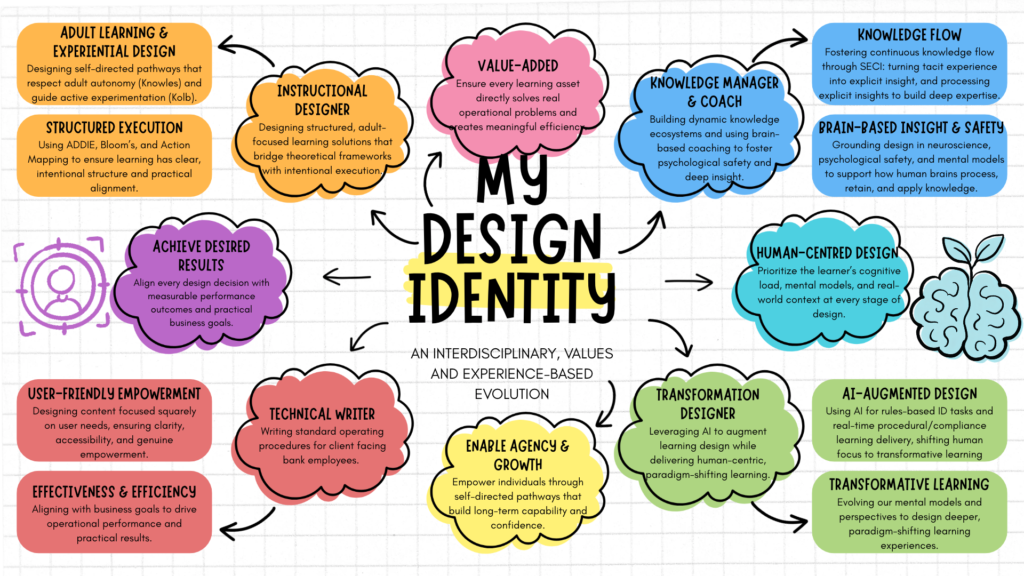
My design identity is an interdisciplinary evolution rooted in four core principles that anchor everything I build:
- Human-Centred Design: Prioritizing cognitive load, mental models, and human needs at every stage.
- Enable Agency & Growth: Empowering learners through self-directed pathways that build confidence.
- Value-Added: Ensuring every solution directly solves operational problems and creates meaningful efficiency.
- Achieve Desired Results: Aligning every design decision with measurable performance and business outcomes.
Here is how my journey and integrated toolkit have evolved across my roles:
1. Technical Writer Roots: User-Friendly Empowerment
My foundation began in technical writing, where my focus was building standard operating procedures and clear documentation. My goal was twofold: driving user-friendly empowerment by creating clear, accessible content tailored to user needs , while simultaneously supporting effectiveness and efficiency to help the business meet operational goals which I think is based on design thinking.
2. Instructional Designer: Structured Execution & Adult Learning
As an Instructional Designer, I expanded into structured execution—leveraging ADDIE, Bloom’s Taxonomy (McLeod, 2024), and Action Mapping (Moore, 2013) to build intentional, clear learning pathways. Grounded in andragogy and experiential design (Knowles, 1984; Kolb, 1984), I focused on respecting adult learner autonomy while guiding active experimentation, reflection, and practical application.
3. Knowledge Manager & Coach: Knowledge Flow & Brain-Based Insight
Over time, my professional scope expanded into Knowledge Management and Brain-Based Coaching (NeuroLeadership Institute, n.d.).
- Through Knowledge Management, my lens shifted to knowledge flow via the SECI model (Nonaka & Takeuchi, 1995)—fostering continuous organizational learning by turning tacit experience into explicit insight, and processing explicit insights to build deep expertise.
- Through Coaching, I grounded my practice in brain-based insight and psychological safety, creating the optimal cognitive conditions for human brains to process, retain, and apply wisdom effectively.
4. The Horizon: Becoming a Transformation Designer
Today, I view my destination as a Transformation Designer—someone who uses a technology-enabled human design approach to cultivate deep, paradigm-shifting learning.
- AI-Augmented Co-Creation: I leverage AI and modern technologies to handle rules-based ID tasks and deliver procedural, compliance, and software information in real-time at the moment of need.
- Enabling Human Transformative Learning: By using technology to shoulder routine content delivery, I free up human energy and cognitive capacity to focus on constructivist co-creation, critical thinking, and transformative personal and organizational growth.
Closing: My Integrated Toolkit
My design identity isn’t about leaving my past roles behind—it is about unifying them into an integrated toolkit. Depending on what a project requires, I toggle seamlessly between technical writing clarity, instructional design structure, knowledge management flow, and brain-based coaching.
My North Star remains constant: designing with empathy, evolving through insight, and delivering real value and results. I am eager to explore new instructional design models in this course to continue refining how to create transformative, high-impact learning experiences alongside all of you!
(Below, I’ve shared my visual mind-map outlining this evolution!)
References
Knowles, M. S. (1984). Andragogy in action: Applying modern principles of adult education. Jossey-Bass. https://www.semanticscholar.org/paper/Andragogy-in-action-Knowles/eb5ff8103f6148b90d5ec88d59070fe377c60465
Kolb, D. A. (1984). Experiential learning: Experience as the source of learning and development. Prentice-Hall. https://www.researchgate.net/publication/235701029_Experiential_Learning_Experience_As_The_Source_Of_Learning_And_Development
Mager, R. F. (1997). Preparing instructional objectives: A critical tool in the development of effective instruction (3rd ed.). Center for Effective Performance.
McLeod, S. (2024, January 11). Bloom’s taxonomy of educational objectives. Simply Psychology. https://www.simplypsychology.org/blooms-taxonomy.html
Moore, C. (2013). Action mapping with Mager: Get results with training [Blog post]. Cathy Moore Learning Solutions. https://blog.cathy-moore.com/
Nonaka, I., & Takeuchi, H. (1995). The knowledge-creating company: How Japanese companies create the dynamics of innovation. Oxford University Press. DOI: 10.1016/0024-6301(96)81509-3
NeuroLeadership Institute. (n.d.). Brain-based coaching certificate. NLI Individual Solutions. Retrieved November 8, 2026, from https://neuroleadershipinstitute.org/solutions-for-organisations/coaching/ and https://individuals.neuroleadership.com/
AI Disclosure Statement
I used AI as a helpful partner to design and edit this blog post and mind-map. The AI helped me organize my writing, shorten the text to fit neatly into my visual layout, and connect my past experience in teaching, knowledge sharing, and coaching to explain my design identity. I wrote, directed, and chose every personal story, insight, and final direction myself.