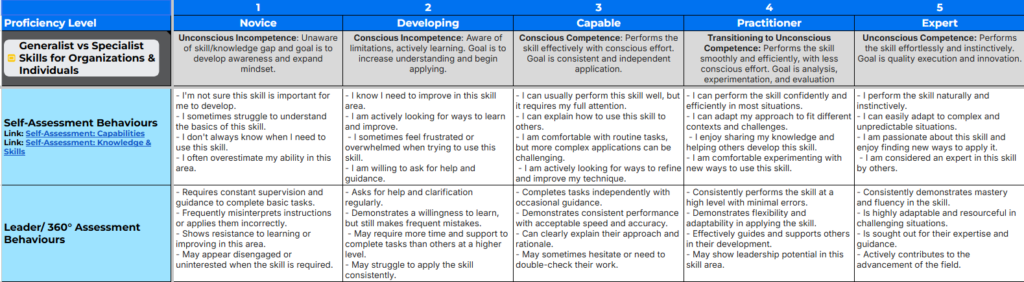
I compared Action Mapping with 4C/ID using a Learner Journey infographic, which clearly illustrates how each model structures learning over time toward competence, professional judgment, and expertise. Both models aim to improve workplace performance through authentic application rather than passive knowledge acquisition (Moore, 2017; Van Merriënboer & Kirschner, 2018). Critical conversations provide an ideal comparative context, as both models require observable communication behaviors and sound judgment.
Additionally, both frameworks deliver information at the moment of need, though their mechanisms differ.
- Action Mapping trains learners to recall supportive information only when reality demands it, while referencing procedural information from authentic job aids (Moore, 2017).
- Conversely, 4C/ID systematically regulates the timing and volume of both supportive and procedural information to manage cognitive load during complex learning (Costa et al., 2022; Van Merriënboer & Kirschner, 2018).
Key distinctions also emerge regarding learner proficiency.
- Action Mapping starts by targeting specific behaviors and performance gaps, making it ideal for learners building awareness and foundational skills through focused practice (Moore, 2017).
- In contrast, 4C/ID cultivates integrated capability through whole-task progression, supporting advanced learners as they coordinate knowledge, skills, and judgment across increasingly complex scenarios (Costa et al., 2022; Van Merriënboer & Kirschner, 2018).
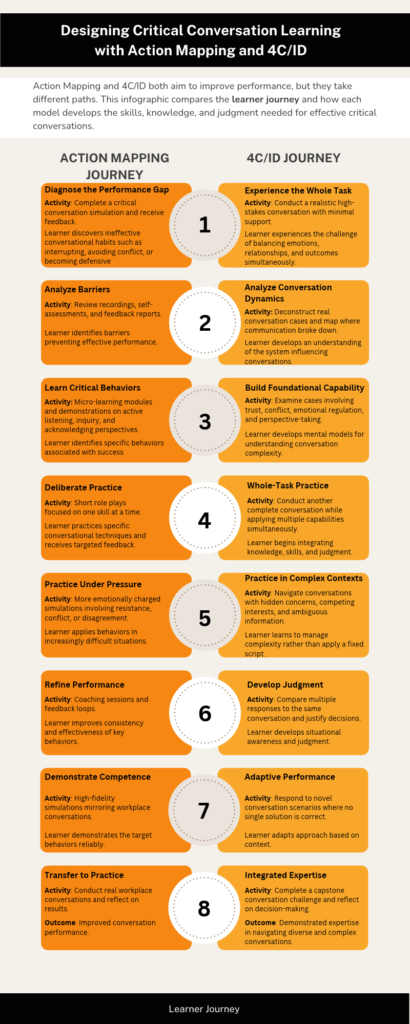
Rather than competing, these models serve complementary stages of development. Having designed a team proficiency framework to align expectations on what “good looks like,” I readily recognized this distinction. This insight reinforces assessing learner proficiency before selecting a design model—a lens I apply both to training design and to leadership decisions regarding performance and annual compensation. Finally, while not central to this comparison, the analysis reaffirmed that meaningful growth requires pairing behavioral practice with critical reflection (Cranton, 2002).
References
Costa, J. M., Miranda, G. L., & Melo, M. (2022). Four-component instructional design (4C/ID) model: A meta-analysis on use and effect. Learning Environments Research, 25(2), 445-463. https://doi.org/10.1007/s10984-021-09373-y
Cranton, P. A. (2002). Teaching for Transformation. New Directions for Adult and Continuing Education, 63–71. https://doi.org/10.1002/ace.50
Moore, C. (2017). Map it: The hands-on guide to strategic training design. Association for Talent Development.
van Merriënboer, J.J.G., Kirschner, P.A., & Frèrejean, J. (2024). Ten Steps to Complex Learning: A Systematic Approach to Four-Component Instructional Design (4th ed.). Routledge. https://doi.org/10.4324/9781003322481
My Proficiency Model
I developed this proficiency model for my team and I to have an equal standard to assess their proficiency, which not only helps with instructional design activities, but also with development conversations, performance assessments and annual compensation activities.