

History
From a free web design resource created in 1995 to a multibillion-dollar global online learning platform acquired by LinkedIn (Porter, 2015), Lynda.com’s impact on online learning is widespread and its adoption can be seen in government, academia, and business sectors (Lynda.com, 2019).

Team Experience
With a seemingly convenient and easy to use form of technology, our team was eager to experience it for ourselves. We explored a course on Lynda.com titled Editing Images Using Snapseed. Our diverse backgrounds and experiences did not hinder our learning as we all managed to “change” an image and create something new without interacting with a human being. After our experience and reflections, we were curious about our own learning and how Lynda.com could be used in our unique contexts. This prompted further questions.
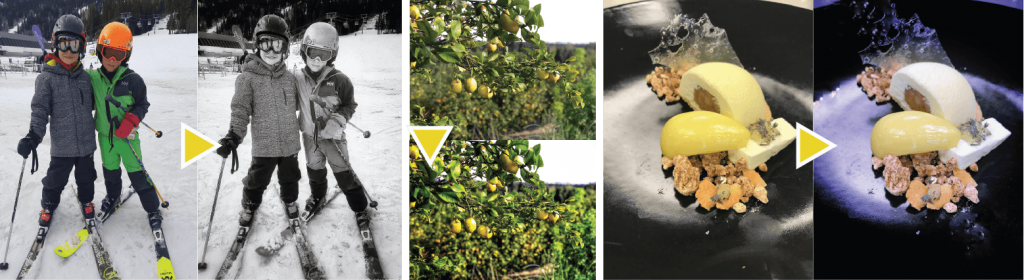
Q1 – What is the process of creating the course and who is involved?
If these videos can be used to support instructors and student learning, we became curious about how the videos are created and who the instructors are.
Authors
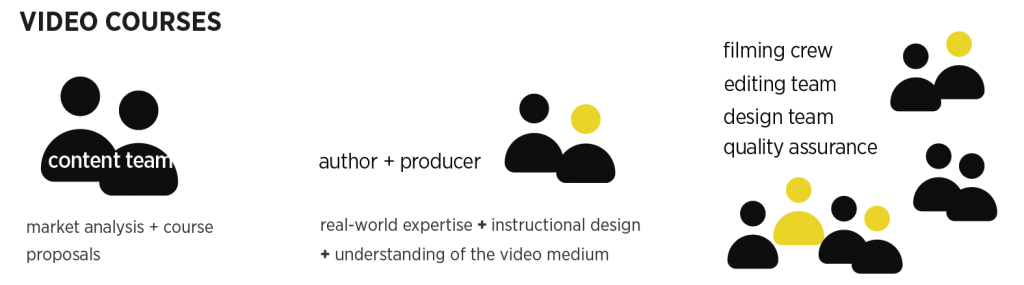
 Lynda.com invests in quality authors to build their library. They have several in-house authors and also contract with instructors selected on status in the community, previous work, completion of a test or “proof of work” (Linkedin Learning, 2013). Instructors are also vetted for their subject matter skills, and their ability to communicate through video.
Production

We learned there is a great deal of work that goes into creating these videos. Lynda.com is kept active producing a massive amount of courses that use a wide range of ed-tech. They also continually update content or retire videos.
Q2 – What are the advantages of using Lynda.com for learning?
After our excitement of learning a new tool through this platform, we were curious about how we could use Lynda.com in our individual contexts. Would it benefit individual learning styles and needs; how would it support instructors?
Advantages
Features/Personalized Learning

Lynda.com offers features that help personalize learning styles. Our team took advantage of the manipulation of narration to speed up and slow down the lesson. In addition, the videos offer closed captions, transcripts and a note-taking function.
These Lynda.com features have the ability to make learning more convenient. The content is broken down into units which align with the tenets of cognitive learning theory. Cognitivists stress that “effectiveness and efficiency of knowledge transfer” can occur through “simplification and standardization” (Ertmer & Newby, 2013, p. 52). These units can be played, slowed down, and re-watched depending on the needs of the learner.
Flipped Classroom
 Through the use of Lynda.com videos, instructors and instructional designers can spend more time creating in-class opportunities for collaborative learning that build off of student’s viewing of videos outside of class time (Tucker, 2012). These videos have the potential to support the instruction of the material by providing a lecture of content, for example, that the students view beforehand. The class time is then used to expand and engage with the new knowledge.
Q3 – What are the concerns of using Lynda.com for learning?
Although it is easy to get swept away by the convenience of Lynda.com videos, our team recognized there are some limitations that may have unintended impacts on individuals and organizations.
Limitations
Isolated Learning
 Through our learning event, we discovered there were no means to test out our newly acquired Snapseed skills with each other. We were reliant on our novice ability to assess if we had improved or mastered the skill.
This raised concerns about the pedagogical effectiveness of using curated videos as a primary instruction. The lack of collaborative learning hinders the ability for learning to take place as learners need to be able to develop their own understanding through social negotiation (Ertmer & Newby, 2013).
Lack of Assessment and Feedback
 A significant limitation to Lynda.com is the lack of assessment or feedback, particularly if this learning experience is not part of a larger learning environment, such as a flipped classroom. Merrill (2008) posits that learning is promoted when students receive an opportunity for practice with coaching and corrective feedback. Although some Lynda.com courses contain exercises and assessment, they do not provide individualized feedback. Our team managed to change an image, but did we really learn a new skill, or was this a false sense of learning? A follow-up session or standard to be assessed against would have helped solidify our learning.
Socio-economic Considerations
 Since Lynda.com’s acquisition of LinkedIn, they now have increased access to Lynda.com user data (Komljenovic, 2018). Data collected is used to recommend further products and training for LinkedIn Learning users and for the development of employability trends and labour reports which are sold to industry (Komljenovic, 2018).
With Lynda.com’s integration into LinkedIn Learning, courses are being tailored to “all user profiles” highlighting “in-demand skills” for career growth (Komljenovic, 2018, p. 10). As a result, Lynda.com has advanced LinkedIn Learning’s positioning as an online learning platform.
This raises the question as to the long-term impact LinkedIn Learning will have on the education sector. Watters (2017) who rallied against the platforming of education warns of the unimagined consequences to our learning, teaching, and democracy that can result from the monopolization of digital learning platforms.
Future Directions
 Lynda.com’s move to LinkedIn Learning has contributed to its positioning in the training and professional development market (Komljenovic, 2018), and expanded its reach globally. LinkedIn Learning offers 12,000 courses and publishes over 40+ new courses weekly in multiple languages (Bersin, 2018). All of this growth opens up new possibilities for Lynda.com’s evolution as LinkedIn Learning.
Illustrations are created by the authors.
References
Bersin, J. (2018, August 1). LinkedIn Learning: A bold success with more growth to come. Retrieved from https://www.linkedin.com/pulse/linkedin-learning-bold-success-more-growth-come-josh-bersin/
Ertmer, P., & Newby, T. (2013). Behaviorism, cognitivism, constructivism: Comparing critical features from an instructional design perspective. Performance Improvement Quarterly, 26(2), 43-71. https://doi.org/10.1002/piq.21143
Komljenovic, J. (2018). Linkedin, platforming labour, and the new employability mandate for universities. Globalisation, Societies and Education, 1–16. https://doi.org/10.1080/14767724.2018.1500275
LinkedIn Learning. (2013). The lynda.com story | How we do it [YouTube video]. Retrieved from https://www.youtube.com/watch?v=zv6rhybZZMc
Lynda.com. (2019). All Courses | lynda.com. Retrieved from https://www.lynda.com/allcourses
Merrill, M. D. (2008). Reflections on a four decade search for effective, efficient and engaging instruction. In M. W. Allen (Ed.), Michael Allen’s 2008 e-Learning Annual 1, 141-167: Wiley Pfieffer
Porter, J. (2015, April 27). From near failure to a $1.5 billion sale: The epic story of Lynda.com. Retrieved from https://www.fastcompany.com/3045404/from-near-failure-to-a-15-billion-sale-the-epic-story-of-lyndacom
Tucker, B. (2012). The flipped classroom. Education Next, 82–83. Retrieved from https://www.educationnext.org/the-flipped-classroom/
Watters, A. (2017, April 3). The top ed-tech trends (aren’t ‘tech’) [Blog post]. Retrieved from http://hackeducation.com/2017/04/03/trends
Hello Team Lynda (LinkedIn Learning).
Great presentation and thank you once again for the rich content and immersive discussion during your live presentation a couple weeks back.
My question to the team is I’ve experienced as an end-user first hand completing learning paths, courses and lessons and was easily able to ‘fast forward’ through many lessons (videos) and get to the quiz and complete the final exam and get a ‘certificate’ of completion. Even though the course itself may have been more than an hour or so, I could fast-forward and get it done within 15 minutes.
Now, the reasons are 2 fold: I’m testing this a a potential platform for our organization to implement, as well as I knew some of the content from experience and education that I just wanted to jump to the exam and not ‘waste’ time.
With the later point, as an adult learner, I don’t want to be ‘forced’ to complete a bunch of courses, as well as waste valuable time, when I know the content. Therefore completing the exam and passing with 100% proved I knew the content. I liked the instant gratification of the certificate and the post on my LinkedIn Profile as well.
I have some thoughts as an educator as to how this may look and what I’ll want to reinforce and do as we possibly implement this platform as an learning solution for our organization, but curious to hear your thoughts on these points.
Dorothy
How I use the tutorials (Beata):
– the learners need to watch the video tutorials or the full course (rare), understand them, potentially apply them, but definitely, have questions about the learned topic.
– when they come back to the classroom and work in teams, they can bring up the questions/issues, and we can solve them together, apply the learned elements with the supervision of the instructor.
– In the classroom, the assessment itself happens when they come back to class and work on the projects and apply the learning or ask directions while they create websites. And those websites will be marked and get feedback.
– The end goal is learning itself.
– Some of the students place the “Certificates” on their LinkedIn profile as showcasing them can have value in my field (web development). Not because it guarantees knowledge, but it shows passion or potential interest in particular topics. In web development, the “paper,” the certificate or degree is less relevant than a good portfolio where one showcases the skills and knowledge. If I see several completed courses and corresponding good portfolio, I value the person’s interest, passion, and investment in their knowledge. So maybe the value of those credentials is more for signalling/emphasizing an interest or passion.
I consider LinkedIn Learning (formerly Lynda.com) video library tutorials for mainly two directions:
– Independent learning: One has access to the service and based on personal learning plan or learning pathways explores different topics.
– Additional resource in a training or program: The access is provided, and the video tutorials are used as a secondary resource in a training or program. The core curriculum is custom developed, but as an additional resource, the video tutorials are curated, used and recommended or required.
To answer your question, I have my personal answer:
– I value when I have the choice (pro-choice…hahaha): I can go through the material if I want to, or jump and challenge the test…
On the other hand, in using the video tutorials and full courses, I would highlight a few tutorials what I would suggest for everyone to watch, even if one feels they know the material and wish to jump to the test right away.
I am very interested in your thoughts about the implementation of LinkedIn Learning in your environment and would love to hear about them if you have some time.
Coffee or tea or some chocolate in Downtown YVR soon, Dorothy?
Thanks Beata,
Appreciate your response back. I do agree with much of what you said and equally have a perspective that LinkedIn Learning would be seen as supplementary or additional learning to support the program that has been designed.
For instance I am currently developing a Frontline Leadership Program at my organization and one of the courses is around interviewing potential candidates. Having a new member join your team is not only the responsiblity of our talent acquistion team, but held jointly with our managers who are trying to fill a position within their department. What we have noticed is there a is a skill gap in how our leaders interview.
There is this great course within LinkedIn Learning on recruiting and onboarding. When I watched some of the video lessons, there was great demonstrations of what a bad interview looks like and a good interview.
They also used a model and interviewing technique we use within our talent acquisition called STAR. It is around asking open ended behavioral questions.
So, as part of my course, I will be using this particular video as either pre-work or during class and having a discussion with our frontline leaders before they actually perform and demonstrate through a role play scenario.
Thanks again.
Dorothy
PS. I’ve IM you to connect downtown soon.