
A Visual of My Networks
MALAT students were asked to create a visual of one of our networks, with the suggestion to try Socilab.com as a tool to map out our LinkedIn connections. Being very new to LinkedIn, my tiny network looked like this:

Although it is small, this visual representation provided me with some insight and curiosity. I noticed that each person in my network had a completely different career, and they weren’t connected to each other. What really struck me was how I had met four out of my five contacts through music, even though only one person is an active, public musician. For example, there is one woman with an HR career who I met because I played in the handbell choir at the church she went to, and there is a psychiatrist I got to know because a bandmate of mine was a social worker in the psych ward with him at the hospital. I became interested in whether this sort of “connected through music” pattern would translate to my largest social network.
I attempted utilizing a plugin to create something like the image above (but larger with way more interconnected nodes) for Facebook. It froze and never worked, so instead I decided to put all my so-called “friends” in lump categories connected to me, simply using good old fashioned counting with tick marks on paper.

I have 409 Facebook friends: 156 in my “music/arts community” category, 96 “non-music/arts, friendly acquaintances,” 65 “childhood friends/schoolmates”, 57 “family,” 16 “work friends,” 8 of “my kid’s friends’ parents,” and only 3 in my “non-music/arts actual friends” group. What surprised me most was how few close friends I have who are not musicians. I know I’m a musician who likes musicians and spends a lot time with musicians, but I did not realize before how much music monopolizes my ties with good friends.
Digital Me – A Plan for Digital Identity and Presence
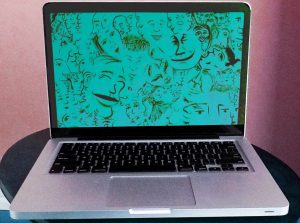
The past week of readings has garnered many ideas about digital identity, literacy and presence. Our assignment is to come up with a plan for the creation of our individual digital personas. A few goals I am aiming for include trying out new platforms, gaining new skills with different tools, and keeping my various media up to date, all while keeping conscious awareness of my intended digital identity.
My primary method for approaching these goals involves simply testing things out. Near the top of my list of social media sites to try out are Twitter and Instagram. One novel skill that I will practice is blogging, which will take place right here on this very page. I also have intention to create and sample a system or schedule to stay on top of my digital presence, and to do so with purposefulness towards my aims.
In my tool belt of skills and knowledge, I have digital literacy plus an eagerness to learn and attempt new things on my side. Gaps I am aware of are a lack of time, a tendency to get distracted online, and possibly spreading my digital presence too wide, thereby diluting it instead of concentrating a more succinct effort in one or two places.
I can attempt to diminish these gaps through time management techniques, setting a timer for how long I want to work to keep me focused and on track, and by deleting any irrelevant digital presence after I find something does not work for me.
I will consider myself successful in these goals once I have tried several tools and platforms and chosen my few preferred paths. Ongoing, my choices are good as long as I can be current in creating and maintaining quality content in alignment with my deliberate digital identity.
Technology Mapping

After watching Just the Mapping by Dave White, I examined my online presence, and placed it into his technology map quadrant.
My understanding of White’s terms “resident” and “visitor” translates as “visible” and “not visible” when doing various activities online. Visitors carry out a specific purpose online without leaving a trail, whereas residents share some part of themselves openly with the worldwide web.
Most of my residencies are related to music. When I first began performing live in the early 2000s, we would poster the town and telephone our friends to promote shows. Now successful turnout is heavily dependent on spreading the word online, especially through social media like Facebook.
Personal and industrial contracting work communications and file sharing make up the bulk of my visiting online presence.
Overall, I’m fairly evenly spread out across my map.
Virtual Symposium is Simply Virtuous
The first week of the class Digital Learning Environments, Networks, Communities was rich with information, delivered to students through Blackboard Collaborate in the form of virtual symposiums. We heard and interacted with a range of speakers from experts and workers in the field of digital learning to students who are near the end of their studies sharing their research projects. Information was given, and a lot of questions were asked and answered.
There were some common themes woven throughout the presentations. Speakers discussed various definitions of “open” and the trends away from the traditional learning model that is solely teacher dictated. There was much talk of the importance of design in e-learning tools, how challenging it can be to make changes within institutions, and aspects of safety and privacy with online presence. There was also dialogue about the hopefulness and expectations for the future through learning and technology. Everyone spoke about which unique path they are currently going down in regards to this broader subject of digital learning.
One tidbit that was surprising to me came from Vivian Forssman from the Centre for Teaching & Educational Technologies at Royal Roads. She pointed out how a lot of e-learning coursework, especially that of MOOCs (Massive Open Online Courses), is centred around high quality embedded video tutorials. Forssman stated that Royal Roads has made a conscious decision not to use that method as a primary means for teaching. I was caught off guard by this since, as a heavy consumer of MOOCs, I fully expected this online Master of Arts in Learning and Technology program to be in that format. She explained that high quality video is costly, and expires too quickly. Instead, faculty and students mainly use various other learning tools and methods, and are also encouraged to create shorter, current, relevant video content to aid in learning. I hadn’t thought of it from the perspective of cost and staying up-to-date in a fast changing industry before, and what she said makes sense to me.
I felt intrigued by Dave Cormier’s example of the 8-year-old who learned how to drive on YouTube and then drove himself to McDonald’s. Cormier attached to that instance a philosophical question of whether we should learn anything, even though we could. I enjoy chewing on that, along with pondering my personal definitions of “free” and “open”, sparked by the dialogue within Cormier’s and several of the other symposium speakers’ presentations.
I agree with Catherine Cronin’s description of “open”, where she insists an individual shouldn’t be categorized as either open or not open. Instead she offers a looser, more fluid and multilevelled classification, where a person has various levels of openness personally and professionally, and operates and posts content from a multifaceted persona based on their many roles in life (eg. parent, worker, activist).
All in all, the virtual symposiums provided many new and fascinating ideas, prompted much discussion, and were a fantastic way to get the LRNT521 ball rolling!
Welcome to your site!

This is your WebSpace powered by WordPress site. It will be the home for your journey through the MALAT program, and you can customize it to meet your needs and reflect your style.
Use these tutorials to learn more about customizing your WordPress site.
Customizing the Appearance of your WebSpace
Creating Content, Pages and Posts
Security and Visibility, Restricting Access to your WebSpace