LRNT 524 Assignment 4 – Learning & Technology: Innovation, Design, & Online Learning Environments

I ended up coming down with a cold on Wednesday, and my voice was a bit scratchy. By Friday the voice was completely gone. By Saturday evening (last night), I started to think, “uh oh, how will I talk in my video for the assignment worth 30% that’s due tomorrow?”

I am not a person who panics, so I calmly started devising Plan B, imagining how much effort (and possibly money) it would take to get my son to read the script for me. It turned out he had plans for all day today, so I had to be innovative and flexible this morning in order to accomplish a 10-minute talk without a voice. In the end, the job is complete, and at the very least I’ve provided myself with a chuckle. And yes, in case you were wondering, I am well-aware (after living with myself for 39 years) of my inherent weirdness.

The lesson to be learned is: record your video assignment earlier than 5 days before it is due in case you lose your voice… Unless, of course, you believe in a higher purpose for all things, in which case one could proclaim it was always meant to be this way! 

LRNT 524 – Unit 3 – Innovation in Context

The 3rd Unit of LRNT 524 focuses on applying innovation within our own context. This post will provide a few comments on some of the readings.

Back in Unit 1, we were prompted to read portions of Crichton and Carter’s (2017) toolkit, and for this Unit, I dove into the remainder. I have an appreciation for the easy, yet rich, digestible nature of the content. The abundant links took me down the rabbit hole on several occasions, getting the cogs turning in my head.

The entire document touched on too much for me to cover every topic here. The overall feel was one of creativity, exploration, problem-finding, empathizing, learning-by-doing, rogue design-thinking situated in a human-centered, socially-conscious context. I was especially fond of the exposition on Carol Dweck’s growth mindset – the embracing of learning and innovation through trials and mistakes (p. 17). The categories of assessment also caught my attention. Crichton & Carter distinguished between assessment of learning (such as grading at the end of a unit or course); assessment as learning (ongoing, informal modifications like coaching); and assessment for learning (teachers use ongoing evaluation and adjust their techniques and activities to support learning), (p.28). I judge the explanation to be a neat-and-tidy discernment which I had never thought of before – a welcome, breath-of-fresh-air when juxtaposed next to more complex and convoluted concepts that are sometimes encountered in heavy learning environments.

After Thomas’s (2010) overwhelming overview of dozens of instructional design models (a Unit 1 reading), Moore (2016) gifted us with some focused clarity on one model – the TAPPA process (Target, Accomplishment, Past, Prototype, Artifact). While teaching the readers about the TAPPA model, Moore touched on the ADDIE and Dick and Carey models to describe the borrowed aspects from these earlier, grandparent models, which paved the way for the making of TAPPA. The author’s stated intention for TAPPA is to serve as a resource for other instructional designers, a tool with an adaptive process of varying complexity and flexibility. Moore depicted the TAPPA process on a non-linear, double-helix continuum.

Ertmer and Newby (2013) also made use of the concept of a continuum by placing three theoretical frameworks on a spectrum alongside a low-to-high-knowledge continuum. The authors familiarized the readers with comparisons of behaviorism, cognitivism, and constructivism utilizing a delightfully organized and intelligible 7-question format to facilitate understanding through differentiation.

For me, understanding is facilitated when I have the opportunity to apply learning, try out new skills, exercise empathy, and spread my innovation wings within my own context.


References

Crichton, S. & Carter, D. (2017). Taking Making into Classrooms Toolkit. Open School/ITA.

Ertmer, P., & Newby, T. (2013 Online). Behaviorism, Cognitivism, Constructivism: Comparing critical features from an instructional design perspective. Performance Improvement Quarterly, 26(2), 43-71. 

Moore, R. L. (2016). Developing distance education content using the TAPPA process. TechTrends, 60(5), 425–432.

Thomas, P. Y. (2010). Learning and instructional systems design. In Towards developing a web-based blended learning environment at the University of Botswana. (Doctoral dissertation).

LRNT 524 – Unit 2 – Why Innovate?

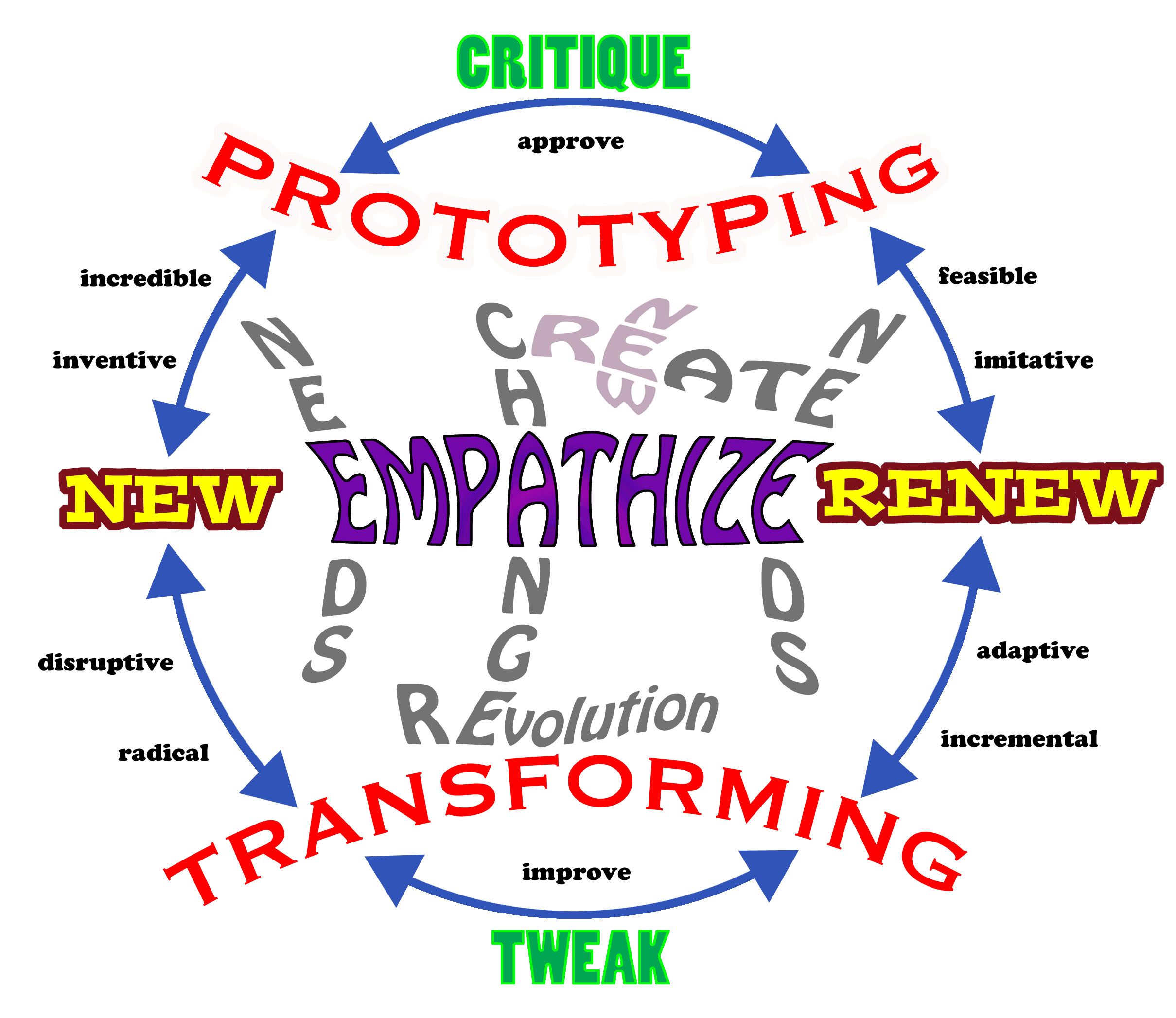
When contemplating the concept of the renew-to-new continuum within my context, I wonder if there is anything I can do in my life that is truly new. We’re all building on the knowledge and ideas and inventions that have come before us. When I think of newness and innovation in a revolutionary sort of way, I think of the iPhone or YouTube, not of me introducing a new learning management system into my workplace. That being said, I suppose the continuum can be molded to fit its appropriate environment, and there’s no need to compare my workplace to the massive progress of the entire planet. Earth-wide innovations are happening too fast and frequently for me to keep up, but I can at least do my part to accept and move with the inevitable, innovative evolution toward digital learning.

Unit 2 asks why we innovate, and we can reflect on this question framed by a poetic musing from Dron: “If we learn new ways of changing, then we can begin a rich evolutionary process where the rules of evolution themselves evolve, thus enabling more change and continuous evolution towards a peak of fitness that forever moves as we approach it” (2017, p. 261).

Goldman (2012) describes one such evolutionary process – the journey to becoming a design thinker – using the term mindshifts to signify four key approaches that are adopted on this path:

  • Human-Centered: focus on empathy;
  • Experimental: perspective that everything is an evolution, a prototype;
  • Collaborative: radical teamwork creates transformative innovations; and
  • Metacogitive: being conscious of the greater context within the design process.

For use in our context-specific design process, we were introduced to design principles, and asked to develop our own. For my assignment, I compiled a fairly straightforward list of helpful items such as “listen to users” and “simplify,” but out of the collection, one of my design principles sparkles and shines as an upgraded version of the infamous Golden Rule, and it goes a little something like this:

“Create a learning environment that I would like to learn in.”


References

Dron, J. (2014). Innovation and Change: Changing how we Change. In Zawacki-Richter, O. & T. Anderson (Eds.), Online distance education: Towards a research agenda. Athabasca, AB: AU Press. 

Goldman, S., Carroll, M. P., Kabayadondo, Z., Cavagnaro, L. B., Royalty, A. W., Roth, B., & Kim, J. (2012). Assessing d.learning: Capturing the journey of becoming a design thinker. In H. Plattner, C. Meinel & L. Leifer (eds). Design thinking research: Understanding innovation. (pp. 13-33). Berlin: Springer. 


Question-Making-Risk-Taking (LRNT 524: Assignment 1-A)

Our Mission

Klaus Rimke, Terra Aartsen, and Angie Maksymetz were challenged to use Stanford’s d.school design thinking process to prototype a single element of an online integrated program for promoting engagement, a sense of inclusion, and intellectual risk-taking. Given how we are a group of three with disparate work domains, we chose to adapt and adopt a joint solution within a context we share: an online graduate program.

Empathize & Reframe

By both interviewing and being interviewed, the empathizing process allowed each of us to approach the problem as designers while also looking through the lens of learners.

“The closer the designer comes to the real user, the more easily the designer can step into the user’s world. The more the designer can live and experience the users’ emotions, the better she can transform the ideas and constraints into appealing and pleasing design solutions” (Mattelmäki, Vaajakallio, & Koskinen, 2014, p. 70).

In box #4 of our design process, a combined need emerged for a structured, socially connected, and safe learning environment.

Solution

The Organization for Economic Co-operation and Development describes stimulating learning environments as “learner-centered, structured and well-designed, profoundly personalized, inclusive, and social” (Crichton & Carter, 2017, p. 18). In order to provide a safe, social, structured domain while addressing our assigned problem scenario, we designed an ice-breaker activity to take place at the beginning of an online graduate program. We named the exercise “Question-Making and Risk-Taking,” and it is detailed below:

1.  Each student conducts a 10-15 minute synchronous interview via telephone, video, or online chat of one classmate, randomly assigned by the professor.

2.  Interview questions: How would you describe yourself in one sentence? What motivates you? How does this program help meet your goals? What is your opinion of the role intellectual risk-taking plays in your education?

3.  Ask 2 or more questions about anything (within reason and being respectful).

4.  Complete a short post on moodle about your interview subject using their name as the title. Your post should contain either their word-for-word responses to your questions, their answers paraphrased, or a profile of them in your words. Optional: include a photograph of your subject (with permission) or an image which represents some aspect of them. YOUR POST IS DUE ON SUNDAY, JANUARY 5th.

5.  The professor has randomly assigned every student three other classmates. Find their names in the titles of interview postings, then read the results to get to know a bit about them. Provide one positive comment and ask each subject one more question about anything (within reason). POST COMMENTS AND QUESTIONS BY WEDNESDAY, JANUARY 8th.

6.  BRIEFLY RESPOND TO QUESTIONS ASKED OF YOU BY SUNDAY, JANUARY 12th. Read about and get to know your classmates at your leisure.

Effectiveness

To tackle the need for structure, we provided clear ground rules, deadlines, and expectations. To address the need for connection, we created an engaging exercise for getting to know peers and building community through an inclusive, egalitarian format. To meet the need for a safe environment which welcomes intellectual risk-taking, we placed this activity in Moodle, allowing students to gain comfort in presenting unpolished content online.

The exercise is intended as a first step, laying a solid foundation for building engagement, a sense of inclusion, and endurance for future intellectual risk-taking while meeting the needs captured from our empathizing process.


References

Mattelmäki, T., Vaajakallio, K., & Koskinen, I. (2014). What happened to empathic design?. Design issues, 30(1), 67-77.

Stanford University Institute of Design. (2016). A virtual crash course in design thinking.

Crichton, S. & Carter, D. (2017). Taking Making into Classrooms Toolkit. Open School/ITA.


To ADDIE, or not to ADDIE… that is the question (LRNT 524, Activity 1)

In my previous, pre-MALAT experience designing online learning programs (industrial safety training), I tended to jump right in and build modules without conscious thought of using any research-backed, theoretical scaffolding. Indeed we would hold meetings discussing necessary content, brainstorm about delivery, and use safety documents to extract content from, but reading Thomas’s (2010) Learning and instructional systems design opened my eyes to an endless universe – the plethora of design approaches. I began eagerly summarizing Thomas’s summarized descriptions of these models in my notes, excited about the possibilities… until I eventually realized the enormity of content and impossibility for me to adopt it all.

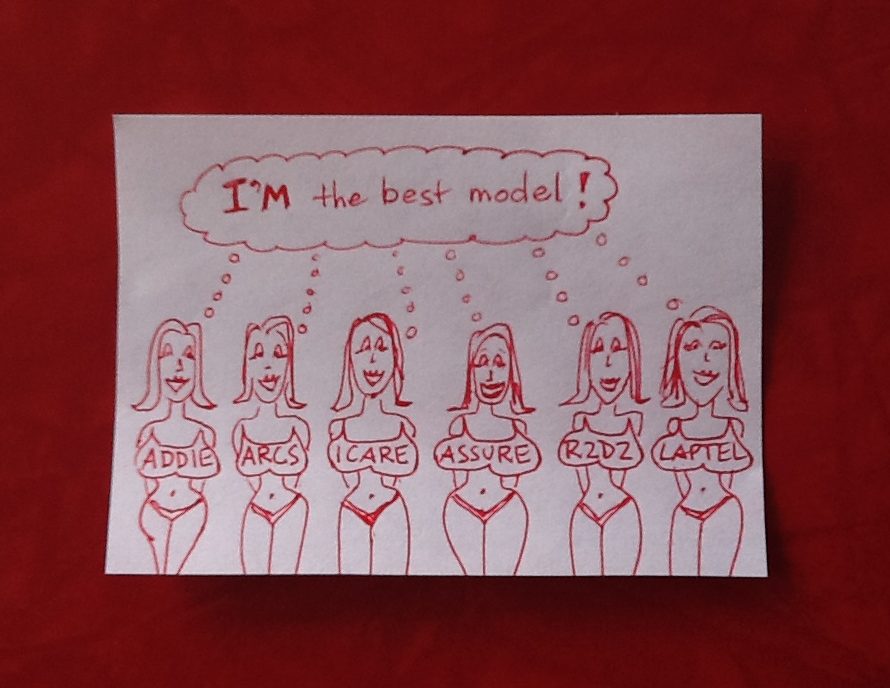
Bates (2014) focused on the relevance of one widely-accepted approach in his article where he asks the question: Is the ADDIE model appropriate for teaching in a digital age? As a newcomer to the educated (as opposed to practical) methods of instructional design, and as a person who values clarity, the popular ADDIE model makes sense to me as a jumping off point despite Bates’s criticisms.

I have not read the official ADDIE literature, but I presume there is not an ADDIE bible which states, “Thou shalt not add to, delete from, bend or modify this model in any way, shape, or form to suit your individual purposes. If you do, you will burn in hell for all eternity.” Bates argues ADDIE is “too pre-determined, linear, and inflexible” for today’s fluctuating learning environments (2014, para. 20), but without offering a viable alternative design model with widespread pragmatic value, I argue that the author’s opinion of ADDIE is actually the thing that is too pre-determined and inflexible.

I see no harm in selecting one clear and concise model with a nifty acronym to use as a runway for takeoff into flight on the journey of gaining skills in instructional design. I learn by doing, not by reading overwhelming, circumlocutory texts describing innumerable theories and models. That being said, I am not in a position experienced enough to proclaim ADDIE as the holy grail of instructional design models, but with some flexibility and pragmatism, ADDIE or any other well-versed model which seems reasonable should do fine as a springboard. A basic model can be selected and then tailored to fit the particular needs and characteristics of learners within a certain context.

(Please excuse my self-motivated cynicism:)

It felt ironic to attempt to consume Thomas’s drudgerous and painstaking reading material about using learning theories and design models to create effective instruction while simultaneously questioning the author’s ability to design and format written content in a digestible way. Our busy world is increasingly inundated with information and new technologies. Learners and workers struggle to have time and focus. Pedagogy is negotiated in a fluxing maelstrom. Will the field of academic writing ever ascertain and prioritize how essential it is to use learning theory and design principles for communicating written words deliciously and efficiently? Will the intravenously-electronic-media-consuming children of today have the ability and time to absorb dry materials when they are adults? Is it even the responsibility of authors, educators, content creators and instructional designers to evolve, research, theorize, and make information ever-more-palatable, or rather, is it the responsibility of the learner to harness motivation, trudge around and exert all the necessary efforts to build skills, accomplish difficult tasks and gain heavy knowledge?


References

Bates, T. (2014, September 9). Is the ADDIE model appropriate for teaching in a digital age? [Blog post]

Thomas, P. Y. (2010). Learning and instructional systems design. In Towards developing a web-based blended learning environment at the University of Botswana. (Doctoral dissertation).