I wasn’t really sure what I expected to find when I mapped my online network. I was also unsure of which network to focus on. I decided against trying to visually represent my largest network, Facebook, because it is not as important to me as a professional. The people I connect with on Facebook I do not want to have impacting my digital reach as a professional, though in saying that I suppose I am a bit naive to believe that to actually be the case. I have a digital voice as an everyday person, and I have a voice as a professional. I have also, on occasion, made that voice heard on Facebook, though I am now wilfully trying to stop this practice, hence its seclusion here.
I also began this course with a desire to know what was unknown to me, and harness its uses for my professional benefit: Twitter and Linked In. I started by making a graphic of my Linked In network, and noted that it is quite sad, and mostly filled with family members, and a few scattered friends with the occasional meaningful education sector contact.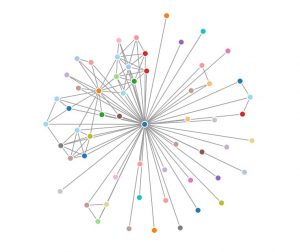 Most of my connections are tiny satellites orbiting me independently. These people are former students, casual acquaintances, or people whose emails I once had and whom I vaguely recalled in physical form (or vice versa). The more connected clusters are the few friends in the education sector who have an active Linked in presence, and my family.
What does this tell me?
My conclusions from my Linked in network reveal a relatively minimal reach, and one that is scattered and not focused in a way that is likely to get my name out there in circles that might advance my career in any capacity. Though I expect my aunt and uncle are proud to see me having even a marginal digital-professional impact.
I was more interested in analysing data from my Twitter network, where I am marginally more active. If my Facebook network is the personal me, and Linked In the professional, then Twitter is a hybrid. I post professional/academic blog posts, but I also react to the news of the day, and advertise my family website and blog posts made there. My followers are a mixture. I was convinced to get on Twitter about five years ago by the senior girls volleyball team I was coaching at the time. So, my first followers were high school students, specifically high school girls. My students aren’t as keen to follow me these days, which is fine as the bulk of my newer followers are made of of academic professionals who I meet and interact with at conferences like the annual Google Apps for Education (GAFE) summits that I attend on an annual basis. I used Audiense to try and gain some insight into my Twitter network.

The Results
My Twitter reach is untapped. I have a limited number of followers, but combined with those that follow my followers, my potential reach grows to 90k. So, while my immediate network is small, if tend to my network my reach is significant. ( I shudder to think what my un-professional Facebook reach actually is!)
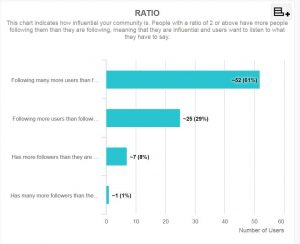
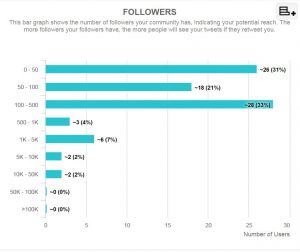
The characteristics of my Twitter followers was interesting also. It appears that by following less people than those who follow me, I have more influence, though I expect this influence is generally negated by the small number of followers I actually have in total. Looking at the followers I have who also have significant followers themselves I found it encouraging for the potential growth of my influence that 33% of my followers had an audience ranging between 100-500. I was excited to note also that I had two followers who had more than 10000 followers, and more interested still to note that these people were professionals in my field.
Conclusions
Being more aware of my network, will help me to gain influence and notoriety in my field. The field of notable e-educators is a growing one, but when compared with others is still relatively small. Ultimately this exercise forced me to take a look at my burgeoning networks, evaluate how I am using them and examine what impact they will potentially have for my professional growth. I view the two mentioned here as digital gardens. They will both require occasional weeding. I have started this process already by unfollowing people who are not likely to have a huge bearing on my professional identity, and in many cases I am connected with these people in more appropriate networks. Just as gardens thrive in weed free environments, they also require nourishment in the form of attention and sustenance. I need to acknowledge these networks if I want them to grow, and not leave them to sit expecting them to thrive as a cactus might in the desert. I recognise also that this is a two way street. I f I want to have a presence, I need to contribute to these networks that I want to be a part of. I have slowly started to take note of the who’s who in the field of e-learning, and found that it was not hard to do once I started engaging a bit. George Veletsianos, who I had cited in our recent debates had even favourited one of my tweets. A quick browse of his followers and a whole new network opens up to potentially further my goals. I wonder how many more rabbit holes I will stumble into this way?

Regarding Twitter, one suggestion that I have to manage different conversations/audiences/communities would be to have different lists of people. Twitter allows you to add accounts to lists. I use tweetdeck and it makes it easy to view multiple lists of people. I scan some lists daily (eg., #RRUMALAT, a list where close colleagues are included, etc) and other lists more sporadically (e.g., the list of cooking blogs I follow).
Lists I was not aware of thank you for this! I do have Tweetdeck, and have found it useful now that I am switching from personal social media to professional social media. I appreciate the input, thank you!
Hey Marshall,
I enjoyed reading your post. I totally agree with your statement that networks need acknowledgement if you expect them to grow. When I started taking interest in mobile and elearning about 5 years ago, I thought it would be smart to sign up to ‘all’ of the social media sites…now that I go back to some of them they are completely overgrown due to lack of attention. I too am going to concentrate on only a couple networks and try to apply them effectively.