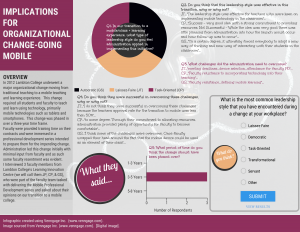
Click on the above infographic to enlarge.
Our college recently underwent a major organizational change, moving from traditional teaching methods to a mobile teaching and learning experience (that we called a mobile/class+ experience) that focused on integrating technology into our classrooms. I decided to interview three faculty that were part of the professional development training team charged with ensuring that faculty were prepared for this change. The interviews are their retrospective opinions on the implementation of this change.
Interview Approach
I began by asking ‘In our transition to a mobile/class + learning experience, what type of leadership style do you feel administration applied in implementing this initiative?’ as I felt it was important for the faculty to consciously identify how they perceived the administration’s approach to leading us into this change. The faculty respondents selected three different approaches:
- Laissez-faire- A hands off approach with little exchange with team members to help them grow (Northouse, 2016, p. 172).
- Autocratic- An approach in which the leaders have great power over their team and don’t allow room for suggestions (Senior, n.d.).
- Task-oriented- Leaders delegate roles and focus on getting the job done (Senior, n.d.).
While these are separate leadership styles, they all share the same characteristic that the leaders word is the law and little or no consultation is allowed for other team members.
The next question was ‘Do you think that this leadership style was effective in this transition, why or why not?’. This question was intended to determine if the leadership effectively enabled organizational change by sharing their vision properly and defining roles of both faculty and administration (Al-Haddad & Kotnour, 2015). The general feeling from the faculty respondents was that although this leadership style was somewhat effective, it could have implemented better. All three respondents mentioned that the leadership effectiveness was limited to the teachers who were already keen on going mobile. This indicates that the leadership did not attempt to investigate the entire faculty’s willingness for change and they limited their leadership to those who had similar shared resolve and shared beliefs (Weiner, 2009).
They were then asked ‘What challenges did the administration need to overcome?’, and while there were several answers to this, all of the respondents mentioned that getting the faculty on board was a key challenge for administration. They hinted that administration did not have a finger on the pulse of the culture of teaching and learning at our college. I asked if they thought that going mobile was too big of a change from the current culture and they agreed. The faculty did not believe the administration and expected the initiative to fail (Biech, 2007). I followed this question up asking ‘Do you think they were successful in overcoming these challenges?’. Two out of the three faculty respondents believed that the challenges were overcome with a limited degree of success that depended on eventually getting faculty engagement. The other respondent did not believe that the challenges were successfully overcome as the rate of approval for going mobile within the faculty was less than 50%, this is a statistic I could not independently verify however.
The final question posed to them was ‘What period of time do you think that this change should have been phased over?’. The timeline that was used for our college to implement the mobile learning change was three years, however, all of the faculty respondents suggested that a time period of three to five years would have been a more appropriate timeline. There was a sense that as this was a new initiative in an post-secondary environment, the administration estimated a fair timeline given the information that they had.
Conclusion
The faculty respondents generally agreed that the implementation of the change to a mobile teaching and learning college was successful, however, they also all concur that it was not lead properly and that more front-end planning would have made for a much smoother transition. While their opinions of the leadership styles varied it was clear that they all felt dictated too, rather than consulted with, by the administration leading this change.
I believe that the underlying foundational principles for education were upheld in this transition and that technology was , and is, being utilized in a successful manner in the classroom (Weller, 2009).
References
Al-Haddad, S., & Kotnour, T. (2015). Integrating the organizational change literature: a model for successful change. Journal of Organizational Change Management, 28(2), 234-262.
Biech, E. (2007). Models for change. In Thriving through change: A leader’s practical guide to change mastery. Alexandria, VA: ASTD.
Northouse, P. G. (2016). Leadership: theory and practice (7th ed.). Thousand Oaks, CA. Sage Publications.
Senior, T. (n.d.). Ten x leadership styles. Leadership Foundation for Higher Education. Retrieved from https://www.lfhe.ac.uk/en/general/lf10/ten-times-tables/10-leadership-styles.cfm
Weiner, B. J. (2009). A theory of organizational readiness for change. Implementation Science, 4(67).
Weller, M., & Anderson, T. (2013). Digital resilience in higher education. European Journal of Open, Distance and E-Learning.