Unit 3 Activity 1 – Reflection

What’s gonna work…Teamwork

In Team Awesome Sauces journey building our presentation on the ​edX101: Overview of Creating an edX Course (edX, 2018b) I realized a couple of important things.  First, collaborating as a team from several different time zones is very challenging…we had many synchronous meetings but due to time zone issues (and work, and family…) having everyone present was difficult.  In spite of that, I feel that the combination of using appear.in to virtually connect and record our sessions and using google docs to asynchronously connect and comment on each others work was very successful. Our committed team members worked tirelessly at all hours of the day it seemed in order to assist each other in our endeavor.


Presentation and Feedback

I felt our presentation went well, and that the audio and video quality was acceptable in collaborate.  What I was really impressed with was how many of our classmates came out to support us on a Friday night of the long weekend!  The discussion after the presentation to me was the most valuable part. In fact, there were a couple of comments in our team feedback that had stated that people wished we could have extended that.  Other valuable feedback was that almost unanimously our classmates appreciated the connection to a recipe for awesome sauce that provided cohesion for our presentation. Also, a couple participants stated that they had wished we could have explain more fully what edX actually was and gone deeper into our actual instance.  In retrospect, we did gloss over some finer details and incorrectly assumed that all had prior knowledge of edX. All in all, I was very pleased with both the presentation and the feedback.


Quality Assurance in MOOCs

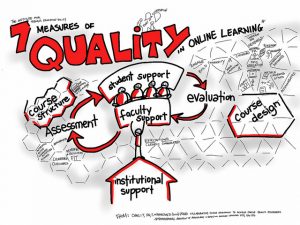
My particular focus was on the quality assurance (QA) in this edX MOOC, and by extension MOOCs in general.  I keep thinking that there should be a magic bullet in terms of QA for MOOCs…a template for how to build a successful MOOC, but the more I look into it the more I find that just like traditional courses, each MOOC is unique and so is the composition of all the participants within that MOOC.  EdX has their own checklist (edX, 2018a), but I found it to focus more on style than substance, and when I compared this checklist and the edX101: Overview of Creating an edX Course (edX, 2018b) to a well utilized traditional online course QA such as Quality Matters (Higher Ed Program > Rubric | Quality Matters Program, n.d.), they both seemed to fall well short.  As I completed my research for this project, I started to fall into the line of thinking that the success of a MOOC should process focused, not outcomes oriented (S Downes, 2016).


MOOCs are here to stay for a while I believe, and as they are a completely different animal than a traditional online course, time will tell what makes a successful MOOC.  One thing is certain, they have provided the educational community an opportunity for discussion on what the future of education looks like.


References

edX (Producer). (2018a). MOOC Development Checklist. ​edX101: Overview of Creating an edX Course. ​[MOOC]​.​ Retrieved from https://courses.edx.org/c4x/edX/edX101/asset/edX_MOOC_Development_Checklist-a11y.pdf

edX (Producer). (2018b). ​edX101: Overview of Creating an edX Course. ​[MOOC]. Retrieved

from https://courses.edx.org/courses/course-v1:edX+edX101+1T2018/course/

Higher Ed Program > Rubric | Quality Matters Program. (n.d.). Higher Ed Program > Rubric | Quality Matters Program. Retrieved January 30, 2014, from https://www.qualitymatters.org/rubric

S Downes.  (2016, December 11).  The quality of massive open online courses.  [web log]. Retrieved from https://www.downes.ca/post/60468
 

QUALITY ASSURANCE IN MOOCS – CRITICAL INQUIRY RESEARCH LOG #2

Below is my second research log.   Much of it was focused on the team presentation and little time was spent on my individual research paper.  I am hoping that this week and next I will be able to spend some serious time on my paper.


RESEARCH LOG

4-May-2018 Team Awesome Sauce Virtual Meeting Used Nicolette’s paid subscription to Appear.in to make sure that our connection worked better than last time….
4-May-2018 Went through our selected course on edX
7-May-2018 Team Awesome Sauce Virtual Meeting
9-May-2018 Team Awesome Sauce Virtual Meeting Divided up specific roles for our presentation
 9-May-2018 Finished our selected course through edX
9-May-2018 started writing introduction for our team video and my 2 minute piece on QA
10-May-2018 Incorporated Dr. Devries feedback on my outline into my new plan Narrowed the focus greatly on my research. Focusing more on what types of QA MOOCs currently employ and whether traditional online QA can or should apply to MOOCs
12-May-2018 Team Awesome Sauce Vitual Meeting Complete draft of our individual written sections and discussed next steps
13-May-2018 Work on script Finish writing draft of my script for the video
14-May-2018 Team Awesome Sauce Virtual Meeting Touch base, evaluate progress.
15-May-2018 Team Awesome Sauce Virtual Meeting Review script drafts and provide comments for each team member
16-May-2018 Finish writing introduction and my individual piece for our team written submittal
18-May-2018 Test collaborate Meet up with Nicolette at 9:00am to go through presentation in collaborate
18-May-2018 FINAL PRESENTATION Moderate final presentation in collaborate
21-May-2018 Review feedback review all of the feedback provided by peers on our presentation
25-May-2018 Write draft for team feedback

Quality Assurance in MOOCs – Critical Inquiry Research Log #1

Here is my first entry for my reflective critical inquiry research log.

Up until this point I have found plenty of information on quality assurance on MOOCs as a whole, but only a few articles that specifically relate to edX.  I suspect that information on quality assurance from one MOOC can be transferred to another MOOC (as long as they are similar i.e. xMOOC compared to an xMOOC), but I need to find research to back this up in order to apply any research on MOOC quality assurance to edX.

RESEARCH LOG

Date Task Comments
20-Apr-2018 Published Unit 1 Activity 3 to Blog
24-Apr-2018 Review blog comments and respond Incorporated comments from Irwin and Krista into my plan for completing Assignment 1 Critical Inquiry part 4
26-Apr-2018 Team Awesome Sauce Virtual Meeting Had issues with Appear.in, then Google Hangouts. We ended up in our RRU Collaborate room. Meeting went well and we re-focused our plan of attack for the group presentation.
28-Apr-2018 Conducted 3 hours of research into topic Focused on RRU Library search and Google Scholar to find articles. Fairly successful as I was able to find 6 more articles related to quality assurance in MOOCs. I was not very successful in finding research that related specifically to quality assurance at edX however.
1-May-2018 Started back at work My year sabbatical is over. Expect that much of my work will now have to be done after hours so I will have to readjust my working schedule
2-May-2018 Started writing Assign 1 Part 4 outline Started to write the outline for Assignment 1 Part 4…I am a little unclear of the expectations. Asked Dr. DeVries for clarification via moodle discussion board
3-May-2018 Conducted 2 hours of web research Conducted 2 more hours of web research for articles. Focused more on perspectives of MOOC quality form the viewpoint of the learner and facilitator. Found 3 articles that will be helpful in writing my final paper.
4-May-2018 Published first research log to my blog

Unit 1 Activity 3- Quality Assurance in MOOC’s (Focusing on EdX)

Image sourced from Flicker. (CC 0). Giulia Forsythe

Our team chose a modality of Educational Apps and the instance we selected was edX (and the edX app).  As edX is essentially a hub for Universities around the world to deliver MOOCs, I decided that for my individual critical inquiry I would investigate how quality assurance is handled at edX, and by extension MOOCs in general.

MOOCs, xMOOCs, cMOOCs…

First of all, it seems almost impossible to pin down what a MOOC specifically is, it is a moving target as they are fluid and their formats and delivery are ever changing.  One thing most scholars can agree on is that at it’s very basic level a MOOC is:

  • Massive – Meaning it is designed to attract and educate as many people as possible.
  • Open – Referring to removal of any and all academic barriers that would restrict participation.
  • Online – Essentially meaning that no element of the course would require participation at a physical location.
  • Course – it has a start and end date, it has a common theme or domain, and there is a progression of events related to the theme or domain  (Downes, 2016).

The next issue I came upon was to determine whether edX was delivering xMOOCs or cMOOCs, two terms that I had never encountered before.  Apparently a cMOOC focuses more on a connectivist learning environment as participants take on the role of both learner and teacher, it mirrors the openness of the web “because the educational content is continuously generated by the online community and shared with others in an open manner” (Admin, 2013).  The xMOOC uses a different format that resembles more of a traditional classroom structure instead of an open online community. Another notable factor that distinguishes an xMOOC is that there is usually a higher education institution behind it rather than, perhaps, a group of like-minded individuals building a cMOOC (D Morrison, 2013).

After navigating through edX, from what I have seen it is definitely a hub for xMOOCs.

Are MOOCs Up To Snuff?

My initial investigating turned up little  hard evidence on MOOCs and how quality assurance was being applied to them.  One study I did find was on applying the Quality Matters™ (QM) standard to various MOOCs that are delivered on various platforms. It studied two MOOCs delivered by Coursera, two MOOCs delivered by edX, and two MOOCs delivered by Udacity and determined that none of the courses received the required 85% to achieve QM standard.  The study did however note that some of the courses would have passed if certain standards had not been applied (Lowenthal & Hodges, 2015).  This idea of not applying certain standards to MOOCs got me thinking…should a traditional quality assurance process even be applied to MOOCs. Stephen Downes suggests that the determinant for success in a MOOC should be process defined and not outcome defined as they should be platforms for discovery and experience (Creelman, Ehlers, & Ossiannilsson, 2014, p. 81).  Martin Weller suggests that MOOCs should only be compared to each other rather than to traditional online courses since their development has been so recent  and their delivery is not the same (p. 84).  Some point to the fact that low retention rates amongst MOOCs indicate that the quality or learning must be suffering, however, Downes (2016) suggests that participants withdrawing from MOOCs are just a product of the design of MOOCs themselves, where learners slip in and out at their own learning leisure.

EdX’s Approach to MOOC Quality Assurance

Although deeper investigation is required into what EdX’s expectations are for the development and delivery of its MOOCs, I was able to find a general checklist for educators and institutions on basic expectations for MOOC development.  The MOOC development checklist (EdX MOOC Development Checklist, 2018) closely resembles many standards that are in the QM rubric for online quality assurance (Higher Ed Program, n.d.).  I have been QM trained and am very familiar with the expectations of courses that achieve the QM standard, and as such I am planning on contacting edX to see to what extent they utilize the QM standard.

What’s next?

I had many questions when I started to research the topic of quality assurance in MOOCs, and now that I have conducted a little research the number of questions I have has grown:

  • What type of quality assurance process does edX employ, if any?
  • If there is a required quality assurance process, does edX require institutions to fall in line with its processes?  The institutions quality assurance processes? A combination of both?
  • Should I expand my research to include other MOOC delivery platforms such as Udacity and Coursera?
  • Should MOOCs even be put through a ‘traditional’ quality assurance process, or should they exist outside any traditional quality assurance process?
  • Should I do a comparative study on how an institution (such as Harvard or UBC) approaches quality assurance in courses they deliver on edX as compared to how they approach quality assurance to online courses delivered internally?
  • Should I apply a proven quality assurance program (such as QM) to a few edX courses and see how they fare?
  • If I run these MOOC courses through QM, how do they compare against traditional online courses that have been run through QM?

These are just some of the questions, and it seems with every article I read more questions than answers come up.  I plan on approaching my inquiry with a simple Know-Wonder-Learn framework that I was introduced to by my team member Bobbi.  I like it’s simplistic approach that allows you to maximize your efforts on the research rather then trying to understand a confusing framework.

I welcome any comments that you have and feel free to add to my list of every growing queries.


References


Admin.  (2013, August 7).  What is the difference between xMOOCs and cMOOCs?.  [web log]. Retrieved from http://blogs.onlineeducation.touro.edu/distinguishing-between-cmoocs-and-xmoocs/

Creelman, A., Ehlers, U-D., & Ossiannilsson, E.  (2014). Perspectives on MOOC quality – An account of the EFQUEL MOOC quality project.  The International Journal for Innovation and Quality in Learning.  3. 78-87.

D Morrison.  (2013, April 22).  The ultimate student guide to xMOOCs and cMOOCs.  [web log]. Retrieved from http://moocnewsandreviews.com/ultimate-guide-to-xmoocs-and-cmoocso/

EdX MOOC Development Checklist. (2018). Retrieved from https://courses.edx.org/c4x/edX/edX101/asset/edX_MOOC_Development_Checklist-a11y.pdf

Higher Ed Program > Rubric | Quality Matters Program. (n.d.). Higher Ed Program > Rubric | Quality Matters Program. Retrieved January 30, 2014, from https://www.qualitymatters.org/rubric

Lowenthal, P. R., & Hodges, C. B.  (2015). In search of quality: Using quality matters to analyze the quality of massive, open, online courses (MOOC’s).  International Review of Research in Open and Distributed Learning.  16(5).  83-101.

S Downes.  (2016, December 11).  The quality of massive open online courses.  [web log]. Retrieved from https://www.downes.ca/post/60468

Exploring Modalities: A Reflection by Team Awesome Sauce

Team Awesome Sauce are: Bobbi Donnison,  Krista Frate, Marshall Hartlen, Steve Minten, and Nicolette Young

After much discussion and mind changing, Team Awesome Sauce has decided to explore EdX, both as a massive open online course (MOOC), and as an educational app for Android or IOS. We will outline the beginning of our journey by using a classic k-12 learning modality: the know, wonder, learn (KWL) chart. A KWL chart is a way to guide inquiry. It assesses what you already know, (in this case our collective knowledge of learning modalities) what we wonder/want to know about our topic, and finally what we hope to learn in pursuing the inquiry further. For the purposes of this post, we applied this inquiry organizing strategy to three guiding questions:

  1. What type of modality did we choose?
  2. What question(s) would you like to pursue as you examine or experience the modality?
  3. What background reading did you do to learn more about the modality? (Blogs, websites, library journal articles). Write a summary of what you learned.

In each instance a degree of expansion and explanation is included, which, it is hoped will help keep all of us on track as we individually and collectively delve deeper into specific issues and aspects of our modality, and the instance of EdX in particular.

What we KNOW about this modality/instance: What type of modality did you choose?

EdX exists in the realm of MOOCs and is viewed by some as more exclusive than competing platforms due in part to the fact that the courses on offer are not necessarily free. It is also driven by prestigious US universities such as Harvard and MIT lending it a certain degree of prestige and legitimacy as well. Similar to other MOOCs, EdX offers the opportunity to upskill for employment, and offers a wide range of eclectic courses ranging from Civil War History, to R Programming basics. MOOCs are a relatively recent platform for learning and EdX is younger still, only coming online in 2012. Considering this relatively short time frame the range and quantity of courses they offer is impressive, as are the academic levels available ranging from self paced tutorials on specific software applications, to micro-masters courses (the latter of which we will revisit in the wonder section). We ultimately chose this modality as it afforded further inquiry more readily across all of our diverse personal contexts, and was also supported by a mobile applications, which extends further, the opportunity for inquiry.

What We Wonder: What question(s) would we like to pursue as we examine or experience the modality?

In the shared economy, traditional means of monetizing are disappearing in favour of pay per use subscription style services (e.g. Air BNB, Uber, Adobe Creative Cloud, Office 365). These services bypass the traditional economy in the same way that MOOCs bypass traditional education, but how can such an enterprise be economically sustainable? EdX is backed by traditional universities, but the cost is a minute fraction of what is available at the parent universities. If such platforms continue to gain traction, will they make the brick and mortar universities redundant? In wondering about this, we also question the legitimacy and quality of education received through such instances. Who will actually recognise an EdX degree, and given the flexible pace and restricted access to university research databases, how can the quality of inquiry possibly compare to similar offerings in more traditional educational settings?

An obvious advantage to learning in this manner is accessibility. EdX courses are available 24-7, restricted only by internet connectivity, but what other benefits are there to this modality? Cost is an obvious one, but again the question of quality persists, and what challenges do these observations present? From a pedagogical standpoint, we are curious to understand what constitutes best practice for course design and delivery? Current best practice traditional classroom teaching incorporates a variety of formative exercises to aid skill development and content knowledge, how does learning through a MOOC account for this and how does it engage the learner?

The opportunity to cater to individual learners seems vast, and we hypothesise that such modalities offer a decent coverage of content knowledge, but how effective are MOOCs at developing the soft skills of human interaction and collaboration, which are increasingly vital in the 21st century economy?

Finally, we wonder who this modality is targeting, and what uses are not currently being utilized, but that may be available in similar applications? If functionality is omitted, what is the rationale, and how does it make for a better learning experience. And perhaps most important of all, if qualifications become recognised as providing credit, how can EdX be assured the student is the student?

What we Learned (so far): What background reading did you do to learn more about the modality? (Blogs, websites, library journal articles).

We explored the basic history of MOOCs and educational applications in general, and then browsed articles pertaining to EdX in particular, including the site itself.

“Today’s online learners require flexibility, and mobile devices are a solution to remove the barrier of a fixed time, place, and mode of learning. Tailoring online education to meet the needs of those who wish to learn “anywhere, anytime,” however, will be an ongoing challenge” (Hutchinson, Tin, & Cao, 2008). MOOCs, on the surface, appear ready to meet this challenge, but the question of feasibility may lie outside of their realm of control. Ultimately for such learning modalities to become truly advantageous, they need to be accepted by the 21st century economy. It seems that some progress is being made in this regard, as some employers who struggle to find candidates with the necessary skill set to be an effective employee, are turning to individuals who have completed coursework, through MOOCs like EdX (Carapezza, 2017). With viability and legitimacy seemingly underway, MOOCs seem like at the very least a supplemental source of learning/upskilling. Team Awesome Sauce plans to continue learning first hand the true value of MOOCs, EdX in particular as we audit various courses currently offered.


References

Carapezza, K. (2017, February 15) These Top Schools Are Offering Big Savings On Master’s Degrees, But There’s A Catch. NPR Ed. Retrieved from https://www.npr.org/sections/ed/2017/02/15/504478472/how-to-get-20-000-off-the-price-of-a-masters-degree

Hutchison, M., Tin, T. & Cao, Y. (2008). Chapter 8: “In-Your-Pocket” and “On-the-Fly:” Meeting the Needs of Today’s New Generation of Online Learners with Mobile Learning Technology. In T. Anderson (Ed.), The theory and practice of online learning (2nd ed., pp. 201-219). Edmonton, AB: AU Press.

Unit 5 – Final Reflections

Image sourced from Flicker. (CC BY 2.0). llreadll.

A lot has happened in the past 9 weeks and I think that this course has offered me some new perspectives in terms of leadership and managing change.  As a faculty, I tend to focus on leading change only from my perspective rather than the perspectives of all involved parties.  The readings and activities gave me pause to consider things through the eyes of an administrator, a support staff, an IT professional, and most importantly a student.

Assignment 4 gave me the opportunity to conceptualize a change in my college that I have been lobbying for-implementing an online quality assurance program.  By using this as my concept for the assignment I was able to flush out several issues that could be barriers to a successful roll-out of such a program.

Looking forward I would like to present a case to administration at my college and hopefully, lead in the development of a quality assurance program for our online courses.

I thoroughly enjoyed working with everyone throughout this course and hope to see you all soon! (Virtually of course…)

Unit 3, Activity 1 – Project Management

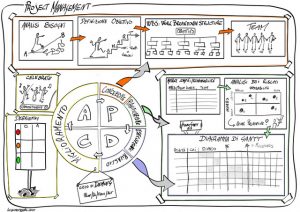
Image sourced from Flicker. (CC BY 2.0).  Luigi Mengato

The issue that needed to be addressed at my workplace was (and still is) to move several courses from an on ground delivery to an online delivery.  This was mandated from administration and faculty were asked to volunteer if they thought that their course would be well suited to move to an online delivery.  Their were two major challenges with this initiative, the first being the obvious challenge of physically (or virtually) building these courses successfully into an online format.  The second major challenge was that faculty we not trained in either online course development or delivery.

Stakeholders

There were several stakeholders involved in this project who had various levels of involvement and most of them stood to benefit in some way from this undertaking.

Administration

The upper administration at our college communicated to the faculty that their wish was to find on-ground courses that were well suited for online learning and convert them.  They were very clear in communicating that time off would be given if your course was selected to be changed to an online format. I believe they underestimated the time it took to convert a course and also the expertise that was required to move a course to an online format.  The benefit to administration was that this would ease some strain on physical classroom spaces within the college.

Faculty

Faculty that decided to convert their course were given a course release for one semester and teamed up with and instructional designer and project developers that were to assist them with the technological aspect of this transition.  In retrospect many of the faculty that accepted this transition said that the time it took to convert to online was way more than one course release. They also noted that they wished they could have received some more formal training on the expectations and process for building an online course.  The benefit to faculty was that this provided more options for students.

Information Technology Department

The Information Technology Department (IT) were integral in the implementation of this project. Not only did they have to procure software technologies to build these online courses, they also need to integrate them into the learning management system.  IT worked closely with administration and the instructional designer throughout this process to ensure that there would be no surprises once the courses went live. The only benefit I could ascertain is that more online courses meant more job security for those working in IT.  This project caused much more work for them.

Union

The Faculty Union was very involved in this project.  They were worried that moving courses online could eventually lead to asynchronous courses in which the role of the faculty would be diminished.  If a benefit was to be found for the Union it was that students from other colleges may be able to take these classes online as a general education credit and this in turn would mean more work for its members.

Instructional Designer and Developers

The instructional designer and developers were in charge of converting the faculties knowledge and ideas into an engaging online format.  They worked closely with the faculty and met regularly to provide pedagogical and technical support in the course development. As developing these courses was a new undertaking, successful courses would benefit their careers.

Students

Last but not least, the students.  Having engaging online courses provided the students with an option to take the course more or less on their own schedule.  It removed the geographical barrier and allowed many of them to learn the content at home, or on the bus, or on break, etc. They are the end consumer and at the end of the day it was the students that were driving this change.

Project Plan

At the time of this project I was seconded from faculty into the role of eLearning manager and as such I was in administration.  Although I did not directly develop the project plan and can’t be sure if a formal project plan was undertaking in the early going, I was a key member on the team.  I recognize several key pieces of managing a project that we were conscience of; cost, scope, quality, risk, resources, and time (Watt, 2014, pp. 13-14).

Cost – As with any project, we were given a budget to work with and had to ensure that our project was completed within that budget.

Scope – Before the project was started we decided how many courses we could develop into an online format.

Quality – We decided to incorporate Quality Matters ™ into our course design as a standard for quality that we wanted to aspire too.

Risk – We recognized that there could be potential issues with the Faculty union not buying into this project and also that there could be a challenge in hiring enough skilled developers within our project timeframe.

Resources – We identified and repaired gaps in our technical software in order to ensure that we had the proper tools to build the courses.

Time – We were given a finite amount of time (24 months if my memory serves) in order to complete the project and developed a schedule based on this.

I think that we underestimated the amount of time it took to bring the faculty, instructional designer, and developers up to speed on the project.  By this I mean we failed to bring them together as a team soon enough and as a result the development lagged. We should have provided more front end training (especially for the faculty) on development and delivery of online courses.

Conclusion

Although our online course development project was somewhat successful, I think more forethought should have been put into it.  I think part of the problem was that we viewed the project as a tame problem that had a fairly linear path to success (Conway, Masters, & Thorold, 2017, p.16).  We could have considered it a wicked problem as the boundaries of what the courses could become were hard to define and as noted above there were many stakeholders with different roles within the education system.

References

Conway, R., Masters, J., & Thorold, J., (2017). From design thinking to systems change: How to invest in innovation for social impact. Royal Society of Arts, Action and Research Centre.  Retrieved from https://www.thersa.org/globalassets/pdfs/reports/rsa_from-design-thinking-to-system-change-report.pdf

Watt, A. (2014). Project Management. Victoria, BC: BCcampus.  Retrieved from https://opentextbc.ca/projectmanagement/front-matter/introduction-2/

Assignment 2- External Scan.

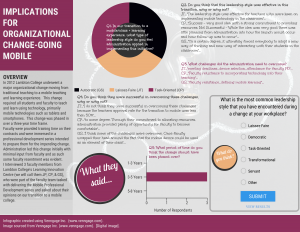
Click on the above infographic to enlarge.

Our college recently underwent a major organizational change, moving from traditional teaching methods to a mobile teaching and learning experience (that we called a mobile/class+ experience) that focused on integrating technology into our classrooms.  I decided to interview three faculty that were part of the professional development training team charged with ensuring that faculty were prepared for this change.  The interviews are their retrospective opinions on the implementation of this change.

Interview Approach

I began by asking ‘In our transition to a mobile/class + learning experience, what type of leadership style do you feel administration applied in implementing this initiative?’ as I felt it was important for the faculty to consciously identify how they perceived the administration’s approach to leading us into this change.  The faculty respondents selected three different approaches:

  • Laissez-faire- A hands off approach with little exchange with team members to help them grow (Northouse, 2016, p. 172).
  • Autocratic- An approach in which the leaders have great power over their team and don’t allow room for suggestions (Senior, n.d.).
  • Task-oriented- Leaders delegate roles and focus on getting the job done (Senior, n.d.).

While these are separate leadership styles, they all share the same characteristic that the leaders word is the law and little or no consultation is allowed for other team members.

The next question was ‘Do you think that this leadership style was effective in this transition, why or why not?’. This question was intended to determine if the leadership effectively enabled organizational change by sharing their vision properly and defining roles of both faculty and administration (Al-Haddad & Kotnour, 2015).  The general feeling from the faculty respondents was that although this leadership style was somewhat effective, it could have implemented better.  All three respondents mentioned that the leadership effectiveness was limited to the teachers who were already keen on going mobile.  This indicates that the leadership did not attempt to investigate the entire faculty’s willingness for change and they limited their leadership to those who had similar shared resolve and shared beliefs (Weiner, 2009).

They were then askedWhat challenges did the administration need to overcome?’, and while there were several answers to this, all of the respondents mentioned that getting the faculty on board was a key challenge for administration.  They hinted that administration did not have a finger on the pulse of the culture of teaching and learning at our college.  I asked if they thought that going mobile was too big of a change from the current culture and they agreed.  The faculty did not believe the administration and expected the initiative to fail (Biech, 2007).  I followed this question up asking ‘Do you think they were successful in overcoming these challenges?’.  Two out of the three faculty respondents believed that the challenges were overcome with a limited degree of success that depended on eventually getting faculty engagement.  The other respondent did not believe that the challenges were successfully overcome as the rate of approval for going mobile within the faculty was less than 50%, this is a statistic I could not independently verify however.

The final question posed to them was ‘What period of time do you think that this change should have been phased over?’.  The timeline that was used for our college to implement the mobile learning change was three years, however, all of the faculty respondents suggested that a time period of three to five years would have been a more appropriate timeline.  There was a sense that as this was a new initiative in an post-secondary environment, the administration estimated a fair timeline given the information that they had.

Conclusion

The faculty respondents generally agreed that the implementation of the change to a mobile teaching and learning college was successful, however, they also all concur that it was not lead properly and that more front-end planning would have made for a much smoother transition.  While their opinions of the leadership styles varied it was clear that they all felt dictated too, rather than consulted with, by the administration leading this change.

I believe that the underlying foundational principles for education were upheld in this transition and that technology was , and is, being utilized in a successful manner in the classroom (Weller, 2009).

References

Al-Haddad, S., & Kotnour, T. (2015). Integrating the organizational change literature: a model for successful change. Journal of Organizational Change Management, 28(2), 234-262.

Biech, E. (2007). Models for change. In Thriving through change: A leader’s practical guide to change mastery. Alexandria, VA: ASTD.

Northouse, P. G. (2016). Leadership: theory and practice (7th ed.). Thousand Oaks, CA. Sage Publications.

Senior, T.  (n.d.).  Ten x leadership styles.  Leadership Foundation for Higher Education.  Retrieved from https://www.lfhe.ac.uk/en/general/lf10/ten-times-tables/10-leadership-styles.cfm

Weiner, B. J. (2009). A theory of organizational readiness for change. Implementation Science, 4(67).

Weller, M., & Anderson, T. (2013). Digital resilience in higher education. European Journal of Open, Distance and E-Learning.


Unit 2 Activity 1 – Managing Change for Learning in Digital Environments

Source: Maryanne Ventrice, Flickr.com CC BY-2.0
(https://creativecommons.org/licenses/by/2.0/)

The unit 2 readings certainly expanded my understanding of leading change in an organization and the history behind organizational development (OD).  Al-Haddad and Kotnour (2015) give a thorough summary of the history of change giving particular focus to Kurt Lewin, who conducted research on change in the fields of sociology and psychology in 1946 and began the movement of OD and change management.  In terms of changing in our ever evolving digital environment, I think that Feldstein (2017), who writes about achieving an interoperable digital learning platform to replace (or at least have a symbiotic relationship with) learning management systems, makes some very salient points that can be applied to the larger issue of leading change in the digital age.  He notes that our understanding of digital environments has evolved to a point where a there is an expectation that any technologies we use should not only work together, but should complement each other.  This means that any method for change that is adopted should be open ended and allow for the integration of future advancements.  Although this is a fantastic idea, I’ll bet it has IT directors pulling their hair out on a daily basis.

After reviewing the many theories that were part of the readings, I find myself leaning towards the Six Step and the Six Sigma systematic change methods (Al-Haddad and Kotnour, 2015) as I generally don’t like to over complicate things.  These two theories have more generalized steps but still encompassed most of the elements of more complicated theories such as the nine steps of Process Reengineering (Al-Haddad and Kotnour).  For example, the first four steps in the Process Reengineering model are all about identifying the process and defining the problem in your organization.  This to me is too prescriptive and might pigeonhole your thought process.  In contrast, the first step in the Six Sigma method is to define the the issue you would like to repair in your organization and seems to incorporate the first four steps of Process Reengineering.  Although this is very broad, your direction is left more open and I believe this allows for more independent thought and exploration.  It also does not surprise me that the theories I selected were both systematic approaches to change as I tend to like a more structured framework rather than a conceptual one.

Leadership plays an important role in managing change and the first step in this is making sure your organization is ready for change.  Two critical aspects of this are to make sure your organization has a shared resolve and the collective capacity to do so (Weiner, 2009).  Having the shared resolve means motivating people to be committed to pursuing the courses of action required to implement the organizational change.  Collective capacity (change efficacy) refers to the individuals shared beliefs that they have the collective ability to organize and execute those courses of action (p. 2).  Another important aspect is to make sure that the change you are planning to make is not vastly different from the existing organizational culture.  If it is too much change all at once disconnects will be created, employees will not believe their leaders and this will result in an unsuccessful implementation (Biech, 2007).  

Weller and Anderson’s (2013) discussion regarding resilience was intriguing to me as the thought of measuring a system’s capacity to “absorb disturbance and reorganise while undergoing change” (p. 3) never really occurred to me.  They go on to further place emphasis on the fact that the ability to retain identity and function is a key piece to a systems digital resilience.  Reflecting on this I realized that our colleges recent transition to mobile learning could be a resilience test.  Even though resilience was not formally investigated, our college underwent a major change to move to teaching with technology and the result seems to have been a success.  We utilized technology to change some of our teaching practice, but retained the the underlying foundations of teaching and learning (p. 3).  The only thing that scares me a little bit about our colleges transition is I am not sure that resilience was consciously thought of from our leaders, the change seemed to be motivated because going mobile was cutting edge at the time.  I am not sure that any thought was given to maintaining the core foundations of teaching and learning…I hope I am wrong about that though…


Resources

Al-Haddad, S., & Kotnour, T. (2015). Integrating the organizational change literature: a model for successful change. Journal of Organizational Change Management, 28(2), 234-262.

Biech, E. (2007). Models for Change. In Thriving Through Change: A Leader’s Practical Guide to Change Mastery. Alexandria, VA: ASTD.

Feldstein, M. (2017, May 28). A flexible, interoperable digital learning platform: Are we there yet? [blog post].

Weiner, B. J. (2009). A theory of organizational readiness for change. Implementation Science, 4(67).

Weller, M., & Anderson, T. (2013). Digital Resilience in Higher Education. European Journal of Open, Distance and E-Learning.


Leading in the Digital Age

Leading in the digital age requires an individual to have the constitution to allow their team to attempt to incorporate ever-changing technologies and make mistakes doing so.  A successful leader in any digital environment also has to understand what makes individuals hesitant to embrace digital change and be able to respond to those fears (Sheninger, 2014).

Although leading in digital learning environments has unique considerations, especially given the constant rate of change with educational technologies, traditional leadership theories can be applied to any digital learning environment by adapting them to each situation.   

My Leadership Approach

My approach to leading has been formed by my work life experience.  Leadership for me in the workplace began by operating my own contracting company, having to manage a project in an adaptive style of leadership for my own employees and sub-trades where workers were rewarded monetarily for their performance (Khan, 2017).  I moved on to teaching students at the college level and found myself employing a servant-leadership style (O’Toole, 2008) that focused on helping my students to successfully gain employment after graduation.  As our college moved towards implementation of digital teaching and learning campus-wide, I accepted successive positions as a Faculty Mentor for teaching and learning with technology responsible for faculty professional development, and eLearning Manager responsible for all development of blended and online learning.  While working with faculty in these roles I found myself utilizing a team or shared leadership style.  I would provide guidance where necessary, but allow team members to share their influence and take the lead when warranted (Northouse, 2016, p. 365).

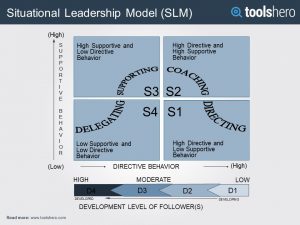
A constant throughout all of these leadership roles has been the ability to adapt to each situation and to understand where faculty, students, or individuals within my team fall on a continuum of development (Northouse, 2016).  Figure 1 illustrates the four categories of directive and supportive behaviours of delegating, supporting, coaching, and directing.  A delegating style of leadership would allow the individuals to lead and take responsibility for achieving a goal.  A supporting style of leadership would allow individuals some measure of control over the project, but the leader would always remain available to help out.  A coaching leadership style requires a leader to involve themselves in the project and provide encouragement while offering solutions to problems.  In the directing leadership style, a leader provides close supervision and clear instruction (Northouse, 2016, pp. 94-96).

Figure 1.  Situational Leadership Model.  This figure illustrates the four categories of directive and supportive behaviours (Situational Leadership Model, develop your leadership styles, n.d.)

As I encounter individuals inside and outside the classroom with varying ability and understanding, I believe adapting my leadership technique to match their style maximizes the potential for a mutually beneficial working or learning experience.

In my experience in a leadership role, I have noticed two things that stand out that are required to be successful in a digital environment.  The first is to allow people to feel safe in attempting and failing at integrating technology.  As Huggins, Klar, Hammonds, & Buskey (2017) note, “you’ve got to allow people the opportunity to make some mistakes [and] learn from those mistakes” (p. 9).  A learning or workplace environment must allow individuals to take risks as a learning opportunity in order to further their growth.  The second thing that I have noticed is that it is important to allow individuals to grow by increasing their capacity to do things on their own.  It is critically important that members within a classroom or organization be tasked to develop their own personal capacities in order to not only further their own growth but also to contribute to the overall success of a project (Huggins et al., 2017).

Leading in the Digital Age

As someone who is engrossed in technology and is always interested to experiment with new advances, digital technologies have provided me with the opportunity to step up in leadership roles.  Sheninger (2014) provides a succinct summary of what traits are important for a leader in the digital age.  He provides a list of seven pillars of digital leadership in education; communication, public relations, branding, student engagement/learning, professional development, re-envisioning learning environments, and opportunity.  I believe these pillars transcend not only education but also digital environments.  One can take any of these pillars and apply them to a workplace and connect them to a successful leadership practice.  For example, if one selected student engagement/learning and changed it to employee engagement/learning it would not be difficult to see how having employees engaged and committed to learning would contribute to the overall success of any organization.  Conversely, if one selected a leadership theory that predated the digital revolution it would not be a challenge to apply its main tenets to leading in the digital age.  For example if one selected the skills approach to leadership, which places an emphasis on abilities that can be learned and has been identified and studied since 1955 (Northouse, 2016, p. 43), one could take the three general administrative skills of technical, human, and conceptual and apply them to leading in the digital age.  Technical skills are the proficiency at a specific type of work, this could easily be applied to one’s technical proficiency (p. 44).  Human skills are the ability to work with people and in any digital leadership environment managing people is critical (pp. 44-45).  Conceptual skills are the ability to work with ideas and concepts and in the digital age, new technologies are always expanding the possibilities for new advances.

Conclusion

I truly believe that leadership has to be an individualistic approach.  What works for one individual’s personality style might not work for another.  Contextual factors such as where we are employed and our position within an organization also play a part in our leadership style.  Identifying what style of leadership you employ can help you recognize both your strengths and weaknesses as a leader and provide you with a first step towards becoming a more effective leader.


References

Huggins, K., Klar, H. W., Hammonds, H. L., & Buskey, F. C.  (2017). Developing Leadership Capacity in Others: An Examination of High School Principals’ Personal Capacities for Fostering Leadership. International Journal of Education Policy and Leadership, 12(1).  

Khan, N. (2017).  Adaptive or Transactional Leadership in Current Higher Education: A Brief Comparison. The International Review of Research in Open and Distributed Learning, 18(3).  

Northouse, P. G. (2016). Leadership: Theory and Practice (7th ed.). Thousand Oaks, CA. Sage Publications.

O’Toole, James (2008). Notes Toward a Definition of Values-Based Leadership. The Journal of Values-Based Leadership, 1(1).  

Sheninger, E. (2014). Pillars of digital leadership. International Centre for Leadership in Education.

Situational Leadership Model, develop your leadership styles. Retrieved from https://www.toolshero.com/leadership/situational-leadership-hersey-blanchard/


A MALAT Student Blog