Impacts of Digital Learning on Poverty


Impacts of Digital Learning on Poverty

Group Activity 1 Unit 4 Royal Roads MALAT
Danielle Beare, Jessica Brown, Amanda Dunn, Chad Flinn, & Alastair Linds

“In the world today, information is a resource for development, and the absence of reliable information is an epitome of underdevelopment” (Huang & Russell, 2006, p.160).

As we began to discuss and further explore the topic of poverty in relation to digital learning, it was clear to us that we could easily go into a rabbit hole of information and research. We choose to narrow our scope to focus on rights around access to information and technology (or lack thereof), and how the cycle of poverty, and already present digital divide, are further impacting those in poverty.

Societal barriers that are already in place and how digital learning is further impacting them.

Social Mobility:

  • As the world becomes more reliant on a digital marketplace it is important that individuals are taught digital literacy.  It is becoming essential that people learn to evolve their digital skills at the same pace as the industry is growing. This means that not only do they have to have access to information and communication technology (ICT’s) to use, they have to understand how to use them to their full potential (Krish, 2018, p.3).
  • It is important for people to have a base level of competence in traditional literacies in order to fully benefit from access to ICTs.  Studies have shown that children from a higher economic background exhibited higher levels of information and multimedia literacy than those from a lower economic background (Warschauer, 2007, p. 43).
  • Access to ICT and online learning may in fact increase the digital divide.  Even with an equal amount of access the minority students will not engage as actively as those from a higher economic background.  Studies show that a shift from oral to written creates anxiety in those who do not possess basic skills in traditional literacies (Tawfik, 2016, p. 600).

Cycle of Poverty:

  • Poverty doesn’t just affect financial decisions but the stress of poverty takes a toll on cognitive decisions. Even if someone in poverty has access to the internet, because of this the idea of further education may not be substantiated.
    • Being poor means coping not just with a shortfall of money, but also with a concurrent shortfall of cognitive resources. The poor, in this view, are less capable not because of inherent traits, but because the very context of poverty imposes load and impedes cognitive capacity. The findings, in other words, are not about poor people, but about any people who find themselves poor (Mani, Mullainathan, Shafir, Zhao, 2013, p. 980).
  • Poverty influences the perception of education. Without significant possibility of reward education is often determined to be of less value than labour.

    • Particularly in rural areas, many children may be involved in agricultural work or domestic duties (for example, fetching wood or water), so sending them to school involves an opportunity cost to the household (Van der Berg, 2008, p. 14).
  • Engagement online is directly affected by the level of poverty. Access to the internet, how people access the internet, and what they do with the internet are all diminished.

    • Social inequalities such as poverty, illiteracy, and unequal educational opportunities, prevent all Americans from enjoying full participation online and in society more generally (Yoshikawa, Aber, Beardslee, 2012, p. 157).

How has digital learning changed the access to information and what impacts has that made?

  • Access to information, including the creation, application and communication have been the key to the evolution of successful societies, including having access to education, employment, social interaction and civic participation (Farmer & Studies, 2015).
  • With receiving and sharing information being a human right (United Nations, 1948, Article 19), and digital learning and technology fast becoming the forefront of sharing information (Warschauer, 2007, p. 41), the digital divide currently seen between the different socioeconomic status’ ( Marien & Prodnik, 2014, p. 36) could be looked at as infringing on one’s rights.
    • Digital Divide – the economic, educational, and social inequalities between those who have computers and online access and those who do not (Merriam-Webster, 2018).

What is being done to bridge the divide?

Access to Education for All:
As movements towards open education flourished, there rose a belief  that open, digitally distributed educational resources could bridge some of the educational gaps prominent within vulnerable populations, and thus, we are morally obligated to share educational content:

 “If educational materials can bring people out of poverty, and information can now be copied and shared with greater ease, there is a moral obligation to do so. Information should be shared, because it is the right thing to do” (Caswell, Henson, Jensen, & Wiley, 2008, p. 8).

  • As mentioned above, subsequent research related to digital literacy suggests that making content open does not mean that it is accessible to vulnerable populations: “something being freely available (e.g., open access, open educational resources, etc.) is insufficient to enable many people to successfully engage with a more open educational provision” (Lane, 2009, p. 9).
    • With open education, came massive open online courses (MOOCs) that have the ability to reach new learners; however, it has been seen “that MOOCs are not increasing access to postsecondary institutions and knowledge for underserved populations” ( Tawfik, 2016, p. 600) and are being primarily used by currently employed and educated people (Tawfik, 2016, p. 600).
  • A Way Forward: Although making traditional educational content open may not assist to limit divides and “bring people out of poverty”(Caswell, Henson, Jensen, & Wiley, 2008, p. 8), tailored content designed with vulnerable populations in mind could be effective.
    • “It  is how  that openness  is instantiated or  structured to meet the  particular needs of excluded  groups that makes the difference” (Lane, 2009, p. 9).


References

Caswell, T., Henson, S., Jensen, M., & Wiley, D. (2008). Open Content and Open Educational Resources: Enabling universal education. The International Review of Research in Open and Distributed Learning, 9(1). https://doi.org/10.19173/irrodl.v9i1.469

Digital Divide. (2018, May 12). Merriam-Webster Online. Retrieved May 29, 2018, from https://www.merriam-webster.com/dictionary/digital%20divide

Farmer, L. S. J., & Studies, A. (2015). Information as a Human Right, 6(March), 18–35. https://doi.org/10.4018/ijavet.2015010102

Huang, J., & Russell, S. (2006). The digital divide and academic achievement. The Electronic Library, 24(2), 160–173. https://doi.org/10.1108/02640470610660350

Krish Chetty, Liu Qigui, Nozibele Gcora, Jaya Josie, Li Wenwei, and Chen Fang (2017). Bridging the digital divide: measuring digital literacy. Economics Discussion Papers, No 2017-69, Kiel Institute for the World Economy.http://www.economics-ejournal.org/economics/discussionpapers/2017-69

Lane, A. (2009). The Impact of Openness on Bridging Educational Digital Divides. The International Review of Research in Open and Distributed Learning, 10(5). doi:10.19173/irrodl.v10i5.637

Mani, A., Mullainathan, S., Shafir, E., & Zhao, J. (2013). Poverty Impedes Cognitive Function. American Association for the Advancement of Science; 341, 976-980. https://doi:10.1126/science.1238041

Mariën, I., & A. Prodnik, J. (2014). Digital inclusion and user (dis)empowerment: A critical perspective. Info, 16(6), 35-47. doi:10.1108/info-07-2014-0030

Tawfik, A. A., Reeves, T. D., & Stich, A. (2016). Intended and Unintended Consequences of Educational Technology on Social Inequality. TechTrends, 60(6), 598–605. https://doi.org/10.1007/s11528-016-0109-5

United Nations. (1948). Universal declaration of human rights. Paris, France: United Nations. (http://www.claiminghumanrights.org/udhr_article_19.html)

Van der Berg, S. (2008). Poverty and Education. Education Policy Series, 1-28. ISBN: 978-92-803-1322-2

Warschauer, M. (2007). The paradoxical future of digital learning. Learning Inquiry, 1(1), 41–49. https://doi.org/10.1007/s11519-007-0001-5

Yoshikawa, H., Aber, J. L., & Beardslee, W. R. (2012). The Effects of Poverty on the Mental, Emotional, and Behavioral Health of Children and Youth Implications for Preventions. American Psychologist, 67(4), 272-284. doi:10.1037/a0028

How are digital structures going to impact my digital presence and identity?

My plan discussed in Cultivating my Digital Presence had 3 main goals. The one I chose to reflect on while I was reading was how I am going to become more visible as an educational professional and learner.I knew I needed to perform certain tasks, such as blog and tweet often, follow others, hashtag, and participate in dialogue. What I did not know, was how these different interactions fit within the virtual structures.

As Dron & Anderson explain, “Twitter’s hashtags provide a powerful means of clustering around a single topic” (p. 79) forming a Set. Since it is just one word (a hashtag) that may allow me to connect with someone else, it is important that I choose my words wisely. As I tweet more often, I think I should be researching different hashtags beforehand, to confirm that my thoughts are reaching the intended set of people.

To help me narrow down my search for appropriate sets, I may want to use my Nets – people I follow- and see what hashtags they commonly use ( Dron & Anderson, 2014, p.79). Hopefully, as I become more visible, my net will grow which will allow me to see new sets I can contribute too.  Furthermore, I hope that by increasing my network, I will be able to find more online learning communities to be a part of. It is my hope to find such “community that promotes each member’s sense of autonomy, engagement, and collaboration.” (vanOostveen, R., DiGiuseppe, M., Barber, W., Blayone, T., & Childs, E., 2016, p. 3)

Reference

Dron, J, & Andreson, T. (2014). Teaching Crowds. Edmonton, AB: Athabasca University Press

vanOostveen, R., DiGiuseppe, M., Barber, W., Blayone, T., & Childs, E. (2016). New conceptions for digital technology sandboxes: Developing a Fully Online Learning Communities (FOLC) model. In Proceedings of EdMedia: World Conference on Educational Media and Technology 2016(pp. 665-673). Association for the Advancement of Computing in Education (AACE).

My network of networks

This was an interesting exercise for me, as I was struggling with finding a way to visualize my own networks. I loved the nodes that could be created with software like Socilab, but knew LinkedIn would not be a good representation of my networks ( currently sitting at 14 connections). I found one app just to look at Twitter, but due to my lack of use of Twitter in the last 3 years, the connections were heavily weighted to my B.Ed network.  In an ideal world, I would use my connections that I have between three platforms: facebook, twitter, and google. As I did not want to spend hours learning a new software to do this, I chose to draw it the best way I could on my Ipad using my Notability App.

When thinking about my networks, I initially categorized my connections in at least one of four options: University of Victoria, Friends and Family, School District connections, and Part Time jobs. I can no

w add a fifth category option, which would be Royal Roads. Full disclaimer, I did forget about this RRU initially as it is still so new. I am curious how different this map would be in one year as my RRU connections grow.

From here this is where things get messy. I am fortunate to work close to where I went to University, not far from where I grew up, and where I held many part time jobs. This makes my map into a web, and shows my how interconnected my networks are. It also reminds me how important it is to maintain networks and keep connections alive. My B.Sc and part time job categories are not nearly as intertwined within my networks as others. As time goes on and we become further removed from our initial commonality, I am sure they will only become more removed. My map reminds me that it is important to maintain these past relationships as you build new ones, something I know but seeing it is always a good reminder.

This thought lead me to some research where I found an article that discusses how “Social ties are continuously being created and lost as well as changing their nature over time.” (Feld, S. Suitor, J. Hoegh, J., 2007)

As the MALAT program becomes a larger part of my life, some of these other categories will change, but with the use of digital platforms, I hope to still keep them within my larger network.


References

Feld, S., Suitor, J., & Hoegh, J. (2007). Describing changes in personal networks over time. Field Methods, 19(2), 218-236.


Cultivating my Digital Presence

As a secondary school teacher, I have been a part of many conversations with our students about the dangers of posting on social media. We used examples such as losing jobs, or not being hired, and losing scholarships. As a university student training to become a teacher, I was also lectured about the dangers of posting personal pictures and being fired from my job.

When it comes to social media use and our instructions with our students, we heavily rely on fear and consequences (Schryver, n.d.). We often lecture about what not to share, but rarely do we speak about what to share and what benefits it may lead to. This model has lead us to using closed and more private methods of online technology and a lack of digital presence in some of our students (Waters, 2015). This has also rubbed off on me and my own practice; choosing not to post personal items and keep my personal and professional lives separate. Rheingold (2010) stated “that participating…gives on a different sense of being in the world.”( p. 18)

As I begin to ponder on what cultivating my digital presence may look like, these are some of the main topics that weigh in my mind.

Goal and purpose

  1. Become more visible as an educational professional and learner.
  2. Improve my own media literacies: attention, participation, collaboration, network awareness and critical consumption (Rheingold, 2010) focusing primarily on collaboration and network awareness.
  3. Become a model for my students on how you can share yourself publically, but to do so in a safe manner.

Approach

  1. Maintain and use conversations on the MALAT blog to gain confidence and experience.
  2. Share my responses and prompt conversations via twitter.
  3. Follow hashtags and participate in professional development discussions virtually.
  4. Coming to terms with not everything having to be perfect to be shared.
  5. Embrace the opportunities sharing online can bring.

Skills and Knowledge gaps

  1. Skills
    1. I am comfortable with using the technology needed for twitter and blogging.
  2. Gaps
    1. I am trying to stay current with competitions for my attention on digital platforms.
    2. I am trying to curate my own digital presence combining my personal and professional lives.

Strategies to overcome the gaps.

  1. I must build a routine to regularly monitor certain content creators in the field of education (via twitter, blogs and hashtags).
  2. I must build my comfort level for sharing. To start, keeping a log of my thoughts as I am consuming social media content. Posting my thoughts, when I feel like I can add to the conversation.
  3. Hopefully as I slowly start to share more, I will become more comfortable and it will become easier. I will set a goal of 3 posts/tweets a week for the first few months and hope it grows from there.
  4. Reflect continuously on what I am sharing and if it will benefit me or someone else. Become comfortable with the ebb and flow that happens as I transition back and forth from a visitor and a resident ( White, 2011).

Measure(s) of success

  1. Routinely use my media presence as a way to expand my social network.
  2. Feel more comfortable posting online and doing so quicker (ie. less time second guessing myself).

Overall, I am excited to see what this challenge will do for my online presence. I am nervous, as I know that I will be anxious with putting myself out there. I would probably be content with being a visitor for the rest of my life. However, I am up for the challenge, and will keep you posted on how things are going.

References

Rheingold, H. (2010). Attention, and other 21st-century social media literacies. Educause Review, 45(5), 14.

Schryver, K. (2013, February 5). Who are you online? Considering issues of web identity. The New York Times.

Watters, A. (2015, July 15). The Web we need to give students. Bright.

White, D. S., & LeCornu, A. (2011). Visitors and residents: A new typology for online engagement. First Monday, 16(9).

Mapping my digital use

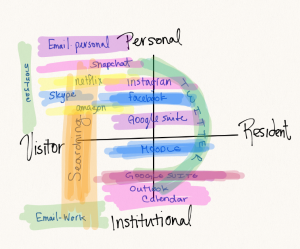
I am not surprised that my map looks like we just took a hard right turn and sent everything flying to the left.  I often think about how much time I spend on social media and the internet in general, but how I am just observing ( visiting). I follow and keep up with multiple different accounts on social media and YouTube, but never find myself interacting with them, just watching- sounds a little creepy.

This made me realize just how separate my certain accounts are. I have always kept my emails and google account separate for work and personal, with very little overlap. For me, they serve two different purposes. I even have two instagram accounts, one open account where I share pictures of my dog and our adventures ( no pictures of me), and a private account where I share more personal ones of myself.

This brings me back to the balance of being open and sharing. I think Twitter has been my best tool for balancing the resident half and being both personal and institutional. A few years ago I use Twitter more frequently and I tried to do a mix of educational and (chosen) personal communications. I added the feed to my blog to help challenge myself to Tweet more and try to work on those connections.

I really enjoyed learning about Visitors and Residents mapping, as this is a relatively quick exercise that can lead to great discussions and reflective thought. Let me know if you have any questions.

Where do I even start?

As the Royal Roads MALAT virtual symposium has come and gone, I am left even more excited to really start to dig in to this program. I have given myself some time to reflect and reread the pages of notes I had taken to try to make sense of it all. I feel like I would be able to write pages discussing all the sessions I watched and ideas presented, this was truly an enriching experience. Where do I start was a big thought I had as I worked on this first blog post.

Well let’s start with one collaborate session I was available to be live for was with Trish Dyck discussing the Key Success Factors for Virtual Teams. This session seemed very practical for me, as we are embarking on working in virtual teams for the next two years. The practical resources that was shared for our teams to use is something that I think will be used plenty in the next two years http://teamswork.royalroads.ca/ . I also enjoyed the practice what you preach model that was used, when a few of us were able to turn on our cameras and see each other, whether we were the one speaking or not. This really connected what Dyck was talking about on how important it is to build that community virtually.

The topic of virtual community is something that has been on my mind lately and something I struggle with in my own practice. Currently I am a secondary DL teacher, but I do not do any virtual face to face with my students. We do have a physical community space for our students, but not all our able to take advantage of that. I am torn with how I can create more of a community in my own online classroom that works within the restrictions of a asynchronous model.

This leads me in to the next topic which is about openness and open education.This topic had me perplexed on what open education actually meant. Hearing that Open education could vary from being an Open education practice ( OEP), Open education resources (OER) or Free- open admission (Cronin, 2017). Furthermore, the discussion around the teacher being open and in which way is something that I am constantly thinking about, as I am sure every educator does at time. The break down of openness and sharing that Cronin (2017) gave using macro, mesa, micro and nano was exactly what I needed. I struggle daily with how much of myself I should bring in to school and how much I should as of my students. I hope that I can come to a conclusion for my own practice that will work for me and my students, I guess time will tell. 

After watching and reflecting on all of these, I think one of my largest take aways is what Dr Elizabeth Childs (2018) said in the last session, and that is “to be intentional”. As life is busy, and adding a masters degree is not making it less so, it is easy to look at some tasks as hoops to jump. I am going to challenge myself to remember those words as I work through this program.

References

Childs, E., Veletsianos, G. (2018, April) Threading the Themes Together Presented in the Virtual Symposium of the 2017 MALAT Program at Royal Roads University, Victoria, BC, Canada.

Cronin, C. (2017, April). Open culture, open education, open questions Presented in the Virtual Symposium of the 2017 MALAT Program at Royal Roads University, Victoria, BC, Canada.

Dyck, T. (2018, April).  Key Success Factors for virtual Teams Presented in the Virtual Symposium of the 2018 MALAT Program at Royal Roads University Victoria, BC, Canada.