
Our “threesome” decided to look into how to buy the most appropriate inflatable paddle board (iSUP) for our leisure use. This is something none of us is genuinely or deeply familiar with, but both Chad and Beata were looking into purchasing one in the near future; thus a great opportunity arose.
The Search Begins
Gone are the days from our childhood where, in the nearby library after hours of research, we could feel the  satisfaction that we did everything we could to gather the necessary and available information on a topic. Now with the internet, no matter how deep you go into the rabbit hole, you can still go deeper. There is no “I finished” feeling, only the “I’ve got to stop here” feeling. Not only is knowledge readily accessible and available to today’s learners but knowledge scarcity has disappeared with digital formats, and learners like us no longer need to visit local libraries (Weller, 2011).
Is Google Our Best Friend?
We all began our search on Google (our best friend) and gave ourselves a 2-hour time limit. An initial search of “inflatable paddle board” resulted in close to fifty-six million findings and a quick feeling of overwhelm for this activity. A few adjustments and further refinement of search variables, phrases and filters, still resulted in a few million.
Within a couple of hours of searching, we realized we had an abundance of information, with the resources available online for free in the forms of personal blog posts, the best iSUPs of 2018, customer reviews, comparisons, and YouTube video tutorials. We needed to narrow down our search quickly. We experienced that the abundant digital content is changing the way we search and find information and how we learn. This project reiterated the importance of having a plan in place before beginning the research. Without a time limit or a specified set of criteria, the whole process could have taken a lot longer than it did and with a lot more stress.
Time is No Friend of Mine
There was no issue in finding content on iSUP’s. The issue becomes the scarcity of time. There is the old saying that says “you don’t know what you don’t know until you know it.” With the limited amount of time that we gave ourselves and with the abundance of content available we were just beginning to understand what we “didn’t know.”

We had an abundance of content, but whether these sources were reliable and useful would take several hours to find out. This is where abundant content met our limited time, and limited individual attention (Weller, 2011). As Weller (2011) pointed out, having access to abundant content conflicts with having limited time to absorb it, digest it, and make use of it: now it is not the content that is scarce, but our time and attention. Clicking through different pages, skimming articles, best practices, and quickly listening to tutorials were time-consuming. It was not easy at first to feel comfortable that we were finding what we were looking for.
Great Minds Don’t Think Alike
 The three of us had different ways of organizing our information, and we were able to communicate our findings with each other to help make an informed decision. The internet gives us these opportunities to interact and organize, share our resources, and ultimately creating a learner- organized virtual support system (Anderson, 2016). For example, we used a combination of charts and Evernote to keep track of our findings. Without visiting a retail store, the three of us could find the best ISUP to meet our individual needs.
The freedom of information at our fingertips gave us a sense of freedom and independence. The internet gives the user the power to communicate and research with the added benefit of a very low cost (Anderson, 2016). We did not have to visit stores or call any manufacturers which could have taken days to research. In addition, we were able to read online reviews that gave us authentic feedback on our paddle boards.
There was a time where you would have to go to a store to seek experts advice on what board to use and why. Now through YouTube and blogs, we can seek the advice of regular people who are just like us. As Anderson (2016, p. 41) cites Bruns, we have entered the age of “Produsage.” No longer are reviews and tutorials being put out by the companies who have a vested interest but by consumers of the products themselves. With a smartphone and an opinion, anyone can put their content on the net.
Nowadays the ability to quickly and effectively find, access and navigate information is a required transferable skill (Weller, 2011). How can we support the learners to navigate this abundant content supply?
Paddleboard Lessons Anyone?
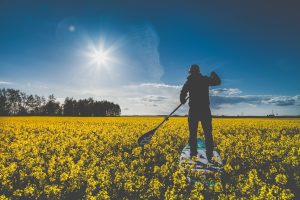
As the instructors of a course in information on paddleboarding (Wouldn’t that be a nice gig?) we found that the theory of Connectivism fits nicely as a model for instruction. What we are effectively teaching is not only what to look for when there is an interest in paddleboards but how to organize and synthesize what they have found. As instructors we would use the principles of connectivism (Weller, 2011, p.231):
- Learning and knowledge rest in the diversity of opinions. We would have our students find at least five sources of information providing them with criteria such as paddleboards for beginners, iSUP vs solid body, and maintenance.
- Learning is a process of connecting specialized nodes or information sources. Students would have to provide similarities and differences that they found among their sources, such as prices of accessories.
- Learning may reside in non-human resources. Where are the students curating their information? Teach them how to do this, such as evaluating credible sources.
- Nurturing and maintaining connections is needed to facilitate continual learning. Have the students find a blog of a person that owns a paddleboard and they could follow on the subject of iSUP.
- Reality shifts, what may be true today may not be true tomorrow. Have the students look at the history of iSUP and discuss what has changed. With this information then visit relevant brick and mortar stores, and get info/tips/best practices from the hopefully informed salespeople. Reflect on the different approaches of finding information (online and in person) and discover the positives and negatives to these approaches.
Will Beata or Chad Buy an Inflatable Standup Paddleboard?
This process was a great experience. It was not new to any of us that we are in this digital age of abundance of content.
The conclusion of this activity was interesting as Beata took her information to a store to compare as she is interested in purchasing one. One 2017 study showed that about 71% of consumers are still shopping online to find the best price but many visits the brick and mortar stores after that to get some real-life experience, especially in higher priced items. This is called webrooming (shoppers browsing online and buying in-store), and that is precisely what Beata did. She had seen and touched solid SUPs before but had a hard time imagining how an inflatable paddle board could bear such weight and forces and behave similarly to the solid ones. This empirical evidence, literally touching the iSUP and jumping on it, as well as trying out the different quality paddles provided the final information to be able to make a final decision, the iSUP!
Another interesting result is Chad who was initially interesting in purchasing a paddleboard just for lakes and oceans found out that the sport can extend to rivers. This opens up a whole new world of items to research.
Danielle who had never actually thought of this product as a possibility is now looking to invest in one for the summer!
Maybe we will see each other on the water one day, and compare our purchases!
References:
Anderson, T. (2016). Chapter 3: Theories for Learning with Emerging Technologies. In Veletsianos Emergence and Innovation in Digital Learning: Foundations and Applications (pp. 35–50). https://doi.org/10.15215/aupress/9781771991490.01
Weller, M. (2011). A pedagogy of abundance. Spanish Journal of Pedagogy, 249, 223–236.
All images are taken from pexels.com with a creative commons 0 license. Click here for more information
Feature image is by the author


September 30, 2018 at 9:20 am
Hi Chad, Great post you three! I love the reference to learner-organized virtual support systems. I found this exercise (and other team activities) so much more enjoyable than slogging through the information myself. I have also really enjoyed the shift of learning in the digital era to what Siemens referred to as more learner-centered or learner-controlled (as cited in Weller, 2011). The independence and self-direction give so much more freedom which helps to keep me engaged.
Did any of you have any thoughts on Community of Practice for this subject? Would you consider finding some other ‘SUPpers’ to band together with once you purchase a board?
My husband finally caved and bought me an inflatable for my birthday this past summer. ($399 at London Drugs!!!) It is heaven…and I cannot wait to try some yoga moves on there once I gain some skill and balance!
Thanks for the post.
Christy
Weller, M., (2011). A pedagogy of abundance. Spanish Journal of Pedagogy, 249, 223–236. Retrieved from http://oro.open.ac.uk/28774/2/BB62B2.pdf
October 2, 2018 at 12:48 pm
Great post guys, I really enjoyed reading about the different experiences you encountered throughout your research, it makes me consider to invest in one lol.
Throughout the various blog posts that I have read, each post has common themes reoccurring such as; a vast amount of content available, being able to narrow your scope when searching for information on a particular topic, being able to distinguish which sources are credible and valuable etc. This exercise/ activity for my teammate Jessica and I, highlighted the importance of time management when conducting searches and narrowing our scope towards finding the relevant information needed due to the availability of abundant content. As you guys have mentioned “the importance of having a plan in place before beginning the research” I think is very important to consider when conducting research.
Cheers
Phyz