
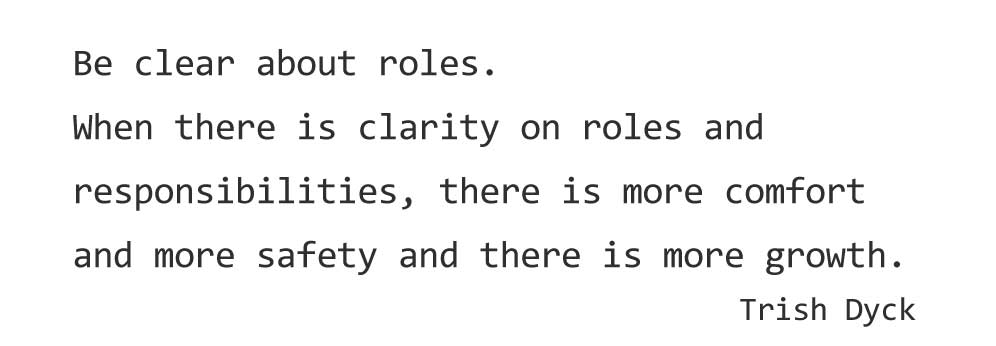
Topic: Key Success Factors for Virtual Teams presented by Trish Dyck
The presentation was a great addition and complimented the team coaching session and the team assignment in the Link course.
I am a huge fan of collaboration in Slack, but I agree that in virtual teams we need to bring “our faces” into the same room. It does not matter if that room is a Collaborate room, Google Hangout, or Zoom video… Just meet (virtually) and put faces next to those voices and messages and allow to take turns in the conversation (Google Guide: Understand team effectiveness, 2014).

Code-named: Project Aristotle
This Key Success Factors for Virtual Teams presentation was the second time when I heard Trish mentioning the research where Google searches itself for building more productive teams. Code-named: Project Aristotle, where the name seems to be a tribute to Aristotle’s quote, “the whole is greater than the sum of its parts”, and the research goal was to answer the question: “What makes a team effective at Google?”
The end result was a guide to understanding team effectiveness. As in many other organizations much of the work done at Google is done collaboratively by and in teams.
“The team is the molecular unit where real production happens, where innovative ideas are conceived and tested, and where employees experience most of their work. But it’s also where interpersonal issues, ill-suited skill sets, and unclear group goals can hinder productivity and cause friction.” (Google Guide: Understand team effectiveness, 2014, paragraph 1).
The researchers found that what really mattered was less about who is on the team and more about how the team worked together. In order of importance, the following important parameters surfaced: psychological safety, dependability, structure and clarity, meaning, impact.
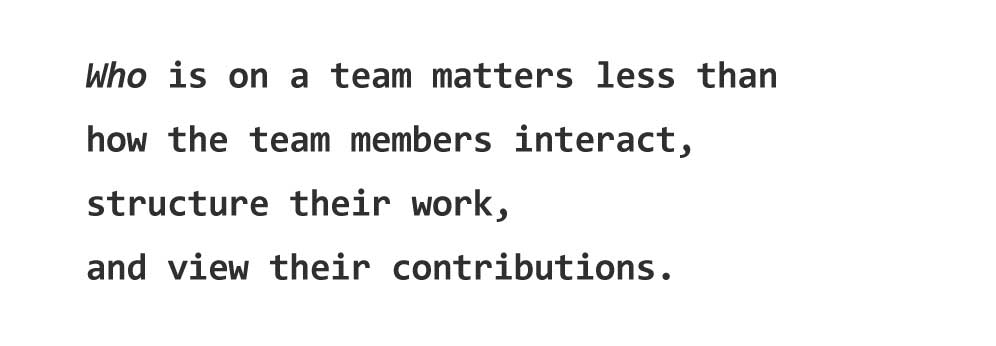
The researchers also discovered and listed which variables were not significantly connected with team effectiveness at Google: colocation of teammates (sitting together in the same office), consensus-driven decision making, extroversion of team members, the individual performance of team members, workload size, seniority, team size, tenure.
Distributed companies: Automattic
There are several companies that have embraced remote work culture, virtual teams and are called distributed companies (Wikipedia). In the web development field, one early adapter is Automattic, the company behind WordPress, which maintains being “distributed” with more than 650 employees, living in over 65 countries, speaking almost 80 languages.
I believe it was Toni Schneider, the previous CEO of Automattic, from whom I first read the term distributed: “Our people are distributed. They’re spread out. No negative connotations. They’re not removed or separate from anything” (Schneider, 2010).
A distributed company doesn’t have one, large centralized office but there are other office options available. At Automattic, employees work in a distributed workforce system meaning that they work remotely – mostly from home at their convenience (or really from anywhere), but if there are several people near each other that’s a good reason to start up a co-working space (Mullenweg, 2018).
Toni Schneider described few key benefits of distributed companies and virtual teams:
- Employees get the best of working remotely – flexible hours, no commute, a personal work environment, more time with friends and family.
- The employees get to live where they want, not where the job market dictates.
- Employers can hire great people wherever they find them.
- The virtual teams use many communication tools, and the conversations can be archived, they are searchable, and visible to the entire team.
- The teams can be social, can meetup time to time in different locations in the world.
Matt Mullenweg, the founder and the current CEO of Automattic says from his leadership experience that although web collaboration tools got better over the years meeting in person is still the best way to connect with someone and get to know each other. In his opinion virtual has gotten better but in-person engagement with colleagues is still vital in order to forge a stronger company culture. Automattic holds a one week long “grand meetup” every year. Last two years this event was in Whistler, British Columbia (Canada) where the more than 600 employees attended from all over the world. Apart from this annual meet-up there are normal group meetings as well as where a group of 8-15 people come together to discuss team projects and strengthen the teams’ collaboration.
All illustrations are created by the author.
References
Dyck, T. (2018, April). Topic: Key Success Factors for Virtual Teams Presented in the Virtual Symposium of the 2018 MALAT Program at Royal Roads University, Victoria, BC, Canada.
Google Guide: Understand team effectiveness. (2014). Retrieved from https://rework.withgoogle.com/print/guides/5721312655835136/
Mullenweg, M. (2018, February 18). No Office Workstyle. Retrieved from https://ma.tt/2018/02/no-office-workstyle/
Schneider, T. (2010, March 8). Retrieved from https://toni.org/2010/03/08/5-reasons-why-your-company-should-be-distributed/
Wikipedia. (n.d.). Distributed workforce. Retrieved from https://en.wikipedia.org/wiki/Distributed_workforce