

Going through the d.school Design Process, reading the Mattelmaki et al. (2014) article and discussing it with my husband, I had the following thoughts on empathic design, empathy in the design process and its relation to my current work in teaching and web.
Our ability to share the feelings of other humans, to put ourselves in their shoes and see the world from their perspective, is a cornerstone of a community, teaching or building anything new in today’s world. But in my professional experience, this sometimes ends up being an unconscious projection of our own experiences and biases onto other people. Empathy is the mid-point on a continuum of automatic emotional response: quick, intuitive, easily manipulated, and often misleading.

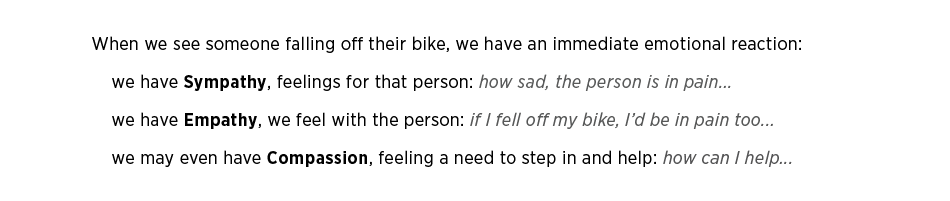
With empathy in the driver’s seat, we literally put ourselves in someone else’s shoes, and during this, we are not basing our actions on their experiences but instead projecting ourselves onto them by figuratively asking ourselves what we would want if we were in that situation. But unless we are, or have been, in the same situation with the same prior experiences, our automatic emotional response can mislead us resulting in solutions that work counter to our intentions. We need to use our automatic emotional responses wisely and make ourselves aware of when we are projecting our own experiences onto others so that we can focus on their experiences rather than our own.
Our empathy is rooted in our life experiences and social and emotional biases. In his Thinking, Fast and Slow book, Daniel Kahneman (2011) explains how our thought processes are split into System 1: fast, reactive, emotional, and System 2: slow, reflective, logical. He also describes how factors such as bias, availability, proximity, that power System 1 often mislead us. Sympathy, Empathy, and Compassion fit under System 1 and are likely to all these errors.
We make decisions as a designer (any kind) based on years of experience what has shaped our biases toward our preferences, but our audience does not see the world through our eyes. Thus, we should move our thought process from the emotional and reactive System 1 to the reflective System 2, and we can take a critical look and design in a balanced way and can create better designs by truly placing the people we communicate with at the center of our process.
How do you feel about the Design Challenge?
Illustrations are created by the author.
References
Kahneman, D. (2011). Thinking, Fast and Slow (Kindle). Farrar, Straus and Giroux.
Mattelmäki, T., Vaajakallio, K., & Koskinen, I. (2014). What Happened to Empathic Design? Design Issues, 30(1), 67–77. https://doi.org/10.1162/DESI_a_00249
Schairer, S. (n.d.). Empathy vs Sympathy vs Compassion | The Chopra Center. Retrieved November 17, 2018, from https://chopra.com/articles/whats-the-difference-between-empathy-sympathy-and-compassion
Stanford University Institute of Design. (2016). A Virtual Crash Course in Design Thinking — Stanford d.school. Retrieved November 12, 2018, from https://dschool.stanford.edu/resources-collections/a-virtual-crash-course-in-design-thinking
Hi Beata,
In response to your question I really enjoyed the d.school process. It allowed me to think about design in a completely new way. I thought that the element of empathetic design was very useful and allowed me to generate new ideas while thinking about the problem in a new way by using a different perspective. However, I am not sure if it would be something that I could do on a regular basis as a sole method of design. As with everything I do, I feel like this would be a great element to a design process, one part of a plan to create a new solution. While doing more research on the d.school I came across a fair amount of criticism for the process. Vinsel (2018) suggests that the d.school is commonsense wrapped up in an excellent business and marketing plan. Iskander (2018) suggests that design thinking is not as innovative as they would like you to think. The author compares it to a model called the rationale-experimental approach that was developed and used in the 1980’s.
Rational-experimental problem solving was built around a series of stages, each leading up to the identification of a solution. Likewise, design thinking is generally described as being made up of modes, stepping stones in the design process, with each mode reflecting a different aspect of design thinking. (Iskander, 2018)
As I have started to discover, all models are built in part, on the foundation of another. I feel like design models offer a selection of elements that can be combined to create a model that works depending on the unique context the designer is dealing with. I am not sure there is any one single solution.
Iskander, N. (2018). Design Thinking Is Fundamentally Conservative and Preserves the Status Quo. Harvard Business Review, (September), 1–9
Vinsel, L. (2018). There ’ s So Little There There : A Response to the Stanford d . school ’ s Defense of Design Thinking. Retrieved from https://blog.usejournal.com/theres-so-little-there-there-a-response-to-the-stanford-d-school-s-defense-of-design-thinking-3cac35a1a365
Thank you, Tanya, for your response!
I do appreciate you sharing the Vinsel (2018) article; I just read it and the one he wrote earlier for Medium (Vinsel, 2017). I feel a lot of overlap in our thoughts and some fears regarding the d.school Design Process. You mentioned Vinsel (2018) suggestion that the d.school is common sense wrapped up in an excellent business and marketing plan. That might be true, but at the same time most of the things what we do, or buy is mainly common sense wrapped up in an excellent business and marketing plan and sold to us, convincing us that we need it. At times we do, other times we don’t. Sometimes they anticipate future demand, different times they create the demand.
In my above post, I described that empathy is the mid-point on a continuum of automatic emotional response. I agree with Daniel Kahneman (2011) and his original work with his research partner Amos Tversky, that the goal is to move our thought process from the emotional and reactive, to the reflective zone, and with that we can design in a balanced way and can create better designs by placing the people we communicate with at the center of our process.
With the d.school design process we seemingly cover the process, but not our reactions. We do not learn in any way how to indeed exercise empathy.
Although it is an off topic, if you are interested in the decision-making process, you might wish to take a look at Kahneman and Tversky’s articles, or later on Kahneman’s 2011 book: Thinking, fast and slow. Kahneman and Tversky work created the field of behavioural economics, revolutionized Big Data studies and research. They are more responsible than anybody for the trend to mistrust human intuition and defer to algorithms.
References
Kahneman, D. (2011). Thinking, Fast and Slow (Kindle). Farrar, Straus and Giroux.
Vinsel, L. (2018). There’s So Little There There : A Response to the Stanford d.school’s Defense of Design Thinking. Retrieved from https://blog.usejournal.com/theres-so-little-there-there-a-response-to-the-stanford-d-school-s-defense-of-design-thinking-3cac35a1a365
Vinsel, L. (2017). Design Thinking is Kind of Like Syphilis — It’s Contagious and Rots Your Brains. Retrieved from https://medium.com/@sts_news/design-thinking-is-kind-of-like-syphilis-its-contagious-and-rots-your-brains-842ed078af29
Hi Beata
Thanks for the post and also it’s been interesting reading the interaction between Tanya and yourself. I have two points that I want to make and would love to hear your thoughts on:
1- I do fully agree with the idea of showing empathy when we are designing. I also agree that we have to be careful with how we do this. Our version of empathy is completely biased by our own experiences, emotions and perceptions. This is why I resonated so closely with Kahneman’s (2011) view of the two systems. We need to be self-aware and understand that empathy is biased, and this is why the second stage is so important. We need to take time to reflect on why we are empathizing the way we are. I guess you could call it reflective empathy?
2- I’m glad you brought up the medium article that was written by Vinsel (2017). He makes a strong point against design thinking (actually he makes more than one, not that I agree with all of them, but again he has his biases and I have mine). One thing he mentions echoes my own feelings about the design thinking process, “We can use language like “empathy” to dress things up, but this is Business 101. Listen to your client; find out what he or she wants or needs.” (2017). I teach an entrepreneurship course at BCIT and this is literally in lesson #1.
Again I do think empathy plays a huge role in design but I do think we need to be careful. We need to take time and reflect on where our empathy is coming from. By digging deeper into yourself and our own biases maybe we will find some innovation that wasn’t there before?
Kahneman, D. (2011). Thinking, Fast and Slow (Kindle). Farrar, Straus and Giroux.
Vinsel, L. (2017). Design Thinking is Kind of Like Syphilis — It’s Contagious and Rots Your Brains. Retrieved from https://medium.com/@sts_news/design-thinking-is-kind-of-like-syphilis-its-contagious-and-rots-your-brains-842ed078af29