

Barack Obama described that the needs of the 21st-century students are the problem solving, critical thinking, communication, collaboration, creativity, and innovation (2009, as cited in Goldman et al., 2012). Rowland suggests that a novice designer [of any kind] should gain experience in design thinking process with real or realistic situations in a case-based method of teaching what he considers the best methods of learning the design process (1992, as cited in Kenny, Zhang, Schwier, & Campbell, 2005). These lead me again to design thinking. Goldman et al. (2012) also state that post-secondary students need more development in critical thinking and problem-solving, and that design thinking has the potential to improve them. I agree that these skills in students need improvement and would expect that design thinking help in achieving it. Goldman et al. (2012) describe the design thinking process as thinking imaginatively using new instead of traditional or expected ideas, thinking differently from a new perspective. The five key stages in design thinking relate to the ability to empathize, define, ideate, prototype, and test (Stanford University Institute of Design, 2016). It is a change from learner-centred to human-centred with a stronger understanding of the interactions and empathy needed to transition to the design thinking process.
Mindshifts represent the active shifts that a student makes during the design process (Goldman et al., 2012, p. 15). It’s a change in thinking that can happen quickly and intensely or slowly and gradually. Carol Dweck (2007, as cited in Goldman et al., 2012) states that growth in mindsets can be learned through hard work towards problem-solving. Mindshifts can be challenging to observe though, and throughout the Goldman et al. (2012) study, the viewpoint was shifted to looking more at the epistemological aspects during the evaluation of design thinkers.
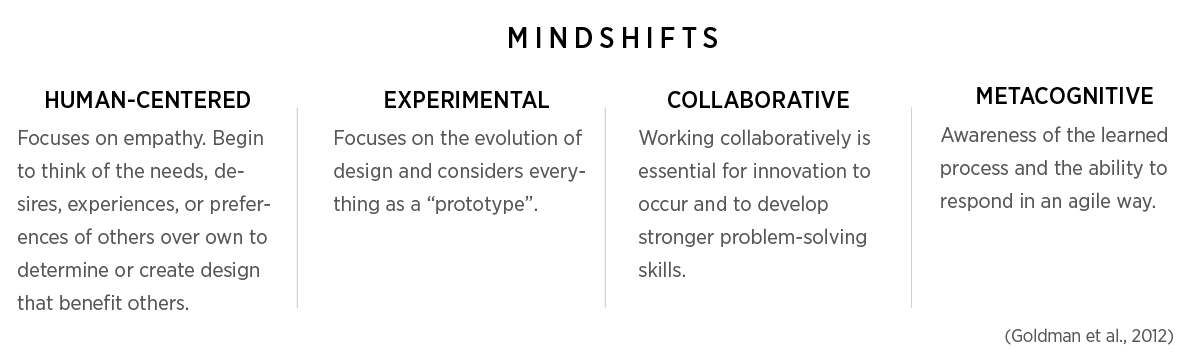
Takeaways for my next case study:
Design thinking encourages different thinking; design thinking is problem-solving and creative confidence and puts doing and innovating at the center of problem-solving.
Heightened confidence in thinking and finding a new dimension to flush out concepts and innovative challenges, seem to empower students to deal successfully with challenging tasks.
Illustrations are created by the author.
References
Goldman, S., Carroll, M. P., Kabayadondo, Z., Cavagnaro, L. B., Royalty, A. W., Roth, B., … Kim, J. (2012). Assessing d.learning: Capturing the journey of becoming a design thinker. In H. Plattner, C. Meinel, & L. Leifer (Eds.), Design Thinking Research (pp. 13–33). Berlin, Heidelberg: Springer Berlin Heidelberg. https://doi.org/10.1007/978-3-642-31991-4_2
Kenny, R. F., Zhang, Z., Schwier, R. A., & Campbell, K. (2005). A Review of What Instructional Designers Do: Questions Answered and Questions Not Asked. Canadian Journal of Learning and Technology, 31(1). Retrieved from https://www.cjlt.ca/index.php/cjlt/article/view/26504/19686
Stanford University Institute of Design. (2016). A virtual crash course in design thinking — Stanford d.school. Retrieved November 12, 2018, from https://dschool.stanford.edu/resources-collections/a-virtual-crash-course-in-design-thinking
Hi Beata! Thanks for kick-starting the conversation for Unit 2. After reading your post and sifting through some other readings for the Unit, I’m wondering what you think about barriers to design thinking. What do you feel are current barriers to teachers, learners, or corporations adopting design thinking in their practices?
I’m also interested in the use of the terms ‘learner-centered’ and ‘human-centered’. I’m going to set off on a tangent, but hopefully I’m clear enough to create conversation.
In healthcare, we have thrown the term ‘patient-centered care’ around for over a decade, and yet it still rings false to me, like an unnecessary half-step forward. As healthcare providers, we are taught to assess, diagnose and rapidly treat illness and disease. We were taught to use our knowledge and abilities to heal and cure. Now, with the impact of chronic diseases, we are seeing a shift in care model. We need to empower our patients to make lifestyle changes to improve their own care. We must become educators without ever being taught how to teach. We must embrace the power of our patients and let go of our healing egos. We need to shift to ‘patient-directed care’. This requires a big shift in self-concept for healers. In parallel, what do you think about the terms ‘learner-directed’, ‘human-directed’ or perhaps ‘user-directed’? Do you feel like, in the process of design-thinking, most individuals are capable of full empathy and releasing their own intentions and objectives? Can we be human-directed instead of human-centered in our design-thinking?
Thanks for considering,
Christy
Thank you for your questions, Christy – you asked a few! I am breaking my habit of looking into literature and research right away, in favour of trying to come up with answers/thoughts by myself.
I tried to consider some of the barriers of design thinking which I see as an essential process in every field, no matter how we call it. There are several factors what influences the design thinking process, and its success and any of them can create a serious barrier. My non-comprehensive shortlist includes the following factors:
– Inexperienced facilitation
– Not enough thought in setting up the teams
– Not sufficient prior experience to participate in the design thinking
– Lack of empathy
– Closed mindset
– Misdiagnosing the problem
– Groupthink
– Limiting ideas with early judgement/idea killers
– Fear of poor grades (for students)
In my mind, in teaching the definition of learner-centred encompasses the learner-directed. A learner-centred course can have learner-directed elements. A learner-directed element would be when I offer the students to come up with a course-related topic and independently research it. But a required reading is not a learner-directed element, although it is learner-focused, and leaves the overall course learner-centred. If I think about merely learner-directed, mainly self-study/independent study comes to my mind.
You also asked what I think about the terms ‘learner-directed’, ‘human-directed’ or ‘user-directed’. In my field when we plan the user experience of a website/web application, we describe the person who visits a website as “user.” In discussions, we switched to call them “people,” rather than “user.” There are discussions around how to call the people using our “products/services.”
There are interesting articles considering the nuances of the words “human” and “user.”
Now, it is time to look into the relevant literature regarding the definitions of learner-centred encompasses the learner-directed…