

Research Paper: Supporting Students with Disabilities as they Transition from Post-Secondary to the Workplace by Heather Thompson
Way to go Heather Thompson in presenting a research paper relating to the support for students with disabilities and providing a link to the presentation transcript. I was happy to hear that it was important for the author to have a combination of disabilities such as learning disabilities, autism, ADHD, depression and anxiety as this allowed for a more inclusive approach to supporting students with disabilities.
The topic resonated with me. The web development field slowly start to focus on inclusive design and web accessibility. I do hope the legal background in Canada will stipulate that all new websites need to follow web accessibility guidelines, like it already happened in some other counties, such as Denmark or Norway.
I always struggled how to introduce the importance of web accessibility to students. I leaned toward setting the mindset first as oppose to just exclusively teach the practical knowledge, the code itself. I favour when the students embrace web accessibility, as it intrinsically motivates them to apply the coding guidelines in their website code. Before the web accessibility course, I conduct a quick survey, and without exception I see a preconception, an implicit and experiential bias in the students that accessibility is only for people with disabilities.
It takes several examples, an inclusive design workshop and group discussions to reach the understanding:
- Cognitive / fine motor / sensory skills impairment can be simply caused by lack of sleep, split attention, environmental restrictions, or alcohol / drug inducement.
- Physical impairment does not mean only a missing limb but can be more situational like a broken arm or even just holding your baby in your arm.
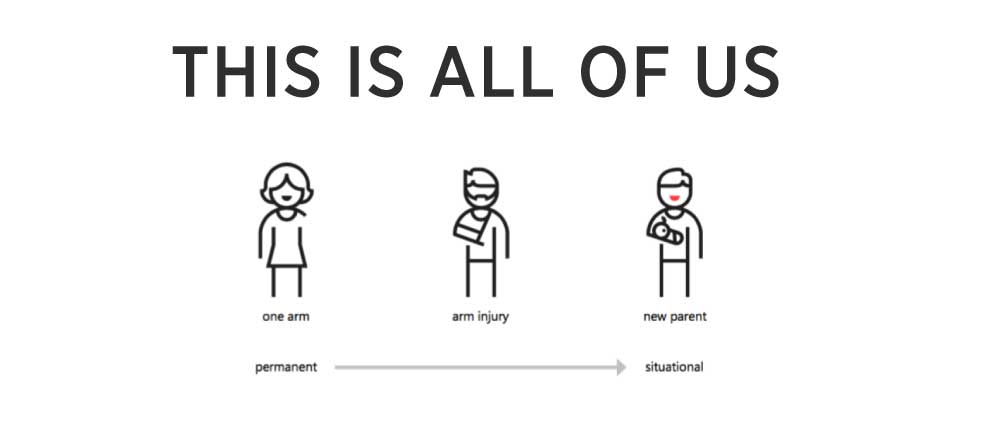
The first principle of web accessibility and inclusive design: recognize exclusion. It means examining what you create and recognizing who would be excluded from using it. Web accessibility means the person decides the best way for them to access the content. It is about making the world understandable and available to all.
I hope to read this research paper when it is submitted, as the author stated that the purpose of her research is to provide educators with different elements that includes recommendations and best practices to support students with disabilities as they transition from post-secondary to the workplace.
As I described in the above illustration: “this is all of us”, as any of us, or our students can be depressed, or fall into anxiety throughout the different school programs.
All illustrations are created by the author.
References
Microsoft. (2016). Inclusive Microsoft Design Toolkit Manual. Retrieved from https://download.microsoft.com/download/B/0/D/B0D4BF87-09CE-4417-8F28-D60703D672ED/INCLUSIVE_TOOLKIT_MANUAL_FINAL.pdf
Thompson, H. (2018, April). Supporting Students with Disabilities as they Transition from Post-Secondary to the Workplace. Paper presented in the Virtual Symposium of the 2018 MALAT Program at Royal Roads University, Victoria, BC, Canada.
W3C. (2018, January 30). Web Content Accessibility Guidelines (WCAG) 2.1. Retrieved from https://www.w3.org/TR/WCAG21/
W3C. (n.d.). Web Accessibility Laws and Policies. Retrieved from https://www.w3.org/WAI/Policy/