
Copyright infringement is the use of works protected by copyright law without permission, infringing certain exclusive rights granted to the copyright holder, such as the right to reproduce, distribute, display or perform the protected work, or to make derivative works. (“Copyright infringement – Wikipedia,” n.d.)

Plagiarism is the “wrongful appropriation” and “stealing and publication” of another author’s “language, thoughts, ideas, or expressions” and the representation of them as one’s own original work. Plagiarism is considered academic dishonesty and a breach of journalistic ethics. It is subject to sanctions like penalties, suspension, and even expulsion. Recently, cases of “extreme plagiarism” have been identified in academia. The modern concept of plagiarism as immoral and originality as an ideal emerged in Europe in the 18th century, particularly with the Romantic movement. Plagiarism is not in itself a crime but can constitute copyright infringement. In academia and industry, it is a serious ethical offence. (“Plagiarism – Wikipedia,” n.d.)
I have been an advocate about copyright for most of my lifetime; my first degree was in publishing major and business minor. For a few years, I wrote magazine articles for major print publications in Hungary. Knowing the copyright laws of one’s residence and respecting the works of others are vital. Designing, creating illustrations myself I always try to avoid the entire issue by only using images, graphics, and researches I produced. This is naturally not always possible; thus we need to know and respect the domain.
Canadian copyright legislation has improved over the last couple of years with the implementation of a significant amendment in 2012. However, unless you’re a lawyer, a librarian who specializes in copyright, or a very-very interested person, the laws surrounding copyright in Canada (and elsewhere) are daunting. For example, posting an image onto your internet blog (or into your presentation) multiple nations and international copyright laws can have an effect.
Countries that are part of the Bern Convention must follow the law of the land when it comes to copyright law, as the law depends on the country the person is is resident. Melanie Wrobel the copyright manager of Royal Roads University shares (2016, 5:36): “In Canada, copyright protection is by default, you do not have to register your work to be protected by copyright.” Canada offers copyright protection of authors death plus 50 years while the United States provides authors death plus 75 years. Depending on where the user resides, that country’s law is in effect regardless of the user’s nationality. If a Canadian is living in the United States but wishes to utilize copyrighted material of another Canadian, then they must follow the copyright law of the USA as that is where the usage is originated.
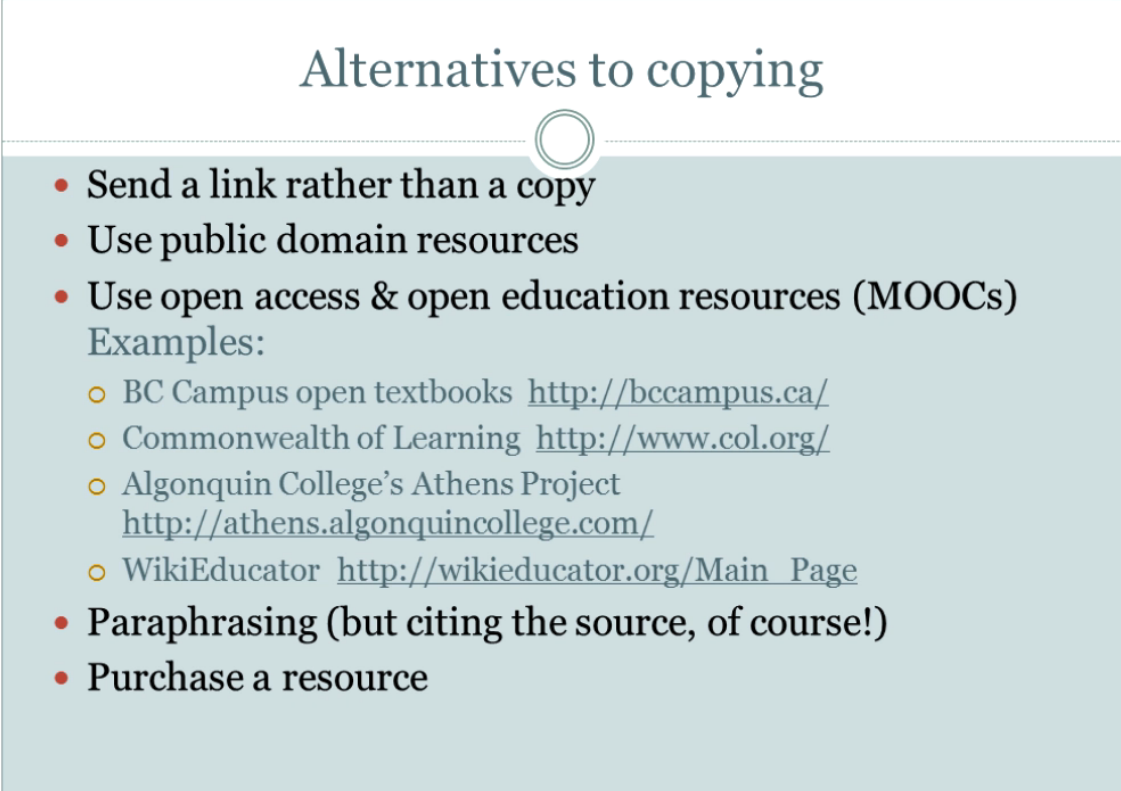
Figure 1: Alternatives 24.40
Melanie Wrobel offered abundant information and resource to get to know what one can or cannot do, and how to avoid intentional or accidental plagiarism. Wrobel created an informative presentation which provides guidance on copyright and practical alternatives to using copyrighted materials. Replacement options were listed (Figure 1) such as providing a link to the material instead of copying it, using materials from the public domain, using resources that are open, using citations and paraphrasing, or simply purchasing the copyrighted resource legitimately (Wrobel, 2016).
I have been working as a teacher for the last seven years and have applied copyright, citation, and fair use policy within the web development program I teach. During the program, the students need to apply many of these rules. Some of them are related to:
- How to use photos, images from the web, such as free libraries (like Pexels, Pixabay, Unsplash etc.), or Flickr, where Creative Commons (CC) rules apply.
- How to use and adequately give credit for proprietary or open source code.
- How to use free (Pexels video, Videvo, Videezy) or other videos in websites or web applications.
- We include some open source materials for the students, which is not surprising as in web development, especially in HTML / CSS / PHP / JavaScript most of the elements are open source. Their citation does not follow APA or other standards such as MLA, or Chicago, but there is a standard way of giving credit for someone’s work.
The implementation of copyright and citation is up to the instructors, but the majority of the instructors are part-time, which makes it difficult to implement or enforce the use of copyright and citation. British Columbia Institute of Technology (BCIT) tries hard and provides all the processes and resources, and fair dealing guidelines.
All illustrations are created by the author.
References
Copyright infringement – Wikipedia. (n.d.). Retrieved from https://en.wikipedia.org/wiki/Copyright_infringement
Plagiarism – Wikipedia. (n.d.). Retrieved from https://en.wikipedia.org/wiki/Plagiarism
Wrobel, M. (2016, June 13). A Guide to Copyright [Video file]. Retrieved from: https://moodle.royalroads.ca/moodle/mod/page/view.php?id=245370