
Photo by Josh Calabrese on Unsplash
Looking through another’s lens can be said to be at the heart of empathic design. As Matthews et al., (2017) indicates, “Instructional designers are also increasingly encouraged to express empathy in their work (p. 486). As instructional designers, it is imperative to see the problem through the lens of the people that we are designing for. Matthews et al. (2017) identifies three notions of empathy that were derived through the research with instructional designers in the field. These notions are set out as caring for the person, identifying with the person and walking in their shoes (p. 488).
In preparation for designing a different approach to delivering policies and procedures training to staff, I also must take an empathic stance so as to design an instructional tool that will meet the needs of the users.
Kouprie & Visser, (2009) tell us that empathy can be broken into two parts, affective, identifying with feelings of the user and cognitive, understanding the users’ perspective and that “Creating the right balance between affective resonance and cognitive reasoning is a basic issue of empathy” (p. 442).
Stanford University Institute of Designs’ Bootcamp Bootleg offers many methods to utilize in order to gain empathy. When looking into these many methods it became apparent that, not only would more than one of these methods be appropriate for this undertaking, some go very well together in succession. As a result the methods that I have chosen are as follows:
 Overall, throughout the process of gaining empathy, assuming a beginner’s mindset will be of particular use. The development of policies and procedures are often a core component at the management level and managerial understanding can exist at a different level than that of an entry level employee who may be quite unfamiliar with interpretation and application of policies. Assuming a beginner’s mindset will allow for application of an unbiased and curious stance which will allow for an empathic framework of stepping into the user’s shoes (Stanford University Institute of Design, 2016, p. 9).
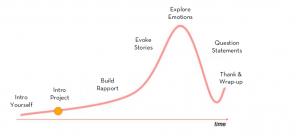 Interviewing for empathy will be useful as a way to gain access to the user’s thoughts, perceptions and feelings as well as a method to explore and record these interactions. Interviews will assist in developing a path toward the cultivation of deep empathy (Stanford University Institute of Design, 2016, p. 12).
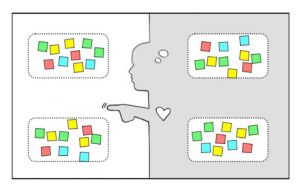
As a way of unpacking the data from the interviews, the use of the empathy map will assist in identifying the users’ needs as well as any insights that can be pulled to “better respond to a design challenge” (Stanford University Institute of Design, 2016, p. 18).
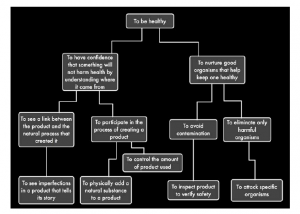
As a final step, the Why-How Laddering may be useful as a way to drill down into the needs of the user as identified in the empathy map, making use of any insights that were gained to go from abstract needs to more specific needs (Stanford University Institute of Design, 2016, p. 23).
Understanding that an identified tension of conflicting needs of multiple stakeholders may arise as identifies my Matthews et al., (2017), the empathy map may prove to be an essential component for categorizing contradictions between what users say and what they do. This may prove to help reduce the apparent conflicting needs (p. 489).
References
Kouprie, M., & Visser, F. S. (2009). A framework for empathy in design: stepping into and out of the user’s life. Journal of Engineering Design, 20(5), 437–448. https://doi.org/10.1080/09544820902875033
Matthews, M. T., Williams, G. S., Yanchar, S. C., & McDonald, J. K. (2017). Empathy in Distance Learning Design Practice. TechTrends, 61(5), 486–493. https://doi.org/10.1007/s11528-017-0212-2
Morris, H. E., & Warman, G. (2015). Using Design Thinking in Higher Education. Educause, (September 2014), 1–15. Retrieved from http://er.educause.edu/articles/2015/1/using-design-thinking-in-higher-education
Stanford University Institute of Design. (2016). Bootcamp Bootleg. Retrieved from http://dschool-old.stanford.edu/wp-content/uploads/2013/10/METHODCARDS-v3-slim.pdf

July 1, 2019 at 8:24 am
Hi Theresa!
Teaching policies and procedures could be a very daunting undertaking! First off, congratulations for addressing this topic so courageously.
I think that you’re on the right track to generate ideas on how to best learn this subject-matter and effectively utilize this knowledge deriving ideas from your audience.
Jumping a bit ahead to the end result, I was wondering how are you planning to deal with the bias of your internal management stakeholders approving your solution, as I foresee some conflicts in the ideas your audience will come up versus the ideas management currently has on how to teach the subject matter, in case your stakeholders think it’s a performance versus a learning problem. As stated in Mathews et al. (2017), “expressing empathy with learners as well as other stakeholders can lead designers to contradictory or conflicting design requirements” (p. 490). My suggestion would be to come up with a strong business case to base your design thinking challenge on, such as statistics of non-compliance and the consequences of this non-compliance for the organization.
All the best with tackling your challenge!