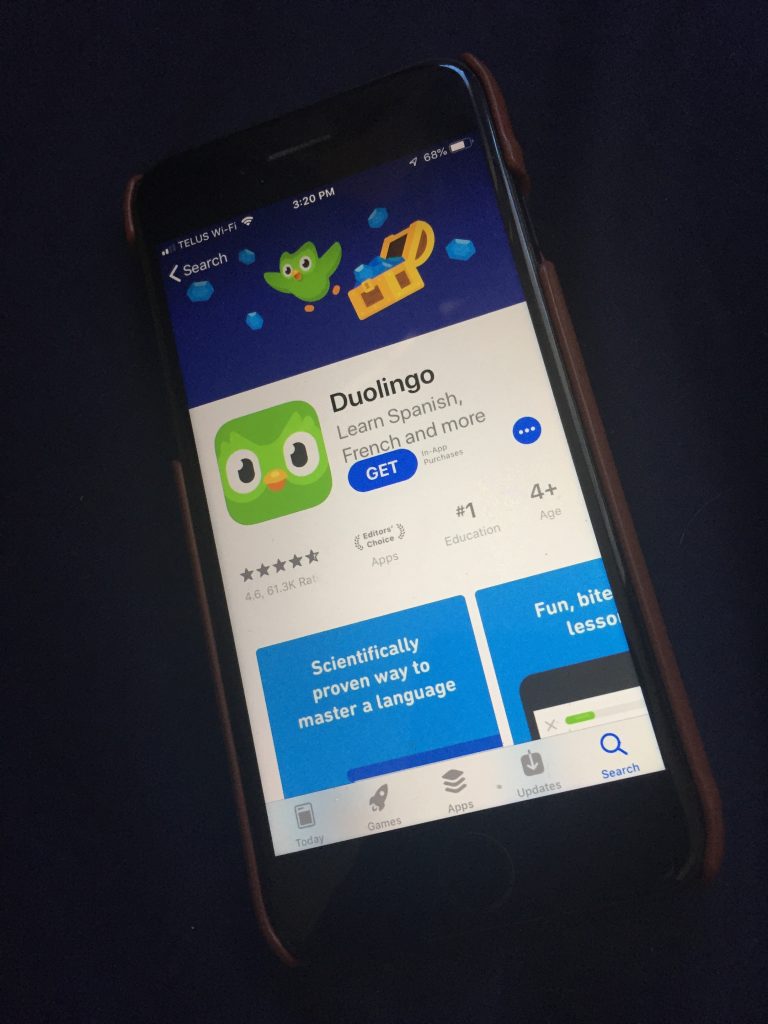
In an effort to examine a learning event through critical inquiry, as a team, we needed to decide on a particular learning event as well as a delivery technology. For the purpose of this exercise, our team chose to learn another language using Duolingo. Individually we were asked to identify a question that we would like to pursue as we explore Duolingo. I, personally, would like to know if the effectiveness of the gamified learning that is employed in Duolingo is affected by time spent. If I enjoy the app and use it more often or if I have a particular goal in mind that leads me to use the app more often, will Duolingo be more effective than for a learner who does not enjoy the app or are not necessarily using it because they chose to.
Vesselinov & Grego, (2012) indicate that 88% of the study participants enjoyed using the app and that the most improvements were made in the groups that were using the app for travel. This may indicate that either enjoyment or goals minded use may increase the time spent thereby affecting the effectiveness of the app. I am exploring this app on my smartphone and so far I have found it enjoyable. The app has many small achievements to unlock and mini levels that gradually increase mastery. There are gems to collect and badges to earn which is an exciting way to engage in a learning environment. The app suggests that the goal is to engage for 10 – 15 minutes per day. It is still to early to know if I am gaining any lasting mastery however, as Cavus and Ibrahim (2009) was cited in Munday (2016), student who used this app on their smartphones enjoyed the app so much that in a survey the suggested that their teachers should use this approach in other areas of the curriculum. I may find that the method of delivery, my smartphone, is as much a motivating factor as the gamified aspect of the app itself in keeping my motivation up and even may increase my use. The question remains, however, will increased use affect the effectiveness of the app? Or if I am not motivated enough to engage more than the recommended 10 – 15 minutes per day, will I achieve the same results?
Let me know what do you think? Do you think gamification is an effective way to learn a new language. Do you think that 10 – 15 minutes a day will be enough to get the results that are cited in the Duolingo Effectiveness Study (2012) or do you think the results will be affected by more or less time spent?
References:
Munday, P. (2016). The case for using DUOLINGO as part of the language classroom experience Duolingo como parte del currículum de las clases de lengua extranjera. RIED V, 19(1), 83–101.
Vesselinov, R., & Grego, J. (2012). Duolingo Effectiveness Study. City University of New York, (December 2012), 1–25.

April 23, 2019 at 10:06 am
You’re asking some interesting and good questions about Duolingo, and the challenging thing will be trying to isolate their various roles, interactions and effects. The questions include time on task, learner choice and/or motivation, method of delivery, the effect of gamification and the role of all of these in successful language learning. This is a complex mix of considerations to explore, each of them with a body of literature that could be further researched. You may want to select one of these and stick with it for the purpose of your study in order to take on a manageable project for the course.
April 23, 2019 at 10:53 pm
Hi Theresa, I am intrigued by your inquiry and the questions you’ve asked and curious to see what it will reveal. Your inquiry resonates with me as I am a former user of Duolingo .It was a major part of my undergrad studies, as I obtained a scholarship to study in Venezuela and had no grasp of the Spanish language. Using this app required more than the recommended time in order for it to be effective in my conditions, as I needed to command the language quickly to function within my classes. What I liked most about the app, was how the learning was scaffolded, each level was built on the other. The cons for me, was I found it difficult to use on my mobile device as the screen size was too small and I had difficulty focusing. Do you think that screen size matters in using this app on your mobile device? Does it have an impact on users/use of the app or the effectiveness ?
April 24, 2019 at 7:10 pm
Theresa, thank you for sharing your experience. I am very interested in your topic as my 10-year-old daughter has been assigned duolingo for the first time this year in class. From her perspective, she LOVES it! From what I hear from her is that it is about getting badges and it feels like a game to her. Of course, I am skeptical, is this just a using technology for using technology sake? The flipside is that she is keen to do more and has asked for me to let her do some at home (no tech for my kids unless necessary homework). I am curious, is duolingo or app’s like this effective for young kids? Judging by her huge number of badges earned and her actual French learned, this may be questionable. She is 10 so it is hard to know.
Good luck with your new language!
Danielle
April 29, 2019 at 7:20 am
The limited exposure I’ve had to research on gamification and learning indicates it may well increase time on task. But I suspect the personal goals are what drive deeper learning vs. badge collecting – ‘learning french because … my trip to Paris in June”, is a powerful incentive to actually learn. I’m really interested in hearing your results.