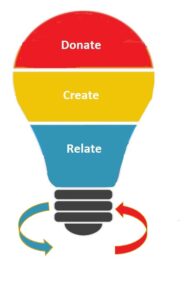
The theoretical framework of engagement is something that increased my interest due to its relevance as the framework for my research into technology-assisted delivery of online guitar lessons. (Kearsley & Shneiderman, 1998) state “The fundamental idea underlying engagement theory is that students must be meaningfully engaged in learning activities through interaction with others and worthwhile tasks” (p. 20). Aston (1999) defines student involvement as “Quite simply, student involvement refers to the amount of physical and psychological energy that the student devotes to the academic experience” (p. 297).
Kearsley & Shneiderman (1998) summarizes the three components of engagement theory as Relate-Create-Donate (p.20) This conceptual structure synthesizes elements from Adult Learning and Constructivism frameworks in that students are self-directed and construct meaning from collaboration with their peers. Engagement theory however is context-based where learning is focused on a specific problem domain with the intent to donate solutions to an authentic worthwhile problem. Another attribute of Engagement theory is that it advocates the use of technology to promote engagement in ways otherwise not possible. So, it prompts the question of what types of technology would best support an engagement, and why?
Robinson and Hullinger (2008) think “student engagement pertains to the time and physical energy that students expend on activities in their academic experience” (p. 101). Participating in other purposeful activities coupled with the level of challenge in educational work directly influences the quality of learning (Kuh, 2001). How students expend their energy is therefore critical to understanding what really matters. Kuh (2001) asserts “Without knowing how students spend their time, it’s almost impossible to link student learning outcomes to the educational activities and processes associated with them” (p.15). So, my question is how to observe student’s use of their time in interacting with the academic environment and gauge the level of motivation for a specific activity?
I am interested in any comments that further my understanding of the engagement theoretical framework to guide and inform my future research.
References
Astin, A.W. (1999). Student involvement: A developmental theory for higher education. Journal of College Student Personnel, 25, 297-308.
Chin Choo Robinson & Hallett Hullinger (2008) New Benchmarks in Higher Education: Student Engagement in Online Learning, Journal of Education for Business, 84:2, 101- 109, DOI: 10.3200/JOEB.84.2.101-109
George D. Kuh (2001) Assessing What Really Matters to Student Learning Inside The National Survey of Student Engagement, Change: The Magazine of Higher Learning, 33:3, 10-17, DOI: 10.1080/00091380109601795
Robinson, C. C., & Hullinger, H. (2008). New benchmarks in higher education: Student engagement in online learning. Journal of Education for Business, 84(2), 101-109.

December 1, 2020 at 4:28 am
Hi Lorne, it seems you are trying to explore two questions to help you determine the TF for your research. The first question is what type of technology best supports engagement in the delivery of online guitar lessons? Secondly, you want to explore how to gauge the level of motivation for a specific activity. The engagement theory is interesting and its three-element of relate, create, and donate may help with building the foundation for your paper. Another TF you may want to explore is the technology-assisted model (TAM). TAM posits that acceptance and use of digital technologies are based on its perceived ease of use and perceived effectiveness (Bernstein, McCreless, & Côté, 2007). In terms of your second question, as you peruse the literature, you may want to check the self-determination theory. It discusses intrinsic and extrinsic motivation. According to Ryan and Deci (2000), motivation is an urge into action to reach a goal. They argued that motivation “concerns energy, direction, persistence, and equifinality – all aspects of activation and intention” (p. 69).
References:
Bernstein, M. L., McCreless, T., & Côté, M.J., (2007). Five constants of information technology adoption in healthcare. Hospital Topics, 85(1), 17-25. Retrieved from https://ezproxy.royalroads.ca/login?url=https://www-proquest-com.ezproxy.royalroads.ca/docview/214591108?accountid=8056
Ryan, R.M., & Deci, E.L. (2000). Self-determination theory and the facilitation of intrinsic motivation, social development, and well-being. American Psychologist, 55(1), 68-78. http://dx.doi.org.ezproxy.royalroads.ca/10.1037/0003-066X.55.1.68
December 1, 2020 at 4:36 pm
Engagement theory is a great choice I think Lorne and you’ve done a great job describing it and its fit with your topic. You’ve posed a very good question … how to observe student’s use of their time in interacting with the academic environment and gauge the level of motivation for a specific activity? … and, unfortunately, that won’t be something you can do as part of the ARP as that would be primary research. However, once you have all of your data in LRNT 691, and have done the analysis and have the findings, one of the recommendations you might make, or the next steps, might be a plan and process for how you might approach and answer that question