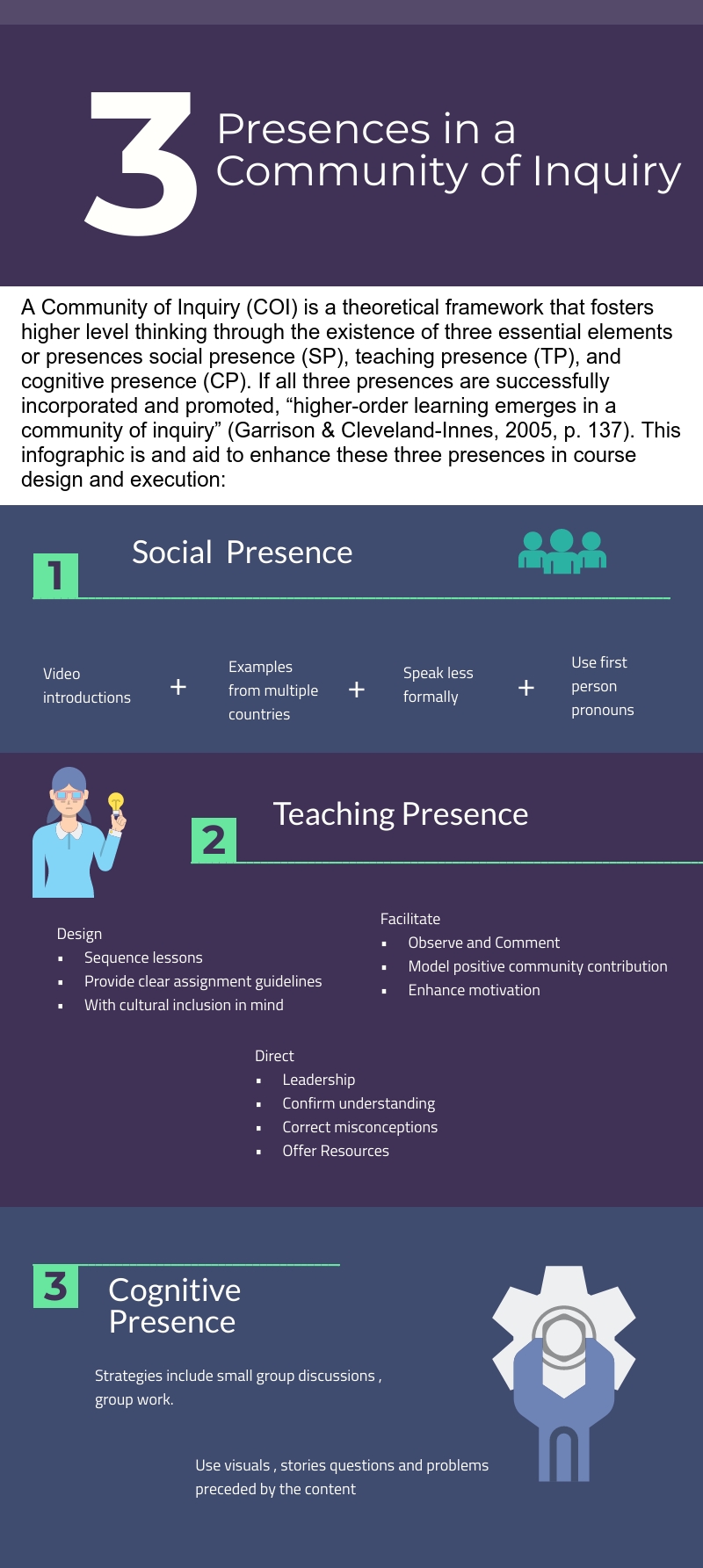
A Community of Inquiry (COI) is a theoretical framework that fosters higher-level thinking through the existence of three essential elements: social presence (SP), teaching presence (TP), and cognitive presence (CP). If all three presences are successfully incorporated and promoted, “higher-order learning emerges in a community of inquiry” (Garrison & Cleveland-Innes, 2005, p. 137). The infographic below provides a couple of ideas to enhance these three presences in course design and execution:
CP – Cognitive presence is the ability to construct meaning through sustained communication.
Strategies for facilitating cognitive presence include creating “small groups of discussion and the opportunity for joint projects in assignments and activities”. (Vaughan, Cleveland-Innes, & Garrison. 2013). Facilitators can foster cognitive presence by visuals, stories, questions, problems, preceded by the presentation of the content. (Vaughan, Cleveland-Innes, & Garrison. 2013)
SP- Social presence is the ability of learners to present themselves as real people in the community to add value via their unique characteristics.
Consider using video introductions to enhance social presence and make class participants more “real” to each other. Design your content with cultural inclusion in mind and incorporate examples from multiple countries. Speak less formally in presentation and address people personally. Use first-person pronouns like “we” and “our” to emphasize the class community. (Northeastern Univesity, 2020 -a)
TP- Teaching presence is the design, facilitation, and direction of a community for the purpose of obtaining a learning outcome.
Design-“Includes activities such as locating and building curricular materials, sequencing lessons, and writing assignment guidelines and evaluation criteria”. (Northeastern Univesity, 2020-b)
Facilitation-Observing and commenting to enhance student motivation and engagement including modeling positive community contributions.
Direction – Anderson, Rourke, Garrison & Archer, 2001 define as “provides intellectual and scholarly leadership” offering their greater content knowledge to confirm understanding, help students correct misconceptions, and offer resources. (p. 8).
References:
Garrison, D., & Cleveland-Innes, M. (2005). Facilitating cognitive presence in online learning: Interaction is not enough. American Journal of Distance Education, 19(3), 133-148.
Northeastern University. (2020, 09 05-a). Retrieved from Teaching Presence in the Community of Inquiry Framework: https://learning.northeastern.edu/teaching-presence/
Northeastern University. (2020, 09 05-b). Retrieved from Building a Sense of Belonging and Community into an Online Course https://learning.northeastern.edu/building-a-sense-of-belonging-and-community-into-an-online-course/
Anderson, T., Rouke, L., Garrison, D. R., & Archer, W. (2001). Assessing teaching presence in a computer conferencing context. Journal of Asynchronous Learning Networks, 5(2), 1-17.
Cleveland-Innes, M., Gauvreau, S., Richardson, G., Mishra, S., & Ostashewski, N. (2019). Technology-enabled learning and the benefits and challenges of using the Community of Inquiry theoretical framework. International Journal of E-Learning & Distance Education, 34(1).

September 13, 2020 at 10:11 am
Hi Lorne,
I appreciated your representation of a Community of Inquiry (CoI) framework to foster higher-level thinking in digital facilitation. I like how you focused on the three foundational basics for Teaching Presence–design, facilitation, direction–to build your points around that presence. I am also a fan of “video introductions” to build a Social Presence amongst learners–a presence that helps to build connections and community to support the later development of Cognitive Presence.
Leigh