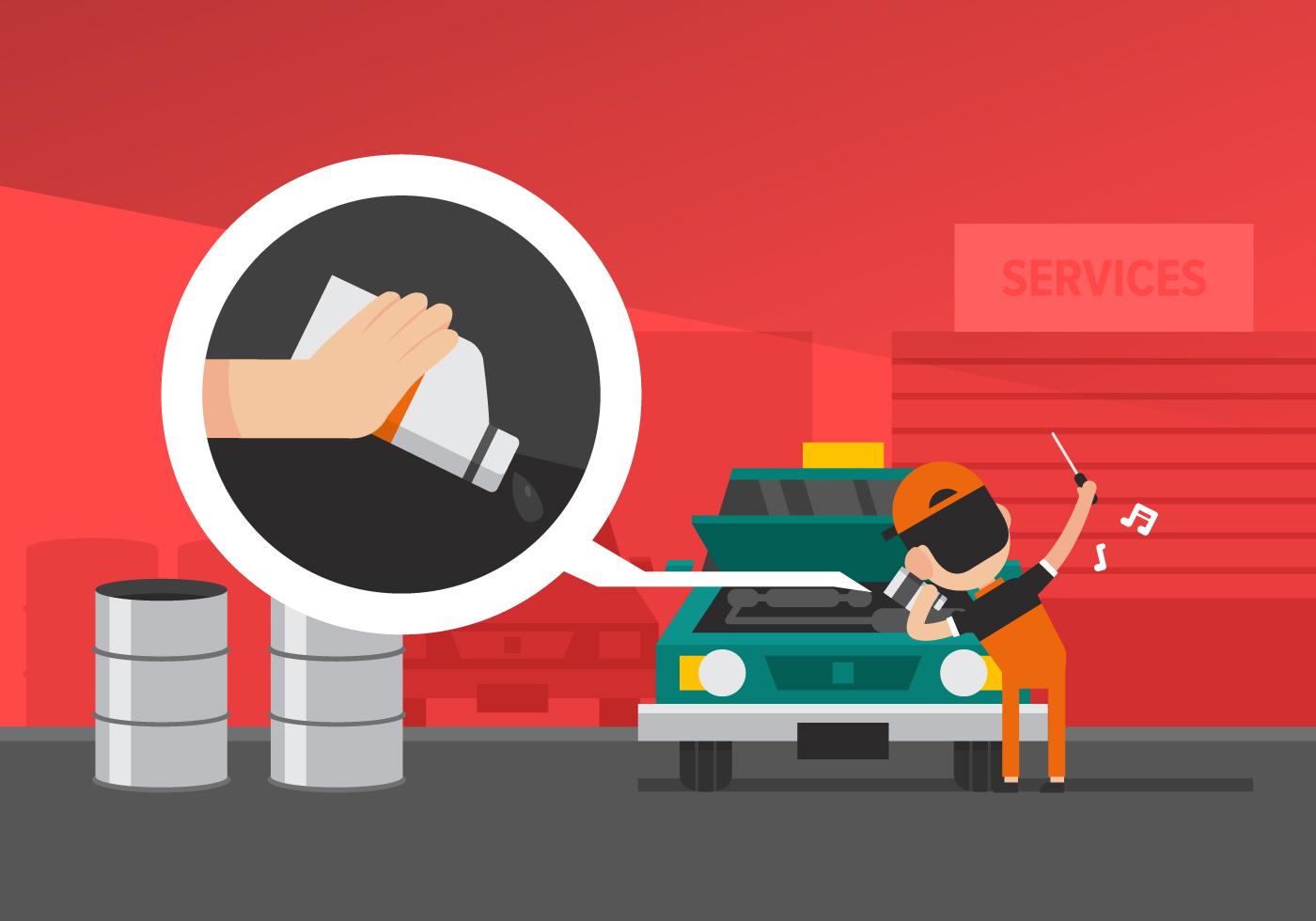
Basic Car Maintenance


<a href="https://www.vecteezy.com/free-vector/tire">Tire Vectors by Vecteezy</a>Image Attribution: <a href=”https://www.vecteezy.com/free-vector/tire”>Tire Vectors by Vecteezy</a>

By: Christina Jones and Leigha Nevay

When you need to get something specific done, you go see a professional with expertise in that area. Basic car maintenance is one of those things most people pay for, yet is surprisingly easy to take care of yourself. There is a large amount of knowledge on the internet with step by step instructions on how to take care of basic car maintenance. Searching “DIY Car Maintenance” resulted in 23.9 million sources of information. When searching “DIY Car Maintenance for Mazda CX-5”, 1.19 million sources were revealed. A further, more defined search of, “2018 Mazda CX-5 Oil Change”, resulted in 5.02 million results. When scrolling through these results, the content provided is relevant to what was searched. There are maintenance schedules, discussion forums, videos, as well as articles and journals all relating to the oil change service for a Mazda CX-5.

Due to there being an abundant amount of content and variation related to this topic, we found that defined searches were the most relevant format of research and created the best content results. This will provide information that is more directly correlated to what task you are completing. It is important to find the type of resource of information that best suits your learning capabilities. For the purposes of this exercise, we defined basic car maintenance as: checking and changing your fluids, changing your air filter, changing your wiper blades, taking care of battery maintenance, and changing your tires. There are many great articles outlining the steps required in completing basic car maintenance, some even specific to your make and model of car. These articles outline the amount of time required to complete the activity, tools required to complete the task, materials needed, and the money that you will save completing this yourself versus going into an auto service shop. The number of videos walking you through the steps far outweighs the written article content available for this topic and also varies from generic material to make and model specific material. There are also plenty of online discussion forums with resources on how to do certain maintenance on vehicles, as well as, the issues that people have run into while completing such tasks. 

“This scale and range of learning related content at least raises the question of whether we have developed the appropriate teaching and learning approaches to make best use of it” (Weller, 2011, p. 226). With there being so many different sources of information, as a learner, you can pick and choose what type of information will work best for you. Educators would need to attempt to complete the task with the resource that was provided to ensure that the information is accurate. As an educator, you would need to find the content that speaks to the majority of your audience, perhaps using a combination of information sources. Starting with written material, then following with a video instruction, could have a stronger impact on the retention for students. Opening discussion forums for students to use while in practice is a great way of ensuring that the students were able to comprehend the information that was presented to them. This would also provide additional material and content back into the system, possibly helping others in the future. 

References: 

Bakke, D., Martucci, B., Curtis, J., Quilty, D., BakkeDavid, D., David, … Lewis, M. (2019, July 24). 8 DIY Car Maintenance Tips You Can Handle – Checklist. Retrieved from https://www.moneycrashers.com/diy-car-maintenance-tips-checklist/.

The DIY Experts of The Family Handyman Magazine. (n.d.). 7 Car Maintenance Jobs You Can Do Yourself. Retrieved from https://www.readersdigest.ca/cars/maintenance/fix-your-own-car-car-repair-tips-experts/.

Linhart, & Jack. (2015, January 23). Fix Your Ride: 7 DIY Car Maintenance Tasks That Will Save You Money. Retrieved from https://www.thepennyhoarder.com/save-money/diy-car-maintenance/.

Eisenberg, T. (2019, August 21). How to Understand the Basics of Car Maintenance. Retrieved from https://www.wikihow.com/Understand-the-Basics-of-Car-Maintenance.

ChrisFix(n.d.). Playlist: Maintenance(Oil changes, windshield wipers, check-ups)  [YouTube Channel]. Retrieved from https://www.youtube.com/playlist?list=PLvKbarVtwhUvvdufd-D0GTB3Cq7tKxuWl

Car and Driver (n.d.). Playlist: Popular Mechanics: Saturday Mechanic: Season 1  [YouTube Channel]. Retrieved from https://www.youtube.com/watch?v=y6HxORx0g-g&list=PLlME_Nm6UYIU3pEslfpKASUIAVjGuClQk

Weller, Martin (2011). A pedagogy of abundance. Spanish Journal of Pedagogy, 249 pp. 223–236.

Melissa Sariffodeen – Canada Learning Code

https://www.instagram.com/p/BOr-Un1hiz0/?utm_source=ig_web_copy_link

In 2011, Melissa Sariffodeen had quit a job in accounting and had set out on a path to learn some digital skills in order to be competitive in the current job market.  She was surprised by the limited avenues for accessing this education.  In hopes of addressing this issue, Melissa and three of her friends hosted a brainstorming session to explore this idea.  What was supposed to be a few people chatting in a coffee shop turned into an 80-person session.  That session also highlighted the gender gap in the technology sector in their hometown of Toronto as well as the lack of introductory-level opportunities to learn to code.  Melissa and her friends took what they had learned and set forth to create a path for women who wanted to explore this industry.  Ladies Learning Code was born and the team launched their first workshop in the spring of 2011, it sold out in a day.  The hunger for this type of programming was obvious.

Melissa launched Ladies Learning Code chapters all over the country and now in 2019, there are 36 chapters cities.  Since that first workshop in 2011, Canada Learning Code, no a nationally registered charity and has hosted over 2800 educational events, reaching in excess of 106,950 learning across Canada.

“At Canada learning Code we believe that digital skills are tools of empowerment. The world is changing com and we want Canada to be ready. We’re here to make sure that all Canadians – Particularly women, girls, people with disabilities, Indigenous youth, and newcomers to Canada have access to the knowledge they need to prosper in our digital world.” (Canada Learning Code, 2019)

Melissa’s vision has also expanded.  The organization began as Ladies Learning Code with a goal to get more women into the tech sector but it has evolved over the years to a place where all Canadians are included.   Creating a space for “all Canadians to have the knowledge to create not just consume technology.”  Canada Learning Code now has programs designed for women, girls, kids, teens and teachers.  They even have a mobile computer lab that travels coast to coast bring tech education to rural communities without access to a chapter, called the CodeMobile.

Over the years, Melissa’s passion for the integration of technology and education has resulted in partnerships with the Google, Microsoft and Government of Canada.   Melissa has met with education officials across Canada to bring awareness to the need for the inclusion of digital literacy into the k-12 curriculum.

Melissa’s LinkedIn: https://www.linkedin.com/in/melissasariffodeen/

Melissa’s Twitter: https://twitter.com/melsariffodeen

Melissa’s Instagram https://www.instagram.com/melsariffodeen/

Sariffodeen, M. [TEDx Talks]. (2017, Jan 18). The Kids Will Be Alright | Melissa Sariffodeen | TEDxYouth@Toronto. Retrieved from https://www.youtube.com/watch?v=9IRoTk-iKPE&t=405s

Sariffodeen, M. [Perimeter Institute for Theoretical Physics]. (2017, Mar 25). Melissa Sariffodeen explains how to hack your future. [Video file] Retrieved from https://www.youtube.com/watch?v=C6EdrW4wH-s&t=57s

Canada Learning Code: About Us (2019) Retrieved from https://www.canadalearningcode.ca/about-us/

The edtech revolution that hasn’t happened…yet!

Everyone seems to have a different starting point to judge when technology first began to be applied to education.  Was it cave paintings, the chalkboard, or was it the advent of radio what really signalled the integration of technology and education?  Regardless of where the line is painted, the reactions to new technology and the actual effects of that technology over time diverge quite drastically.  For example, in 1913 Thomas Edison famously predicted that the books were soon to be obsolete in schools as “It is possible to teach every branch of human knowledge with the motion picture.”  A 100 years later textbooks are still a staple in most classrooms.

So, is “technology doing the same things in a more shiny way”? (Grey, 2012. 5:34).  Over the last hundred years numerous studies have been done to answer questions about; is video more impactful or a live lecture, is an animation superior to pictures and text.  The results do not always fall in favour of technology.  We as educators have learned useful tips from these studies that have improved learner engagement but there has yet to be a complete overhaul of the class of students, with one teacher model of education.

The integration of technology and education has been a personal and professional obsession of mine for most of the last decade.  It is immensely exciting to be part of this field at a time when we are reaching such a deep level of technological integration.  We are very close to where VR and simulators can create digital visualizations almost indistinguishable from reality, machine learning and AI can provide customizable and meaningful learner analytics and student feedback.

However, it remains to be seen if we are finally at the precipice of education technology revolution or if in 100 years our descendants will still be staring at a chalkboard while a teacher lectures.


Muller, D.A. [Veritasium]. (2014, Dec 1).  This Will Revolutionize Education [Video file]. Retrieved from https://www.youtube.com/watch?v=GEmuEWjHr5c

Grey [CGP Grey]. (2012, Nov 5). Digital Aristotle: Thoughts on the Future of Education [Video file] Retrieved from https://www.youtube.com/watch?v=7vsCAM17O-M

E-ducation: A long-overdue technological revolution is at last under way.  Retrieved from https://www.economist.com/leaders/2013/06/29/e-ducation

Understanding Copyright

Listening to the Copyright presentation was very informative.  I noted some key items that may be of use for future review.

    • Fair dealing something to look into deeper. RRU based on Universities Canada.  (Wrobel, 2016, 18.17). Side note: I want to make a mash-up now.
    • Ideas not protected just the unique expression of the idea. (Wrobel, 2016, 5.04)
    • Who owns the copyright (Wrobel, 2016, 8:32)
    • Her example of a basic copyright statement (Wrobel, 2016, 9.25)
    • Good to know the allowances for presentations and elearning for images (Wrobel, 2016, 38:25). Also the permissions for graphics (Wrobel, 2016, 53:03).
    • Copyright and thesis. (Wrobel, 2016, 40.00). vs Research Paper (Wrobel, 2016, 45:18).
    • Register your work with the CIPO for $65 (Wrobel, 2016, 55:53).
    • Understanding Creative Commons (Wrobel, 2016, 57:20).
    • Open Vs traditional publishing (Wrobel, 2016, 1.03:01).


Wrobel, M. (2016, June 13). A Guide to Copyright (video webcast). Retrieved from: https://ultra-ca-prod-sms.bbcollab.cloud/media/stream?original_media_url=sms_73e7fdd4f37d43febde43e4472315f20&media_display_name=LRNT502

Dr. Veletsianos – Answers Our Research Questions

Dr. Veletsianos answered student questions on research, many of his replies were very informative and I look forward to applying his insights into my future research.

My team asked a question about how research that is done today with today’s ethical standards might be seen in the future and how that is reconciled.

I found his closing statements of that ensuring “participant wellbeing is at the center of your project” and that “it should never be an afterthought” very impactful.  (Veletsianos, 2019, 2.32)

Reference:

Veletsianos, G. (2019). Questions about Research for George Veletsiano [Audio recording]. Retrieved from https://docs.google.com/document/d/1yzG3Sqo0wImXN0tUf9dcjXODISiSYt9gH8_gJnMC_hY/edit

Team Awesome’s video presentation


Dicheva, D., Dichev, C., Agre, G., & Angelova, G. (2015). Gamification in Education: A Systematic Mapping Study. Educational Technology & Society, 18(3), 1–14. Retrieved from https://www.researchgate.net/publicat…

Landers, R. N. (2015). Developing the theory of gamified learning: Linking serious games and gamification of learning. Simulation & Gaming, 45(6), 752-768. Retrieved from https://doi-org.ezproxy.royalroads.ca…

Perryer, C., Celestine, N. A., Scott-Ladd, B., & Leighton, C. (2016). Enhancing workplace motivation through gamification: Transferable lessons from pedagogy. International Journal of Management Education, 14(3), 327–335. Retrieved from https://doi.org/10.1016/j.ijme.2016.0… (Perryer, Celestine, Scott-Ladd, & Leighton, 2016)

John Keller & Katsuaki Suzuki (2004) Learner motivation and E-learning design: A multinationally validated process, Journal of Educational Media, 29:3, 229-239, DOI: 10.1080/1358165042000283084 John M. Keller (2008) First principles of motivation to learn and e3 ‐learning, Distance Education, 29:2, 175-185, DOI: 10.1080/01587910802154970

Jeffrey R. Albrecht & Stuart A. Karabenick (2018) Relevance for Learning and Motivation in Education, The Journal of Experimental Education, 86:1, 1-10, DOI: 10.1080/00220973.2017.1380593

Ryan, R., Deci, E. (2000). Self-determination theory and the facilitation of intrinsic motivation, social development, and well-being. American Psychologist, 55(1), 68-78. MacIntyre, P., Schnare, B., & Ross, J. (2018).

Self-determination theory and motivation for music. Psychology of Music, 46(5), 699-715. Hagger, M., & Chatzisarantis, N. (2008). Self-determination theory and the psychology of exercise. International Review of Sport and Exercise Psychology, 1(1), 79-103. Darden, D. C. (2014).

Relevance of the Knowles Theory in Distance Education. Creative Education, 2014. https://doi.org/10.4236/ce.2014.510094 Mezirow, J. (1997). Transformative learning: Theory to practice. New Directions for Adult & Continuing Education, 1997(74), 5. https://doi.org/10.1002/ace.7401

Gravani, M. N. (2014). Adult learning in a distance education context: Theoretical and methodological challenges. International Journal of Lifelong Education. Retrieved from https://www-tandfonline-com.ezproxy.r…

What makes a good research question?

A few things that make you better equipped to write a good research question.

  • Get a deep understanding of your research topic. This understanding with empower you to formulate a well thought out questions.
  • Look at your question from many directions. Viewpoint matters.
  • Keep the question broad. You want a question that is complex to answer.


References

Royal Roads University (n.d.) Identifying your research question. Retrieved from https://library.royalroads.ca/infoquest-tutorials/how-start/identifying-your-research-question

Digital Presence and Identity

For most of my adult life, I have been very active in online spaces.  I work for a 3D interactive eLearning company and have spent four-year teaching digital literacy to children as the Chapter Lead of Canada Learning Code.  I am an early and avid adopter of many technologies. I am wired in on so many paths I do not think I could distinguish where my digital self ends and “IRL” self begins.

This fact I live integrated with my digital self does not make me uncomfortable or make me feel inauthentic, and it is just a facet of how I live my life.  As White put it I “see the Web as a place, perhaps like a park or a building in which there are clusters of friends and colleagues whom they can approach and with whom they can share information about their life and work” (White & Le Cornu, 2011).

My digital presence is large if poorly mapped to my google search results, due to having varied interests coupled with an incredibly common name.  If you were to check as Will Richardson suggested and google me on graduation day, Schryver, K. (2013, February 5) the results would garner some pretty generalized posts showing my Digital Citizenship in a mostly positive light.  Before MALAT I already had “a Domain of One’s Own” Watters, A. (2015, July 15) at christinaljones.com.  My search engine optimization (SEO) could use some improvement.  I would like to take some time to strengthen this gap.

The readings for this unit also made me reflect on the evolution of the digital self.  I found some of the readings in Unit 2 were quite dated, as many are nearly a decade old.  Even those articles that are newer had phrases that read like a relic of days gone by.  References to MySpace, Rheingold, H. (2010) and digital camera use, Schryver, K. (2013, February 5) made me reflect on my digital self a decade ago. In 2009, I was a new mom, with little peer or family support.  I turned online to find answers to why my baby would not sleep and ended up stumbling into a community of mothers around the world. This drive to educate myself in parenthood was the first step in me becoming a digital resident.

My digital presence in general, as it is already very much a living thing, like all living things it must be tended.  Additionally, I do plan on curating a branch of my digital presence tied to my education.

Goals for my Digital presence:

  • Cultivating content for this blog, and growing interactions with my MALAT cohort peers.
  • Create/Find a deeper social connection with my peers. I feel like peer to peer learning is essential, even in digital spaces.
  • Adding academic content to my LinkedIn and Twitter
  • Increase my SEO

Success will be measured by:

  • If my blog becomes a digital artifact I take pride in
  • If, in 6 months, we (this cohort) has established a network where we can turn to one another for support.
  • If my LinkedIn and Twitter take on a more academic tone
  • My SEO results improve.


Schryver, K. (2013, February 5). Who are you online? Considering issues of web identity. The New York Times. Retrieved from http://learning.blogs.nytimes.com/2013/02/05/guest-post-who-are-you-online-considering-issues-of-web-identity/?_r=0

Watters, A. (2015, July 15). The Web we need to give students. Bright. Retrieved from https://brightthemag.com/the-web-we-need-to-give-students-311d97713713

White, D. S., & LeCornu, A. (2011). Visitors and residents: A new typology for online engagement. First Monday, 16(9). Retrieved from https://firstmonday.org/article/view/3171/3049

Rheingold, H. (2010). Attention, and other 21st-century social media literacies. Educause Review45(5), 14.  Retrieved from http://er.educause.edu/articles/2010/10/attention-and-other-21stcentury-social-media-literacies