The following is a joint blog post from Team 5: Christina Jones, Eunice Leung, Tala Mami, Kerry Sharples, and Lorne Strachan.
What type of learning event and delivery technology did you choose?
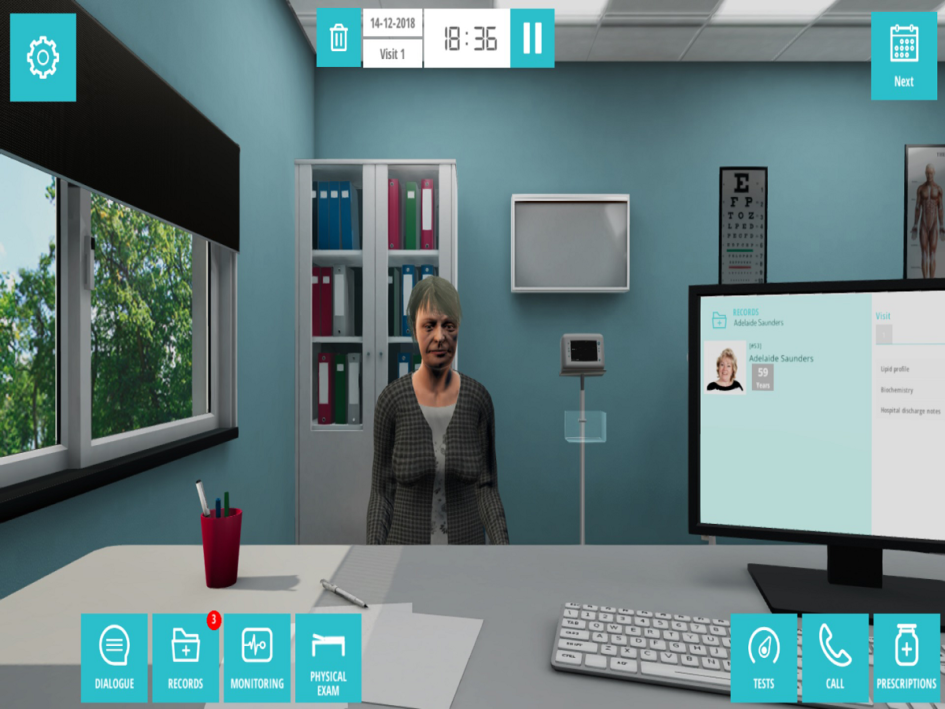
Through brainstorming and shared discussions, we chose to further explore simulation based educational experiences. After an extensive search of simulator applications spanning over multiple disciplines, the team settled on a Healthcare simulation due to their extensive use in this field. For this initial exploration of simulator technology, we chose to participate in a Virtual Healthcare experience (De.ryerson, n.d.). Individually we participated in the simulation, which offered multiple disciplines and perspectives within the nursing field. The experience contained scenario based video clips, along with guiding questions and feedback, promoting opportunities to reflect after completing the simulation. Based on our collective participation, we used it as a basis for a review of associated literature.
What background reading did you do to learn more about it? (Blogs, websites, library journal articles). Write a summary of what you learned.
Our team conducted individual research that furthered our understanding of the application of educational simulation. This included sourcing multiple articles that researched simulation technology in learning. Concentrates of our research include:
- Simulation-based learning in nurse education (Cant & Cooper,2010)
- The effect of realistic scenario-based simulation on nursing students’ competence and confidence. (Alinier & Gordon, 2004)
- Linking serious games and the gamification of learning. (Lanier, 2015)
- The effectiveness of VR simulations on learning tasks in manufacturing (Bashir et al.,2019)
- The use of 3D animation to visualize elements that are otherwise impossible (Dalto, 2018)
- Using simulation to bridge theory and practice gaps in teacher education. (Conick et al., 2018)
- Structured debriefing as a critical part of simulation-based education. (Palaganas & Simon, 2016)
- Simulation and uncertainty (Scott et al., 2020)
- Simulation evaluation(Feinstein & Cannon, 2002)
- The future vision of Simulation in healthcare (Gaba 2007)
Based on the above, what question(s) would you like to pursue as you explore or participate in it?
As a team, we are curious to further explore:
- Importance of debriefing of a simulated learning event to reflect on the experience
Simulations incorporate opportunities for learners to debrief and reflect upon the experience. What is the significance of structured debrief as a component part of simulation education? Do follow-up components to simulations optimize learning and if so, how? Can attending an organized debrief, or answering self-debriefing questions optimize learning experiences? - The application of simulations embedded within a learning experience
Simulation may provide indirect benefits. What are some of these collateral advantages? New technology affords immersive environments allowing applications that were previously limited to the real event, what can now be brought to the learning environment? - Evaluation of a simulation’s effectiveness
Key problems exist in evaluating simulators effectiveness. What are the generally accepted simulator construct concepts? What models are available to evaluate simulations?
Our team is tasked to approach this learning event with a critical inquiry lens. We Invite other teams to comment on questions regarding our chosen learning event and delivery technology. Further research and analysis of the results provided by the learning event will further guide our inquiry. Our team will conduct research to answer our collective questions specific to simulator learning technology and interpret our findings to further share in a team presentation. After the presentation our team will debrief to reflect and assess our open inquiry into learning simulation.
References
Alinier, G., Hunt, W. B., & Gordon, R. (2004). Determining the value of simulation in nurse education: study design and initial results. Nurse education in practice, 4(3), 200-207. Retrieved from https://doi.org/10.1016/S1471-5953(03)00066-0
Bashir, S., Mustufa, H., Syed, H., Mohammed, K., Hisham, A., & Ali, A. (2019). Virtual reality-based engineering education to enhance manufacturing sustainability in industry 4.0. Sustainability, 11(5). doi:10.3390/su11051477
Cant, R., Cooper, S.J, (2010), Simulation‐based learning in nurse education: systematic review. Journal of Advanced Nursing, 66(1) 3-15. doi:10.1111/j.1365-2648.2009.05240.x
Coninck, K.D., Valcke, M., Ophalvens, I., & Vanderlinde, R. (2018). 1 Bridging the theory-practice gap in teacher education: The design and construction of simulation-based learning environments. Retrieved from https://www.semanticscholar.org/paper/1-Bridging-the-theory-practice-gap-in-teacher-%3A-The-Coninck-Valcke/cd487f839aa664af863b47dc56efb18f944e01ba
Dalto, J. (2018). AR, VR and 3-D can make workers better: IE. ISE ; Industrial and Systems Engineering at Work, 50(9), 42-47. Retrieved from https://ezproxy.royalroads.ca/login?url=https://search-proquest-com.ezproxy.royalroads.ca/docview/2115208162?accountid=8056
De.ryerson. (n.d.). Virtual Healthcare Experience. Retrieved from https://de.ryerson.ca/games/nursing/hospital/index.html
Feinstein, A. H., & Cannon, H. M. (2002). Constructs of simulation evaluation. https://doi.org/10.1177/1046878102238606
Landers, R. N. (2015). Developing the theory of gamified learning: Linking serious games and gamification of learning. Simulation & Gaming, 45(6), 752-768. Retrieved from https://doi-org.ezproxy.royalroads.ca..
Palaganas, J. C., Fey, M., & Simon, R. (2016). Structured Debriefing in Simulation-Based Education. AACN Advanced Critical Care, 27(1), 78–85. doi.org/10.4037/aacnacc2016328
Scott, A., Sudlow, M., Shaw, E., & Fisher, J. (2020). Medical education, simulation and uncertainty. The Clinical Teacher, tct.13119. https://doi.org/10.1111/tct.13119
[Image of patient at the doctor’s office]. (n.d.). Retrieved from www.jmir.org/api/download filename=80900e8aadd1796e3fba3b58bb6ae575.png&alt_name=11529-259511-1-PB.png
April 21, 2020 at 10:14 am
I think this is an exciting topic to explore. Simulation is widely used in my organization not only in education but also in system-wide initiatives. Simulation-based education seems to promise the next level of teaching and learning. I am curious about what insights your team has formulated while you are in this exploration phase? I had experienced first-hand a simulation-based workshop on leadership development, specifically on dealing with conflict – team and patient conflicts. It was not a pleasant experience for me – feeling on stage, and the spotlight is right at me- scrutinizing my every move. This feeling and experience I had maybe the anomaly. Although I had a bad experience, I have seen and heard sessions on simulation-based education in Nursing and Allied Health, and I can appreciate the advantages. I think you have a good start with your questions. From my perspective, I wonder how the social-constructivist theory informs the design of a simulation-based education debriefing. How does this impact the psychological state of learners, especially in the area of safety? How do you make it safe for learners to participate in the debrief to inform the evaluation and assessment of the program? In terms of the benefits and “collateral advantages,” on the flip side, what are the potential socio-cultural issues of simulation-based education in healthcare?
Thanks for sharing your thoughts. I am looking forward to learning more from your team since this is an intimate subject for me.
April 24, 2020 at 11:45 am
Hi Sharon,
Thank you for your comments and your thoughtful questions. It is a very interesting topic indeed and delving into the simulations as a group has been a unique learning experience. We have all shared that we feel the scenarios were easy to use and informative, each of us walked away from the learning experience with newfound knowledge. With that being said, some of us have more experience with simulations and found that the type of simulation we did, was very basic and in some respects, would not be considered a “true simulation”.
Great question regarding social constructivism theory, as the simulations are independent study which limits the interaction with others. The language used within the simulation was plain English, which made the virtual gaming system (VGS) easy to follow and understand. There was a live “patient” in the simulation, which allowed the learner to gauge the tone and demeanor based on the answers provided. This cannot be compared to real life, as we cannot anticipate the behaviors of everyone, but it implored a therapeutic approach in how we respond or the tones we can use to diffuse a situation.
This ties in with how it psychologically affects each learner. The simulation does not state you are wrong when an answer is incorrect, but veers the learner to a favorable answer, while explaining why. This can help with confidence and approach in the future. When the learner has completed the scenarios, the VGS gives a summary with the leaners progress and option of a printable PDF. The learner can attend an organized (private) debrief and can answer self-debriefing questions which optimizes the learning experience. In a clinical setting, you could share the results with a team lead or Clinical Nurse Educator to promote a more versatile learning experience. Patient safety really comes down to knowledge. “Participants and observers should feel comfortable in responding authentically to a given patient ‘situation’ and draw on tacit knowledge to personify holistic practices” (Kelly, et all. 2016).
Understanding the socio-cultural issues of simulation-based education in healthcare is another amazing question, that would vary based on what unit the learner is on, what type of nursing specialty there is and the geographical perspective of the hospital/care home. “Culture is a consideration within the contexts of: organizational, ethnic, socio-economics, geographical, political, personal values and beliefs and societal standpoints” (Horvat et al., 2014). Regardless of where the learner is in the world, being culturally sensitive towards the learners and patients is a necessity for a well-run, respectful environment. The developers of the VGS did an okay job in acknowledging the differences within these expectations, though it should have been more in depth to ensure more knowledge and understanding was gained.
Thank you again for taking the time to post and raise some very interesting and thought-provoking questions.
References:
De.ryerson. (n.d.). Virtual Healthcare Experience. Retrieved from https://de.ryerson.ca/games/nursing/hospital/index.html
Horvat, L., Horey, D., Romios, P., & Kis-Rigo, J. (2014). Cultural competence education for health professionals. The Cochrane Database of Systematic Reviews (Online), 5(5), CD009405. Retrieved from: https://doi.org/10.1002/14651858.CD009405.pub2.
Kelly, M. A., Hopwood, N., Rooney, D., & Boud, D. (2016). Enhancing students’ learning through simulation: Dealing with diverse, large cohorts. Clinical Simulation in Nursing, 12(5), 171-176. https://doi.org/10.1016/j.ecns.2016.01.010.
April 23, 2020 at 7:39 pm
The program I work with uses simulation training as a major part of the program. Each year of the program has substantial simulation components. I have always been impressed with the concept, though I have never experience simulated training. I see it as being very useful in any medical field since not all tasks are accessible for training.
I do not know if your list of questions is in a specific order, but I like that the importance of debriefing is first (whether it was by accident or not). From what I have observed of simulation training, the debriefing is as important as the training itself. The learning that occurs in the debriefing allow the students to apply knowledge more quickly in the next scenario. At least they should be able to!
I came across this article a while ago and found it interesting. https://www.newswire.ca/news-releases/universite-de-montreal-opens-quebec-s-first-virtual-reality-optometry-lab-in-partnership-with-fyidoctors-visique-831580808.html. I think that simulation training will become more common as technology advances.
Thank you for your thoughts.
April 24, 2020 at 1:58 pm
Hi Kathy,
I am glad you were able to notice the important role of debriefing in simulation-based learning. You are right, debriefing is a critical component that will affect the learner’s experience and can contribute to optimizing the learning experience (Levett-Jones & Lapkin, 2014). Palaganas, Fey & Simon (2016) postulated that debriefing in simulations seeks to improve technical and nontechnical skills and facilitate self-reflection. Debriefing as a tool enables a learner to self-correct and enhance their performance in a safe environment without putting patients’ lives at risk.
During our critical inquiry journey, we came to the conclusion that debriefing has several aspects, it can be seen as a summative tool to help enhance the overall simulation experience, and it also has a pedagogical aspect where debriefing is used to encourage reflection and application of learning.
Thank you for taking the time to comment on our blog post and for sharing this interesting article.
References
Levett-Jones, T., & Lapkin, S. (2014). A systematic review of the effectiveness of simulation debriefing in health professional education. Nurse Education Today, 34(6), e58-e63.
Palaganas, J. C., Fey, M., & Simon, R. (2016). Structured Debriefing in Simulation-Based Education. AACN Advanced Critical Care, 27(1), 78–85. doi.org/10.4037/aacnacc2016328
April 23, 2020 at 10:30 pm
Hello team! I have never participated in simulation based learning in any of my endeavors, so I am very much looking forward to the results of your explorations into the effectiveness of this learning tool. I am constantly looking into ways to improve my training of new teachers and have been wanting to bring in digital learning aspects. This may be one direction I’d like to follow, so your results may play a part in my decision making!
April 25, 2020 at 4:24 pm
Hi Susan,
Before this group project began, I hadn’t participated in simulation based learning before. My background is teaching and education, so my hands on experience came from doing practicums in schools. As well, I had attributed this form of training for higher risk professions (e.g. doctors, nurses, pilot) that would require individuals a safe environment to make mistakes and learn from them. However, through working with my team, conducting research, and further understanding of what simulation learning entails, I see that there’s a potential to utilize and expand the use of this technology in other industries, such as teacher training.
One of the examples I came across was Coninck, Valcke, Ophalvens, and Vanderlinde’s (2018) research. They examined how adopting a competence-based approach to designing simulation can be used to support teacher and student interactions, and can have the potential to be situation specific, such as conducting parent teacher interviews, managing student behaviours, and teaching performance (Coninck et al., 2018). The potential is there! The goal of simulation is to mimic real life environments and situations where the individual can build upon their knowledge and skills needed for their job.
Thanks for stopping by and providing your comments!
Reference
Coninck, K.D., Valcke, M., Ophalvens, I., & Vanderlinde, R. (2018). Bridging the theory-practice gap in teacher education : The design and construction of simulation-based learning environments. Retrieved from https://www.semanticscholar.org/paper/1-Bridging-the-theory-practice-gap-in-teacher-%3A-The-Coninck-Valcke/cd487f839aa664af863b47dc56efb18f944e01ba