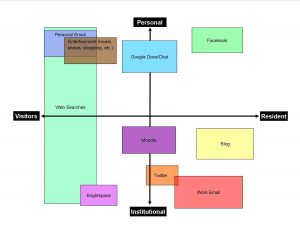
Until now, I have worked at having a small footprint online. I do not have many social media sites, only Facebook and even there I keep my posts light and positive. I do not see online communities as somewhere to go to express my frustrations, ask hard questions, or get into emotional or philosophical discussions. When I applied to the MALAT program, I realized that my digital imprint would not only change but also increase.
My overall goal in cultivating my digital presence is to not change from who I am offline. According to Schryver, “texting and email and posting let us present the self we want to be” (Schryver, 2013, para. 7), when cultivating my online identity I want to stay true to myself. As I write my posts and other online contributions, I will review them to ensure my true personality comes through. I also would like to include examples from my life to support my posts.
My purpose for cultivating a stronger online presence is to build credibility. Part of my philosophy, both at work and at home, is that we need to move to more of a digital lifestyle. As I move through the program and on to my next career, I need to move to a more digital presence as I would like to teach or create courses that feature software or are in an online environment.
These are my three main gaps in building my online presence:
- Lack of knowledge of online spaces
- Minimal network
- Moving out of my comfort zone
In order to fill these gaps, I will look at online spaces and create new accounts or take accounts out of hibernation and start to use them, accept people into my network, try to be open to joining new networks, and know that leaving my comfort zone is not a bad thing, as it will help me grown and learn. Jenkins said, “children need a safe space within which they can master the skills they need as citizens and consumers” (Jenkins, 2009, p. 24), I think it is safe to say we are all children when it comes to learning, not in the way of age, but in the way of innocence.
I will know I am successful in my goal by seeing my network grow as well as change, and I will see the number of spaces I participant in increase, becoming more of a resident online versus the visitor I am now. I will be able to measure my success in being out of my comfort zone by becoming calmer when looking at new online spaces.
References
Jenkins, H. (2009). Confronting the challenges of participatory culture: Media education for the 21st century. MIT Press. Retrieved from https://www.dropbox.com/s/co9mdasoh8r1ew7/8435.pdf?dl=0
Schryver, K. (2013, February 5). Who are you online? Considering issues of web identity. The New York Times. Retrieved from https://learning.blogs.nytimes.com/2013/02/05/guest-post-who-are-you-online-considering-issues-of-web-identity/?_r=0