A Brief History of Technology in Education

When I think about history of technology in education, I find myself thinking about the early 1900s.  I think this is because so much has changed since that time and there are still people alive today who remember using a slate in school and now can use computers.

Educational Technology came into play during World War II, as the US military utilized films and media to train soldiers, which lead the ground work for the presentation software we have now (Educational Technology, 2019, para. 66).  As time progressed, computers became more commonly used and in the 1980s, they became affordable bringing them into the home (TED, 2016, 0.13).  In the 1980s and 1990s, education saw the arrival of Computer-based learning (CBL), introducing micro-worlds, and simulations (Educational Technology, 2019, para. 68).  These new atmospheres increased the methods, which students could learn, allowing those who struggled with reading and writing to learn in ways that worked for them.

Today there are computers everywhere from our pockets to our cars, including in our classrooms.  In his TedX Talk, Brown said “technology means that student of today have access to information that student of the past simply did not have” (Brown, 2016, 4:43); since he did that presentation technology has only advanced and more information is available.  Educators can now welcome technology into the classroom to have having guest speakers from all over the world connect over the internet allowing students to hear from people living the situation rather than read about it in a report.

Slate boards where used in classrooms as early as the fourteenth century until the mid-twentieth century (Slate (Writing), 2019, para. 7), meaning that educational technology remained consistent over 500 years; over the last 100 years we have gone from using slates in the classroom to tablets.  What will the history books say about the next 100 years?

Reference

Educational technology. (n.d.). In Edutechwiki. Retrieved September 8, 2019, from http://edutechwiki.unige.ch/en/Educational_technology#A_short_history

TED. (2016, March 28). Redefining Learning & Teaching using Technology. | Jason Brown | TEDxNorwichED [Video file]. Retrieved from https://www.youtube.com/watch?v=AOTEQVYDPpg

Slate (writing). (n.d.). In Wikipedia. Retrieved September 8, 2019, from https://en.wikipedia.org/wiki/Slate_(writing)
Discussion About Copyright with Melanie Wrobel

While I have never worked with copyright, I have always had a healthy respect for the copyright laws and their intent, though at a conceptual rather than detailed level.  It was beneficial to listen to Melanie discuss copyright, what she has seen students do and how to avoid the same issues.  I appreciated that Melanie started with the statement that she is a librarian who has experience with copyright, but is not a lawyer so her presentation cannot be taken from a legal standpoint.  To me, this added to her credibility in this presentation, given that copyright is based in using information appropriately.

Where do I start with what I learned from Melanie?!  She made the copyright laws sound clear, and I suspect they become more so as one works with them.  I appreciate process, and copyright has clear-cut laws and rules about what is acceptable and what is not.  If there is ambiguity, it is best to ask permission; one cannot go wrong following that path.  This follows from Melanie’s statement that it is best to believe that everything is protected and apply the correct process to ensure publications are used correctly (personal communication, June 13, 2016).

Melanie talked about the Berne Convention and I was surprised to learn about the Law of the Land.  Before listening to this presentation, I would have thought that the law where the work was published would be the law in effect, not the law where the user is located.  As I listened to Melanie explain it, I realized why is made sense.  It would be challenging to know the laws of the country where work was published; therefore, following them could be close to impossible.  By adhering to local legislation, individuals can much more easily ensure they are followed.

A few messages that really stood out were how copyright applies, how publications are used, and who owns the information.  For example, the company one works for is often the owner the work; participants own their stories, but the writer owns the summaries of those stories, and it is not ideas that are copyrighted, but how they are said (personal communication, June 13, 2016).

As the presentation concluded, I felt more comfortable in the world of copyright.  I know that when it comes time for me to use copyrighted information or copyright my own work, I will need to become more familiar with the details, and I now know that I can turn to a librarian for help.

Reference

Wrobel, M. (2016). A Guide to Copyright [Audio recording]. Retrieved from https://moodle.royalroads.ca/moodle/mod/page/view.php?id=347413

Thoughts on Research by Dr. George Veletsianos

One statement that stood out for me from Dr. Veletsianos’ was in regards to ethics allowing certain behaviour while the research is being conducted and then there is a change making that same behaviour unethical.  He addresses this by saying that it is best to be current with the best practices in ethics and attempt to do a bit better than the guidelines state (personal communication, August 16, 2019).  This stood out for me because an important part of research is to do no harm.  As researchers, we cannot rely purely on today’s standards, we need to be able to think ahead to ensure we are doing no harm to those involved in our study.  This idea flowed nicely into Dr. Veletsianos’ discussion on biases.  He pointed out that a benefit of working with a research team is that each person can help bring awareness to biases within the team.  Biases will always be present, but it is important to be aware of them so they do not affect the participants or the research (personal communication, August 16, 2019).  This made me think of how I can be mindful of my biases allowing me to have practices in place to not have them affect my work and help others do the same.  I believe this is always be an ongoing process since biases change over time.


Reference

Veletsianos, G. (2019). Questions about Research for George Veletsiano [Audio recording]. Retrieved from https://docs.google.com/document/d/1yzG3Sqo0wImXN0tUf9dcjXODISiSYt9gH8_gJnMC_hY/edit

What Makes a Good Research Question?

A good research question is the base on which a research paper stands.  If the question is not good enough, the paper will be weak and not be able to prove or disprove the theory.  Here are some points on how to make a good research:

  • Make it clear so you and your audience knows the topic
  • Make it focused so you know what information you are looking for
  • Make it concise so that you do not end up questioning the question as you go
  • Make it complex enough that it requires research to find the answer.
  • Make it arguable so there is discussion possible on the topic

Reference

The Writing Center. (2019). How to Write a Research Question. Retrieved from https://writingcenter.gmu.edu/guides/how-to-write-a-research-question

Reflection on my Digital Presence

This week I have been thinking about how far I have come in my digital presence.  When I started this course, I had a very minimal digital footprint and now I have a blog that I contribute to regularly and I am working at expanding my digital network.  While I still have a long way to go, I think I am doing well.  Here is a video with more detail about my digital journey.

Click here

As always, I am looking forward to your comments!

Weekly Casual Post

As part of growing my digital presence (see post from April 30, 2019), I will post a casual post like this every week.  The plan behind these posts is to take what I am learning and apply it to my life as I experience events that relate to the MALAT program.

This week’s post comes from a conversation I had at Heritage Park yesterday as I was working my volunteer shift.  A co-worker and I were talking about how communications have changed between when newspapers were new to now when most of our communications are digital.  My co-worker is young and easily fits into the digital native group, but he chooses to keep his digital presence very low.  He has three social media accounts: a blog, an Instagram account, and Facebook Messenger).  He uses Facebook Messenger without having a Facebook account, he keeps his blog so hidden that someone has yet to find it, and he has fewer than five followers on Instagram.  He explained that he does this because he wants to choose how people see what he does.  This got me thinking about the amount of information available online and who can see that information.  Information’s misuse can happen if it lands in the possession of the wrong person regardless of the medium used to distribute the information.  Being careful online is common-knowledge now, and I suspect that is where his desire to choose who sees the content he posts.  This conversation got me wondering if he was missing something by not interacting online.  He has taken great effort to structure the tools to his needs, but I wonder if that restricts his learning in a way that he had not considered.

The readings throughout this course have had one constant theme; online publics change and grow with each person and each posting.  Online communities, groups, networks, etc., come from individuals’ experiences both on- and off-line and the only way to encourage that is to dive in the open and see what happens.

Online Visitors and Residents vs Face-to-Face Connections

Before I began the MALAT program, I knew that some people where more comfortable using the computer and venturing online than others.  I am only a few weeks into the program and I have learned that there are visitors and residents, digital natives and immigrants (White & Le Cornu, 2011), and environments that work for each group and that each group does not have hard borders, meaning that one can move between the groups with ease.  Hargittai and Walejko note, “some people may only turn to digital media on occasion and for only a few activities, others may make it an integral part of their lives” (Hargittai & Walejko, 2008, p. 240), recently I experienced a blending of the groups in a surprising way.  I was telling a colleague that I was encouraging my dad to adopt an elderly cat by sending him photos and text messages in the voice of the cat.  As I was sending more messages, my dad was starting to give-in to the idea of bringing home the cat.  After I told the entire story, my colleague responded with comments like “yes, I saw that!  Your poor dad did not have a chance!”, which, if I had sent the messages in an open platform (i.e. social media), her response would have been accurate; however, each message was a text and only my dad and I saw them.  After reading articles about digital presences, I believe that my colleague is an online resident which caused her to default to the thought that, since we are connected on social media, she had witnessed the exchange regarding adopting the cat, when she was, actually, hearing about it for the first time in that moment.

This experience made me realize that while we are able to turn to a digital environment to interact with others, it is important to realize that not all exchanges are visible to our entire network and when we react to something, it is important to know where we fit in the original exchange.  The conversation allowed me to recognize when someone is more of a resident online than I am; which, is something that I was unaware of prior to being in this program.


References

Hargittai, E. & Walejko, G. (2008) The Participation Divide: Content creation and sharing in the digital age, Information, Communication & Society, 11:2, 239-256, DOI: 10.1080/13691180801946150

White, D., & Le Cornu, A. (2011). Visitors and Residents: A new typology for online engagement. First Monday, 16(9). doi:https://doi.org/10.5210/fm.v16i9.3171

The Impact of Structures Have on my Digital Presence and Identity

Without community, we would not have somewhere to exchange ideas about what we are working on or what we are learning.  Learning happens every day, and while it is, primarily, an individualized activity, the connections between learning and life happens in communities as stated by Dron and Anderson, “knowledge is information that has been contextualized, made relevant, and owned” Dron & Anderson, 2014, p. 16).  Until we can take the information we have received and work with it in a community, it cannot truly become knowledge (Dron & Anderson, 2016).  This idea resonated with me in regards to my plan to grow my digital presence.  I have always been a hands-on learner and building a digital presence will not be different.

Overall, the readings helped me realize there are different groups, communities, and collectives available to help grow my digital presence.  When I wrote my original plan, I was thinking I had to build my presence on social media, and now I want to explore other areas where I can join topic related communities.  By creating my blog, I have starting to create a community and now in order to follow through with my plan; it is now time to share it with my network.  Johnson (as cited in vanOostveen, DiGiuseppe, Barber, Blayone, & Childs) states “…reality, including virtual reality, is something that is created, rather than discovered” (Johnson as cited in vanOostveen, DiGiuseppe, Barber, Blayone, & Childs, 2016, para. 6), I think my digital presence will be a combination of what I create and what I discover; I cannot create an entire reality of my own – there is not enough learning in that.  Sharing knowledge is how it gets stronger (Dron & Anderson, 2014), these readings have made me what to go out and share the knowledge!

References

Blayone, Todd & van Oostveen, Roland & Barber, Wendy & DiGiuseppe, Maurice & Childs, Elizabeth. (2016). Developing Learning Communities in Fully Online Spaces: Positioning the Fully Online Learning Community Model. Retrieved from https://www.researchgate.net/publication/312087765_Developing_Learning_Communities_in_Fully_Online_Spaces_Positioning_the_Fully_Online_Learning_Community_Model

Dron, J, & Anderson, T. (2014). Teaching Crowds. doi:10.15215/aupress/9781927356807.01

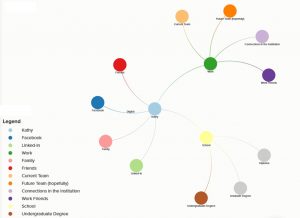
Map of my Network


As my digital footprint is small, so is my network; “there are more networked devices than people in the world” (Anderson, Dron, 2014, p. 3), I fit into this category.  I have several devices that connect to digital networks, but I am not a member of many of them.  Although my network is small, it does what I need it to do.

Breaking Down my Network

Naturally, I am at the center of my network, which connects to six hubs: school, work, friends, family, Facebook, and Linked-In, with school and work having sub-categories.  I split work and school further since they each have a large role in my network.  I included more than my digital network since I believe that a network comes from many connections.  In each of these hubs, there are people with whom I share a connection.  In many cases, these relationships are ones where we help each other.  The lines that attach the network do not have directions (i.e. arrows) because it is a flexible and the connections go both ways, which helps to build a stronger network.  Danah Boyd said, “physical structures are a collection of atoms while digital structures are built out of bits” (Boyd, 2011, para. 11), my network resides using both physical structures and bits.


References

Boyd, D. (2011). Social network sites as networked publics: Affordances, dynamics, and implications. In Z. Papacharissi (Ed.), A Networked Self (pp. 39–58). New York, NY: Rutledge.

Dron, J, & Anderson, T. (2014). Teaching Crowds. Athabasca University Press. Retrieved from http://www.aupress.ca/index.php/books/120235