Shared post by Kathy Moore and Sherry Ruth.
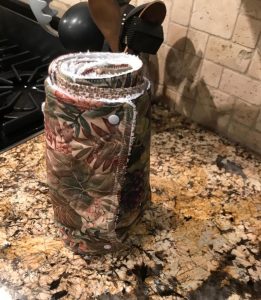
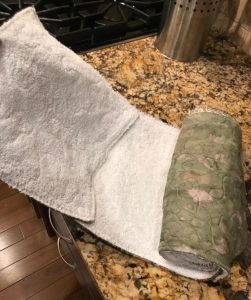
We investigated how to make paperless paper towels after learning about them from a coworker who had received a roll as a gift. Since the idea was new to both of us, we wanted to see what was available for instructions and if there was a community around the concept. Before starting the research, we discussed the ease of the project, the reason behind it, and the uses of the final product.
As with many new ideas, we started with a Google search using phrases we thought would yield the best results. Little did we know that “how to make fabric paper towels” would generate 76,800,000 results with 181,000 videos, and “DIY unpaper towels” would generate over 136,000 results, including 1,670 videos. Multiple variations of different keywords, such as reusable, unpaper, fabric, alternative, washable, and paperless, all provided thousands of results showing the abundant possibilities to learn about this topic online.
We found great diversity among the various sources. Blogs, websites, news articles, and videos offered multiple options including different styles, materials, methods, and uses. That diversity even extended to the individuals providing the content which included sewers, quilters, crafters, money-savers, homesteaders, DIYers, fabric stores, chefs, minimalists, naturalists, and environmentalists. Videos and step-by-step photos with accompanying instructions provided detailed information, varying from non-sewing options to beginner sewer and expert-level lessons. The comments sections of many of these sources created strong networks as conversations often emerged amongst readers, offering suggestions, alternatives, encouragement, and personal stories.
We are confident that there is abundant content available on this topic and we could successfully learn how to make our own paperless towels using our preferred medium, method, and material. Weller (2011) posits that any pedagogy based on the abundance of knowledge currently available should be socially based with free, abundant, and varied content that is easily generated and shared among users (p. 228). The thousands of results from the internet search on our topic certainly met this criteria. Though the amount of content could overwhelm some learners, further Google searches could narrow down the topic, for example, a search of “fabric unpaper towels ‘no sew’ flannel” results in 37 videos.
Extrapolating from Weller’s postulation, we believe that abundant content, including one’s own active participation in producing content and connecting with other participants, may be enough for some learners to learn some content successfully. However, abundant content alone is not enough for all learners and all subjects. There appear to be several determining factors which require consideration. First, it depends on the learner’s prior knowledge of the subject and the subject itself (i.e., how much cognitive processing is required, such as learning how to play a scale on the piano versus Mozart’s Requiem). Second, we believe it also depends greatly on the learner’s ability to navigate the abundant content. The learner must know where and how to search, then how to sift through the abundant content to determine what is valid and appropriate for his/her situation. Finally, and perhaps most importantly, abundant content alone may not be enough if the learner does not have the skills and motivation to successfully absorb the content as knowledge. While Anderson believes “a goal of connectivist learning is to create new connections, regardless of formal education systems, to expand upon and build learning networks” (Anderson, 2016, p. 43), it may be insufficient as a sole source for learning such skills as being more empathetic, doing backflips or flying a fighter jet. Given our skills and knowledge, however, we feel that we could complete this project based on the available content online and perhaps we will one day!
References
Anderson, T. (2016). Chapter 3: Theories for Learning with Emerging Technologies. In Veletsianos, G. (Ed). Emergence and Innovation in Digital Learning: Foundations and Applications. Edmonton, AB: Athabasca University Press.
Weller, M. (2011). A pedagogy of abundance. Spanish Journal of Pedagogy, 249, 223–236.
Nice work Kathy and Sherry! I had no idea that such a thing existed so I enjoyed learning about that and how you incorporated Anderson and Weller’s articles into your post.
Wondering…during your research, did you find any feedback on the useability?
Thank you for your comment. From what we read, the usage for unpaper towels are the same as for paper towels. Many people use them for household cleaning, to wipe up spills in the kitchen, or as towels in the bathroom to dry hands. The usages seems unlimited!
Kathy
Well done! Reading the comments on Sherry’s blog raises a different question for me. Let’s assume that you begin creating your first eco-friendly roll. Do you anticipate needing feedback on your individual creation at any point during this process? If so, did your search indicate how accessible such feedback may be?
Thank you for your comment.
I don’t anticipate that I would need feedback if I were to make this item. I found that the available instructions would likely give me enough information that I would be able to make a roll successfully; however, our search did show that if someone did want feedback on his/her project, that would be possible through the comments section on many of the sites.
This is very neat! What a cool topic!
I have been trying to reduce my footprint and I am a heavy paper towel user. I’m a bit of a germaphobe, so paper towels put my mind at ease. I’m eager to learn a bit more about this and see if I can reduce my paper towel use!
Thanks for the intriguing post!
~Leigha
Thank you for your comment.
From everything I have read, this would be a great solution for you! These can be one-use or multi-use before washing so they can fit your needs!