For my visual network, I chose to use a sample of contacts from my Facebook ‘Friends’ list. I chose this network to analyze, as it is the most rich and varied collection of network contacts I have. I was really interested in playing with some of the software options available to contextualize the data. What I hoped to emphasize, was the type of contacts my network contained, and identify the strength of each contact in hopes of identifying areas that were lacking and room to potentially strengthen my network.
Due to limitations of the software (or limitations of my ability to master the software) I was unable to create the visual I was trying to achieve. I hoped to show one comprehensive map of connections, with my stronger connections closer in proximity to myself on the map, and my weaker connections furthest away. I wanted to see which category of contacts primarily occupied the more proximal spaces. I also want to show connections between nodes, and identify areas of overlap and inter-connectivity.
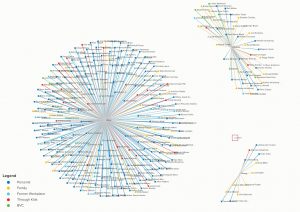
The visual network depicted below is what I was able to achieve after much effort. It depicts a sample of my connections, clustered by the strength of each connection to myself. The different colors of each node correlate to the type, or source of the connection, and can be decoded with the legend.
In rating my connections as strong, medium or weak, I used a simple guiding factor of how frequent my interactions with an individual were. I must admit, that I instinctively rated connections that occurred digitally as weaker, and in-person connections as stronger.
What I have been able to determine from this visual, is that the circle of people with whom I share a strong connection is relatively small when compared to my overall network, and does not contain professional contacts. Given the fluidity of networks, and how they can change (Veletsianos, 2016), this is a gap I do intend to focus on going forward.
References
Veletsianos, G. (2016). Digital learning environments. In N. Rushby & D. Surry (Eds), Handbook of Learning Technologies (pp. 242-260). UK: John Wiley & Sons.
Leave a Reply