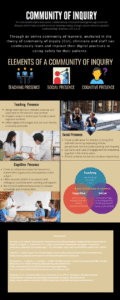
The community of Inquiry (CoI) framework
For a full view, click this link: CoI Infographic
How do you support clinicians and staff to continuously learn and improve their digital practices in caring safely for their patients? One of the challenges we face as an education department in a healthcare environment is to provide real-time support for staff and clinicians with minimal resources. Our learners’ diversity – interdisciplinary healthcare professionals who work 24/7- can be resource-intensive in providing support and continuous upskilling of digital skills using the clinical information system. The community of inquiry (CoI) framework lends well in developing an online community of learners. Creating an online community of learners to support continuous learning to increase proficiency in using the clinical information system seems like a natural progression to a support model that already includes online tip sheets and electronic manuals on how to use the system.
The CoI framework is composed of teaching, social, and cognitive presences. These three elements are interdependent; however, the teaching presence sets the tone and foundation for the rest of the elements. Lack of effective facilitation (teaching presence) can impede learners from engaging and interacting with the subject, their co-learners and the facilitator, supporting the construction of knowledge. According to Vaughan, Cleveland-Innes, and Garrison (2013), “facilitative actions, on the part of both the students and the instructor, create the climate, support discourse, and monitor learning such that presence can emerge, and inquiry occurs” (p. 46). It is critical to developing strategies that support the three elements of the CoI framework to encourage continuous learning and improve digital practices in caring safely for patients.
Several approaches can be employed to create an online community of learners. First, creating a safe space for learners to bring their authentic selves and engaging in meaningful discussions by sharing their personal experiences and expertise in the conversations. Second, setting clear expectations and norms of how learners should interact with each other. Respectful discussions and understanding of diverse perspectives are critical in creating a CoI. Third, essential to the concept of CoI is the ability of learners to challenge the status quo by de-constructing knowledge and constructing new ideas and concepts to enhance clinical practice.
Creating an “extension of learning” (Richardson, Caskurlu, & Ashby, 2018, p.2) for staff and clinicians is integral in supporting them to continuously learn and enhance their digital practices to care safely for their patients. Therefore, developing a community of learners anchored in the CoI framework is a vital component to encourage collaboration, peer support, and respect for divergent thinking.
References
Richardson, J., Caskurlu, S., & Ashby, I. (2018). Facilitating your online discussion [pdf file], Purdue repository for online teaching and learning. Retrieved from https://www.purdue.edu/innovativelearning/supporting-instruction/portal/files/8_Discussion_Board_Facilitation.pdf
Vaughan, N.D., Cleveland-Innes, M., & Garrison, D.R. (2013). Teaching in blended learning environments: Creating and sustaining communities of inquiry. Retrieved from https://www.aupress.ca/books/120229-teaching-in-blended-learning-environments/
Hi Sharon – I enjoyed thinking more about how a COI can apply within a context of professional development in the workplace, as you have shared. There are certainly some unique and nuanced considerations within your learning context. In thinking of practical workplace considerations and enhancing digital skills, your emphasis on peer support and community building resonated strongly, as the learning continues in an applied, day to day sense. The learner inevitably must leverage the knowledge of colleagues for support. I appreciated this example, as it is a reminder that learning takes places in many contexts and that a facilitator and learning community can take many forms. – Sanjay
Thanks, Sanjay for your thoughtful comment. I think the lessons that we are learning from our program and from each can be adapted to any type of setting; a salient reminder that learning is a social process and not exclusive to only the education institutions.
Hi Sharon,
What an interesting and relevant topic to select and tie back into the COI framework. I can appreciate how the framework can lend a hand in developing the online community of learners. There are so many times where patients are scared, stressed and uncertain regarding their health (understandably so) , that we shift the focus to the patient opposed to aiding, training and educating the front line workers.
I really like that you would create a safe space to share stories, meaningful experiences and information – this lends well to facilitation and growth of the individual, as well as installing confidence and knowledge. I used to be a nurse and I feel I learn best from my own mistakes or others, so this is very useful in a healthcare setting, where meaningful discussion and reflection should be considered.
Your infograph was lovely and pleasant to look at. I genuinely think I would see this in a team room at the hospital, or on the education board in the staff room. I think you did a great job in conveying how each presence can benefit and expand the need for communication in the online healthcare setting.
Kindest regards,
Kerry