Assignment 1 Part 2, Reflection paper

Create, Cultivate, and Reflect on your Digital Presence

Assignment 1 Part 2

Atkins and Murphy (1994) provided a model of reflection, which I found useful for writing this paper and decided to follow their 4 stages of reflective practice.

Stage 1:Awareness of uncomfortable feelings.

While cultivating my digital identity and digital presence I realized that on my Youtube channel I focus too much on the knowledge I’m trying to share in to avoid being known. My channel is educational, therefore in most videos, I explain various psychological theories and use them to analyze real-life situations. Yet you won’t see me talking, just hear and you won’t hear much about why this is important to me or how it applies to my life. Hiding behind the material helps me deal with the discomfort of being seen or known. Being seen and known makes me uncomfortable and yet I yearn it. It’s not a mystery why, I have a highly critical father who never finds anything positive to say to me and never misses an opportunity to point out my flaws. It’s bad enough that I project my critical father onto everyone, which makes me feel nervous before anyone can provide any feedback, but I also internalized my father. I always criticize myself harsher and quicker than anyone can do. The negative father complex (Nix, 2011), as well as defence mechanisms developed around it, are hindering my digital identity and digital presence. It became even more evident to me after unit 5 reflection activity. I recorded a quick and generic video of me not saying anything interesting or in-depth about my plan and experience following it. Not thinking much of it, I posted it on my blog and moved on to check out videos of other fellow students. They were much longer, much more interesting and detailed, personal and authentic. Everything I strive to be and do, yet I don’t. Why did I put out such a lazy and boring video? I felt uncomfortable talking about myself without anyone asking. And if someone does ask, I find it hard to believe it’s not just them being polite. Does anyone care about what I have to say? My father didn’t, so I learned to keep it to myself. I learned to stop caring about my own experience. Why should people care anyway? Why should anyone in the world care? My father, whom i loved very much and idealized as child, was my whole world, his personality was bigger than a world. And this world was not interested in me, so whenever I am asked to be interested in my experience and share it, I feel uncomfortable and I shut down. I run away from it like a plague to avoid feeling uncomfortable. It is one of the reasons why I like being a counsellor and an educator. I can focus on giving people what they need instead of talking about myself.

I also find it difficult to spend time on something I don’t find interesting. Curiosity is my main drive. I feel uncomfortable following a routine or doing what needs to be done because it takes away my time and energy from what I am passionate about. Cultivating my digital identity and digital presence involves content marketing and personal marketing, which feels like something I need to do rather than what I want to do.

Stage 2: Examination of components of the situation and exploration of alternative actions.

What drives the desire to have a digital identity? Ertzscheid suggested that there is a connection to Maslow’s pyramid of needs (2016). I attempt to satisfy the need for self-esteem and self-actualization through my digital presence. As I look back on my initial plan to develop my digital identity and digital presence, I realize now that I look for a confident, skilful and guiding hand to satisfy my need for self-esteem and self-actualization. In my plan, I expressed a desire for outsourcing to fill gaps in my skills and knowledge. I keep searching for a father figure, who will believe in me and help me come out of my shell so that I can be seen and known. So far, my efforts produced no results. People, that I approached to become my partner, saw no benefit for themselves. An alternative would be to hire, as I mentioned in my initial plan, a personal brand developer. Why haven’t I done it yet? I don’t believe that my digital presence is significant enough, there is not much to develop and my Youtube channel only has about 50 videos. I plan to rely mostly on Youtube in building digital presence because “on average, videos led to better learning outcomes compared with other methods”(Noetel et al., 2020). I don’t enjoy blogging, therefore I’m not going to keep an active blog outside of MALAT program, but I will put up all my writing on a WordPress website mostly to have a point of reference. I already purchased a domain name and I am looking for an affordable hosting service.

I am at the crossroads when it comes to my professional life. I just quit my job because I don’t enjoy trying to help people that are resistant to help. As I mentioned in a previous assignment, in social services relationships with care providers are rarely sought out and usually resisted (Rooney & Mirick, 2018). Lack of choice plays a major role in resistance (Ritchie, 1986). Based on this evidence and my experience, I do not ever wish to work again as a counsellor for a non-profit organization. I still enjoy being a counsellor and I like playing the role of an educator, how do I combine both into one? Over the next 3 months, I will be travelling with my family in the RV all over Canada and trying to find an answer to that question. These aspects of my personal and professional life are already impacting my decisions when it comes to content creation. At the moment, I am seeking out volunteers willing to be anonymously interviewed about their personal lives for financial compensation. These interviews will be used for testing a new personality assessment that I have developed. I will be sharing the results and the method itself on my Youtube channel because of its relevance to determining personality compatibility in relationships. I have already conducted a few interviews, which is a very similar process to counselling sessions I am used to, except the participants are willing and fully engaging. And I have already started analyzing the material and writing content for the future podcast series on my Youtube channel. So far it feels like an exciting fusion of counselling and educating roles, but is there a demand for this product in real life?

Stage 3: Summary of outcomes of reflection or learnings.

One of the main revelations has been so far is that digital identity is not the same as personal identity (Schryver, 2013). Personal identity can be a by-product of just being, it requires no extra effort if I don’t wish to put in the extra effort. Digital identity is something to be constructed and maintained, as a reputation (Ertzscheid, 2016). Resident-visitor typology (White and LeCornu, 2011) helped me understand my digital presence. And making a plan for cultivating a digital presence and digital identity helped me identify gaps in knowledge and skills, as well as create a long-term vision. I realized that I focus too much on creating content because i enjoy it and don’t spend enough time on adding a personal narrative to it, for the reasons explained in stage one. I still believe it would be helpful to have someone help me build a personal brand, but it might be too early. For now, I will put more energy into weaving a personal narrative in my content. I want people to care. The debate activity helped me realize that sifting through a ton of information that I care little about can be exhausting. If I was more personally connected to the subject or people debating the subject, I’d want to keep coming back to it. That’s what I want from my audience, but I need to give them a reason to care. How do I do achieve that? I need to focus more on emotional expression and sharing personal meaning. What educational format would be more appropriate for it? After reading a theory of transactional distance (Dron & Anderson, 2014), I realized that I prefer a low structure, high dialogue format, which is more suitable for informal educational seminars.

Stage 4: Action resulting from reflection.

I am going to continue creating more content! Right now I am interviewing more volunteers and analyzing our conversations. When I am done with this project, along with previously created content, it will be uploaded to a personal WordPress website with a fancy custom made theme. When it reaches critical mass, let’s say 100 videos on Youtube and about the same number of articles on my site, I will join several online communities, be it Facebook or forums, and start actively engaging in discussions where I can refer to my content.

I am also looking at various personal brand developers to shortlist and ask for advice, as soon as I hit above-mentioned numbers. Meanwhile, I am working on overcoming my psychological issues and hopefully, it will result in a rise of self-confidence and a decrease of self-criticism.

References

Atkins, S. and Murphy, K. (1994). Reflective Practice. Nursing Standard, 8(39) 49-56.

Dron, J, & Andreson, T. (2014). Teaching Crowds. Athabasca University Press.

Ritchie, M. H. (1986). Counseling the Involuntary Client. Journal of Counseling & Development, 64(8), 516–518. doi: 10.1002/j.1556-6676.1986.tb01186.x

Ertzscheid, O. (2016). What is digital identity? Issues, tools, methodologies. Marseille: Open Edition Press. doi:10.4000/books.oep.1235

Nix, D. C. (2011, April 12). The Negative Father Complex. Retrieved June 10, 2020, from https://www.don-nix.com/the-negative-father-complex-2/

Noetel, M., Griffith, S., Delaney, O., Sanders, T., Parker, P., del Pozo Cruz, B., & Lonsdale, C. (2020, May 18). Are you better on YouTube? A systematic review of the effects of video on learning in higher education. https://doi.org/10.31234/osf.io/kynez

Ritchie, M. H. (1986). Counseling the Involuntary Client. Journal of Counseling & Development, 64(8), 516–518. doi: 10.1002/j.1556-6676.1986.tb01186.x

Rooney, R. H., & Mirick, R. (2018). Strategies for work with involuntary clients. Retrieved from https://books.google.ca/

Schryver, K. (2013, February 5). Who are you online? Considering issues of web identity. The New York Times blogs. Alternate link to the The NYT blogs site.

White, D. S., & LeCornu, A. (2011). Visitors and residents: A new typology for online engagement. First Monday, 16(9)
Teaching 21st Century Skills in 20th Century Schools

Teaching 21st Century Skills in 20th Century Schools

by  Joubert, J. -P., & Koval, D.

      In discussing how digital learning impacted teaching 21st Century skills in 20th Century schools, we first need to define 20th Century Schools. While the original source website seems to be business-focused, the breakdown does seem to be sound in describing the typical 20th Century classroom. In particular, a 20th Century school is restricted to the four walls of the classroom, is concerned with passive learning through memorization of discrete facts, facilitated by a teacher who is both judge and the provider of information (21st Century Schools, n.d.). In addition, work was often done in isolation.

Additionally, Budhai and Taddei minimally define 21st Century Skills as being “the 4Cs—critical thinking, communication, collaboration, and creativity.” (2015, para. 1) While other definitions exist, such as Stauffer’s far more comprehensive list (2020), for the sake of brevity we have held to Budhai and Taddei’s definition.

To this end, we have found that digital learning impacted the teaching of 21st Century Skills in 20th Century Schools in the following ways: 

Critical Thinking

  • The Foundation for Critical Thinking defines critical thinking as, “that mode of thinking … in which the thinker improves the quality of his or her thinking by skillfully analysing, assessing, and reconstructing it” (2019, para. 2). 
  • As noted by 21st Century Schools, this definition was not represented in the way that 20th Century Schools taught (n.d.).
  • Additionally, Bates mentions that much of the use of technology during the 20th Century, for example the use of lecture capture systems, was aimed at representing similar functions and experiences to those experienced in classrooms at the time (Bates, 2015, para. 16). As a result, critical thinking in the classroom was not positively impacted at the time by digital technologies. 

Communication:

  • In the 1990’s, high-speed internet access led to lecture capture systems using resources such as Youtube to distribute course lectures and digital blackboards for equations and illustrations (Bates, 2015, para. 16).
  • While using an Learning Management System (LMS) required courses to be reconfigured for use online, the use of lecture capture, “required no changes to the standard lecture model” (Bates, 2015, para. 17).
  • In discussing testing, B.F. Skinner used programmed learning to, “computerize learning, by structuring information, testing learners’ knowledge, and providing immediate feedback to learners, without human intervention other than in the design of the hardware and software and the selection and loading of content and assessment questions” (Bates, 2015, para. 18).
  • Bates also describes PLATO, a worldwide and networked, “computer assisted instruction system,” that, “incorporated [online communication tools such as] forums, message boards, online testing, e-mail, chat rooms, instant messaging” (2015, para. 19).
  • These examples show themselves as precursors to the current use of digital technology, from the range of LMS available today, through to the use of Social Media, forums, streaming services and other digital tools in digital education. While they were at one time novelties or experiments, these uses became far more commonplace as we moved into the 21st Century and, as such, have had a positive impact on open education, especially.

Collaboration:

  • Technology use has been found to be a disengaging factor when collaborating in-person in a classroom (Heflin, Shewmaker, & Nguyen, 2017, p. 98)
  • On the other hand, collaboration increased when technology use had “some form of planning and design for the use of technology to support and promote collaborative work” (Borokhovski, Bernard, Tamim, Schmid, & Sokolovskaya, 2016, p. 20)

Creativity: 

  • On a positive side, technology use supports creativity by “reinforcing students’ intrinsic motivation, self-regulation, curiosity, self-efficacy and knowledge exchange” (Shubina & Kulakli, 2019, p. 104)
  • At the same time, there has been a negative effect of internet technologies on creativity. By facilitating multitasking behaviors, internet technology increases “distractibility and reduced learning, especially in the classroom” (Bruno & Canina, 2019, p. 2125)


References

21st Century Schools. (n.d.). 20th Century Classroom vs. the 21st Century Classroom. http://www.cais.ca/uploaded/Professional_Development/21st_Century_Schools.pdf

Bates, A. W. (2015). 6.2 A short history of educational technology, Teaching in a Digital Age: Guidelines for designing teaching and learning. https://opentextbc.ca/teachinginadigitalage/chapter/section-8-1-a-short-history-of-educational-technology/

Borokhovski, E., Bernard, R. M., Tamim, R. M., Schmid, R. F., & Sokolovskaya, A. (2016). Technology-supported student interaction in post-secondary education: A meta-analysis of designed versus contextual treatments. Computers & Education, 96, 15–28. doi: 10.1016/j.compedu.2015.11.004

Budhai, S., & Taddei, L. (2015). Building 21st Century Skills through Technology. Teaching the 4Cs with Technology. ASCD Arias. http://www.ascd.org/publications/books/sf116038/chapters/Building-21st-Century-Skills-Through-Technology.aspx

Bruno, C. & Canina, M. (2019) Creativity 4.0. Empowering creative process for digitally enhanced people, The Design Journal, 22:sup1, 2119-2131, DOI: 10.1080/14606925.2019.1594935

Heflin, H., Shewmaker, J., & Nguyen, J. (2017). Impact of mobile technology on student attitudes, engagement, and learning. Computers & Education, 107, 91–99. doi: 10.1016/j.compedu.2017.01.006

Shubina, I., & Kulakli, A. (2019). Pervasive Learning and Technology Usage for Creativity Development in Education. International Journal of Emerging Technologies in Learning (IJET), 14(01), 95. doi: 10.3991/ijet.v14i01.9067

Stauffer, B. (2020, March 19). What are 21st Century Skills?. Applied educational systems. https://www.aeseducation.com/blog/what-are-21st-century-skills

The Foundation for Critical Thinking. (2019). Our concept and definition of critical thinking. https://www.criticalthinking.org/pages/our-conception-of-critical-thinking/411


Academic writing and a drowning dog: post debate reflection

 Sometimes, a happy ending makes a terrible experience worth having, sometimes, it doesn’t.

While camping at a secluded lake today, I heard a dog barking loudly and noticed it swimming in the middle of the lake. It was heading towards the shore, but then for some reason, maybe 15 meters away from it, turned around and started swimming back, towards the other shore. And then did it again. And again. And again. Every lap the barks became quieter and soon turned into barely pronounced whining. The dog was clearly exhausted and struggling. I looked around, there was only one family on the beach and they were aware of the dog but did not seem concerned, so I assumed they weren’t the owners. It seemed inevitable that it was going to drown soon.

I grew restless and rushed into water to swim towards it. I was pretty sure I could not save it because it was a rather large breed and I am not strong enough to carry its weight but I knew i wouldn’t be able to forgive myself if I didn’t try.  I quickly realized why it kept turning away from the shore. It was very muddy, legs kept sinking into it, it wasn’t possible to find a solid ground. Like quicksand, the mud was swallowing my legs and I couldn’t even attempt swimming towards the dog. I ran around the lake in search of a less muddy entrance into the water, but had no luck.

At this point the dog was barely staying afloat. I made two more attempts to walk into the mud and had to turn back when it reached above my waist and I felt no ground to walk on. I finally sat on the beach, all dirty, tired and disappointed. And just helplessly looked away. I could not save it and it was time to accept its demise. I could still hear it making some noises, but it sounded like the end was several minutes away.

And right at this moment its owner showed up. The dog heard him whistling and shouting and made a last ditch attempt to reach the shore. And it got lucky, found a more rocky ground. Then the owner pulled it out.

What a terrible experience. I cried from helplessness. It lasted no more than 20 minutes, but i was so tired after that I couldn’t even feel happy that the dog survived. And yet, as strange as it sounds, I am glad this happened to me. Maybe, it is simply because my life was that boring and repetitive in the last several months. This awful experience made me feel alive.

Cant say I feel the same about Academic writing. The debate was interesting to judge, but the Academic writing part of it felt like a prolonged drowning.  And for me it always is. There is usually a happy ending – I learn something new and I get a decent grade, but this kind of drowning never makes me feel alive.

This is not a MALAT type of post but it is exactly why i am going to post it. If I only aim to post what I can reference and do it in a proper APA format, I feel like I am not going to post much. So there it is.

Network map


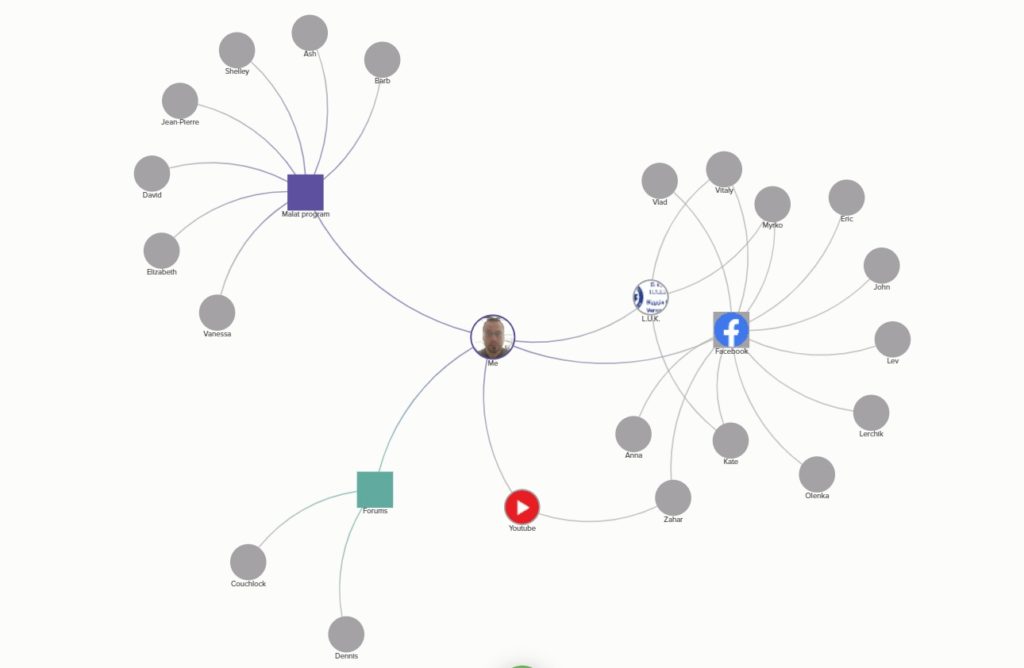
My network map is defined by my preference for close and meaningful personal connections. I could’ve added more people to each circle, but I don’t consider my connections with them intimate or meaningful. My narrow social circle used to  something I was concerned about, but as I grow older I prefer quality over quantity more and more.

Would I like to expand my networks ? Yes, of course, but only with people that matter.

https://kumu.io/Zzzaratustra/malat


Reflection

While creating a Digital Presence Plan I identified a significant gap in my Digital Identity – lack of personal narrative. I focus too much on delivering theoretical knowledge and not enough on how it is relevant to real life in general and to my life in particular. Why do I care about teaching this stuff? Why should anyone care? vanOostven et al. (2016) suggests an obvious but sobering conclusion “If students do not see their learning as having real world integrity, they tend to become disengaged” (page 8). Cognitive presence, argued by Garrison, Anderson, & Archer, (2000, p. 89), is only one aspect of a community of Inquiry model. Social presence, which includes emotional expression and Teaching presence, which includes sharing personal meaning, are significant aspects of learning. I need to focus on them more while generating content. Once I successfully integrate social and teaching presence, what will it look like? I started wondering about the structure. There is a theory, which suggests (Dron & Anderson, 2014, p. 62) that it is one of the three dimensions of transactional distance, which also includes dialogue and autonomy. The author divided them into four quadrants and suggested that each represents a different level of autonomy, based on low/high dialogue and low/high structure axis. I seem to prefer low structure, high dialogue and the format that fits best with such combination, according to the author, is seminar. I like the idea of having educational seminars, where emotional expression and sharing personal meaning play a major role. I believe it is something I should include in my plan and make it one of my goals.

References

vanOostveen, R., DiGiuseppe, M., Barber, W., Blayone, T., & Childs, E. (2016). New conceptions for digital technology sandboxes: Developing a Fully Online Learning Communities (FOLC) model. In Proceedings of EdMedia: World Conference on Educational Media and Technology 2016 (pp. 665-673). Association for the Advancement of Computing in Education (AACE). 

Garrison, R., Anderson, T., & Archer, W. (2000). Critical inquiry in text based environment: Computer conferencing in higher educationThe Internet and Higher Education2(2–3), 87–105.

Dron, J, & Andreson, T. (2014). Teaching Crowds. Athabasca University Press.

Digital Identify Digital Presence Plan

1) overall goal and purpose for cultivating your digital presence and identity:

To create a personal brand of an educator/counselor/coach which will attract enough clients so that I can make a living as an independent consultant

2) approach for achieving this goal:

Find/create a niche market for myself: relationship counselling for single people

Generate content (writing articles, making educational/psychoanalytic videos)

Use Youtube and personal wordpress based website to share content

Create online courses based on generated content

Use social networking platforms for marketing

3) identification of skills, knowledge gaps:

a)Project management skills could be improved. I tend to focus more on one area, such as generation of content and neglect everything else.

strategies and approaches to address the gap:

Introduce structure and planning to project management.

One way to do it is to divide the project into different categories and attach timelines and deadlines to each one. Schedule tasks, so that a chunk of the day/week/month is dedicated to each category. Ideally, I would like to outsource the areas where i lack skills/knowledge/passion to someone who can do it better, so that I can focus on generating content.

b)Video editing skills are too basic. I tend to focus on substance more than on form. Delivery/presentation of content is weak.

strategies and approaches to address the gap:

  • Learn how to edit videos better and make them more appealing. Ideally, I would like to outsource the editing to someone else.
  • Make the content so powerful or relevant that delivery/form becomes less important

c)Zero knowledge/skills in creating online courses.

strategies and approaches to address the gap:

Learn how to use software and course delivery platforms such as Articulate 360, Teachable, Skillshare, etc

d) Poor marketing skills. I tend to focus more on theory and general practical application rather than giving the audience a personal narrative – why am i doing this ? how does this fit into the story of my life ? What makes it relatable or why should people care ?

strategies and approaches to address the gap:

  • Focus more on a personal narrative when generating content
  • Analyze feedback and adapt to the expectations of the audience
  • Hire a personal brand developer/marketing specialist

5) measures of success:

How many people visit my website and Youtube channel ? How many people are taking online courses ? Is my audience growing ? Am i able to generate any income from it ?

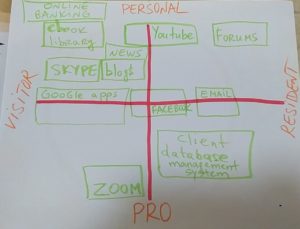
resident-visitor typology map

Looking at maps of others made me realize how limited my online presence is. I don’t visit as many places.

Looking at my own map made me realize how underdeveloped my personal online presence is.  I don’t contribute much.

I am mostly a visitor and perhaps my introversion can take a partial blame for that.

I always felt that internet is over saturated with mediocre content and unless i have something significant to share, it is pointless to add mine to a world where supply exceeds demand.

I started a youtube channel this year and I am in it for a long haul, as i have enough content to generate for years to come, so that’s a big step in the right direction.

I need to pull away from other places though. I am addicted to playing chess and I spend at least 2 hours a day on various chess playing websites. It brings me nothing but misery, maybe that’s why i didn’t put it on the map.

Virtual Symposium reflection

I am torn between the real and the imaginary. My professional life and my passion. They have been separated for a decade and MALAT program is a step towards answering the question:

Is it meant to be ? Can they ever get married and have a happy life together ? It is hard to say exactly how far apart they are, but the gap appears everywhere, even in my reflections on a Virtual Symposium.

With one eye, I was watching for clues as to where this career path might lead me. What is the role of an Instructional Designer ? Where can I apply myself as an ID ?  What environment do I better fit in ? How can the knowledge and experience presented in Virtual Symposium help me in my professional life ?

I was surprised to learn that IDs can play a role even in hands-on industries such as dentistry, culinary or trades. It widened my perception which was previously limited to thinking that online courses are mostly tied to theoretical fields. Isn’t it great that there are more career options than I previously thought ? Of course, if I want to continue growing professionally, but such growth, while beneficial, will be taking me in a different direction, away from my passion. I’d like to teach personality psychology, but mostly non-mainstream theories along with my own ideas. And there is no existing academic environment which would allow me to do that.

That’s why, with my other eye, I was watching for any ideas as to how I can succeed on my own. How can i create my own environment, my own digital presence ? How can i communicate my ideas better ? How can i reach an audience ? How do i create my own courses ? How do I avoid the pitfalls (such as  mediocrity of user interface) of many open source platforms and the costs of visually appealing software developed by for-profit companies ? Should I stick with something as boring as Moodle or experiment with more visually pleasing Articulate 360 or something similar ? I was not surprised to hear that some of the instructors share my distaste for Moodle.  Since we rely on it in this program, I appreciate the honesty.

One idea which caught my eye was discussed by Amanda Dunn in her research project “The impact of Self-Efficacy by implementing a community of inquiry into a self-paced online highschool course”. From my own experience, having a community of inquiry, such as a discussion forum, increases engagement and promotes deeper inquiry into subject.  In her research Amanda used an article by Anderson (2017), which explores in more detail the community of inquiry model introduced by Garrison (2009) and argues that social presence, such as discussion forum, is one of the factors behind a successful course. He cites a paper by Holstein and Cohen (2016) which analyzed student perceptions.

During Virtual Symposium I learned a lot about systemic constraints of formal education. I also found myself feeling ambivalent about the use of academic language in presentations as well as research papers. I understand the need for a structure and standards in an academic environment and I don’t disagree with it. Academic writing is one of the areas where I need to improve, but this gap is probably not the reason why I want to gravitate away from academia. Would I be the first person to wonder about the limitations of an academic system ? Would i be the first person to say out loud how dry and disengaging the academic language is ? Especially if one is aiming at capturing the attention of a general public. Probably not. If I were to start writing according to strict academic standards, I would have to resist the urge to write “Probably not” in a previous sentence. It might sound silly, but freedom (or at least flexibility ?) of expression is important to me. If i can avoid placing such limitations on myself, do I not owe it to myself to try ?

I can only hope that this program will prepare me to stand on my own, but it is very likely that I will end up joining the very system that I resist.


References

Anderson, T. (2017). How Communities of Inquiry Drive Teaching and Learning in the Digital Age.                         Retrieved from https://teachonline.ca/tools-trends/insights-online-learning/2018-02-27/how-                 communities-inquiry-drive-teaching-and-learning-digital-age

Garrison, D. R. (2009). Communities of inquiry in online learning: Social, teaching and cognitive presence.
In P. Rogers et al. (Eds.), Encyclopedia of distance and online learning (2nd ed., pp. 352-
355). Hershey, PA: IGI Global.

Holstein, S., & Cohen, A. (2016). The Characteristics of Successful MOOCs in the Fields of Software,                    Science, and Management, According to Students’ Perception. Interdisciplinary Journal of E-                   Learning & Learning Objects, 12.