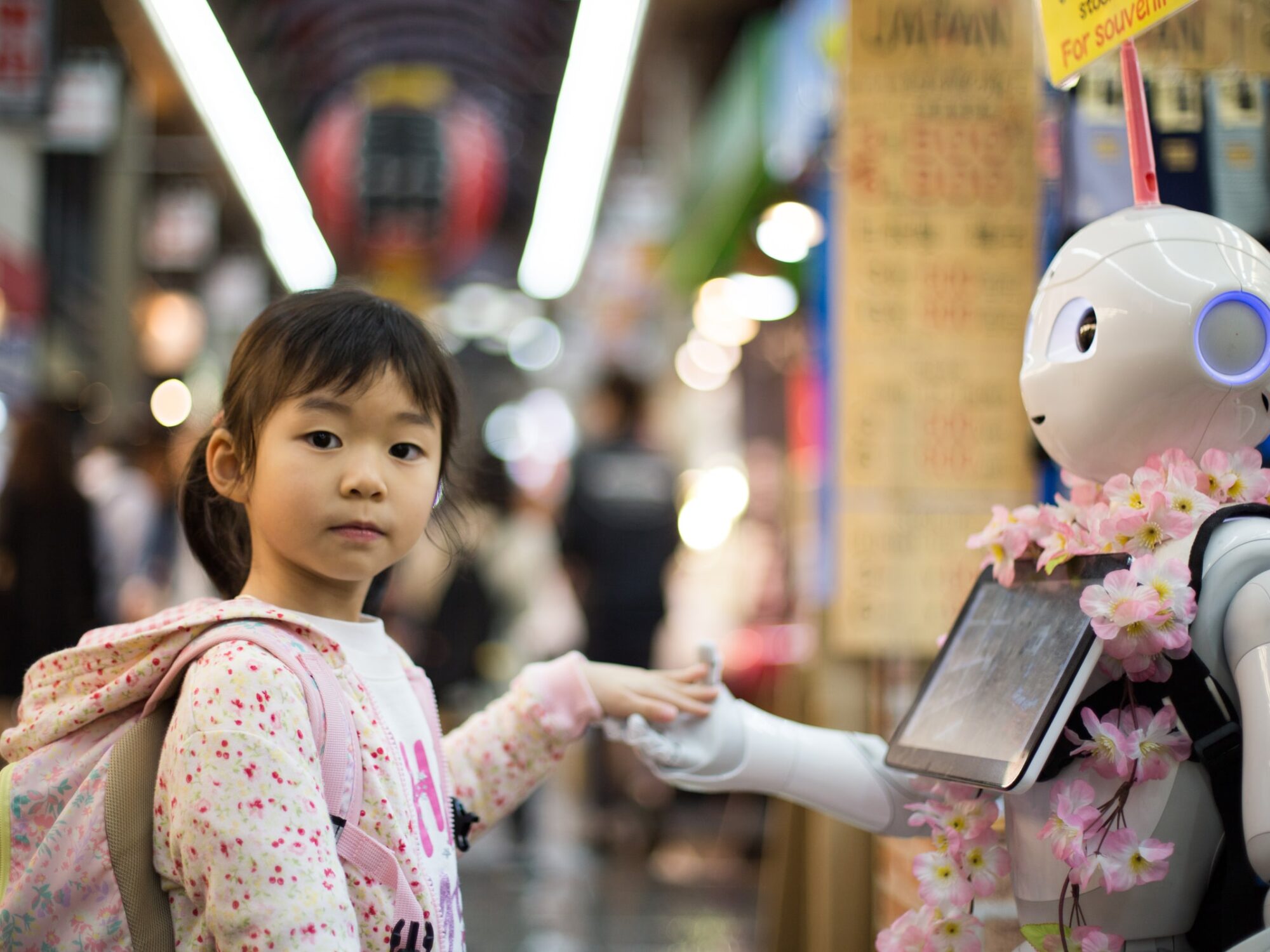
Photo by Andy Kelly on Unsplash
“The only constant in life is change” – Heraclitus.
Much of the last twenty-five years, the educational technology field has gone through many stages of, to a large degree, adaptation, innovation, and expansion. To use Heraclitus’ analogy from the quote above, the same can be said about higher education. It has undergone significant change and continues to do so. As I reflect on the lessons from the past to speculate the future in ten years, I question how the implications of the decisions made in the present time shape the future in education? More importantly, what new opportunities and challenges lay on the horizon? Will Artificial Intelligence (AI) take over the role of the educator by the 2030s? Most likely not yet, but they most likely will emerge and change many aspects of human endeavour, including the way we teach and learn, universal accessibility, and privacy security in ten years. I am optimistic but cautiously hopeful that future machine intelligence will be built solely with the intention to help human intelligence reach the next level of innovation.
AI technology is “evolving faster than expected and is already surpassing human decision making in certain instances” (Walker, 2018, p.1). AI is a broad term to describe machines that respond to stimulation consistent with human responses, given the human capacity, judgment, and intention, according to Shubhendu & Jaiswal (2013). Adaptive learning is one of the many aspects of AI. Recent research has revealed the benefits of using personalized learning and adaptive learning experiences based on the learner’s preferences, habits, knowledge, and skills (Wozniak, 2020). The idea of differentiating learning experiences and analyzing styles to determine the best method of learning and teaching is not new. It dates back to 1779, when Thomas Jefferson introduced a “Bill for the More General Diffusion of Knowledge” (Dockterman, 2018). However, using emerging technology to automate this process is. The field of Artificial Intelligence in Education (AIED) also has achieved success, in the last twenty-five years, in terms of technology development, theoretical contributions, and impact on education (Roll & Wylie, 2016).
Thus, in 2030, it is not too far out of reach to think that most educational programs in higher education will be developed by instructional designers, curriculum developers, and subject matter experts to create pedagogically sound goals, objectives, content, and authentic assessment with adaptive learning integrated, in a Universal Design for Learning (UDL) environment. In the present time, facial recognition technology can already extract faces from non-faces, identity, gender, and feigned emotional state (Cottrell, 1991). Additionally, automatic speech recognition systems can use sound voice and recognize the mouth shape (Wu et al., 1991). Moreover, adaptive learning can deliver customized learning experiences that address the learner’s unique needs through just-in-time feedback, pathways, and resources. Notably, Essa (2016) speculates, “recent advances in big data, learning analytics, and scalable architectures present new opportunities to redesign adaptive learning systems” (para. 1). These are possible cumulative evidence that the next generation of adaptive learning in the future will also need to change, evolve, and integrate many other aspects of AI to stay relevant.
As a result, what will adaptive learning look like in 10 years in education? It is feasible that adaptive learning can detect facial expressions to analyze the learner’s emotional state for even more accurate data analysis of the learner’s understanding of the topic. Additionally, with speech recognition, the learner can give speech commands to the content or assessment instead of needing to click or type. According to the World Health Organization (2003), there are 300 million people with a disability, including approximately 180 million visually-impaired and 250 million hearing-impaired. Thus, with such a universally accessible and flexible learning environment, it would be helpful for most learners, learners with learning and thinking differences, and fundamentally needed for learners with different physical abilities. Rose & Meyer (2002) agree that UDL is now possible because new technologies make it possible to build learning materials and environments that are more flexible.
Given if such AI advancements could come into fruition, it will be an evolution and certainly, change the way we live, learn, and teach. However, it is undeniable not to be alarmed by Elon Musk’s statement against AI, founder of SpaceX, declaring it “the most serious threat to the survival of the human race” (Gibbs, 2014, para. 1) or Bill Joy’s manifesto, co-founder of Sun Microsystem, entitled Why the Future Doesn’t Need Us. Additionally, with a large collection of sensitive data and personal information, it is clear that they need to be confidentially safeguarded against improper disclosure, yet, it is a problem far from having a well-defined solution (Livraga, 2015). Despite such warnings, development in AI continues to advance. At the moment, AI assistance is helping us with day-to-day tasks, help us learn more effectively, identify our grammar mistakes, and “freeing us up to do more meaningful work and have more leisure time” (Walker, 2018, p.9). However, it would be a naïve approach to think adaptive learning utopia for the learners, educators, educational institutions to depend on others to safeguard confidential biometric information and prevent a breach of data security in 10 years. Optimizing AI for maximum benefits requires a drastic change of approach, a balance of privacy security, and safety protocols for ethical innovations.
In closing, we can look through the lessons from the past to form a picture of what the future might hold and the decisions made today will foreshadow certain results, in 2030. It is safe to assume that AI is here to stay, it has changed the way we live, work, and continues to do so. Adaptive learning has made its way into education, it is continuously changing the way we teach and learn, providing convenience, flexibility, and accessibility. In spite of all of the great inventions and innovations, we do not yet have a solution for data security. I am doubtful that there will be a solution in 10 years, however, I am hopeful that each individual learner, educator, and educational institutions would be more cautious and diligent when it comes to giving up personal information.
References
Cottrell, G. W. (1991). Extracting features from faces using compression networks: Face, identity, emotion, and gender recognition using holons. In D. S. Touretzky, J. L. Elman, T. J. Sejnowski, & G. E. Hinton (Eds.), Connectionist Models (pp. 328–337). Morgan Kaufmann. https://doi.org/10.1016/B978-1-4832-1448-1.50039-1
Dockterman, D. (2018). Insights from 200+ years of personalized learning. The Science of Learning, 3(1), 1–6. https://doi.org/10.1038/s41539-018-0033-x
Gibbs, S. (2014, October 27). Elon Musk: Artificial intelligence is our biggest existential threat. The Guardian. https://www.theguardian.com/technology/2014/oct/27/elon-musk-artificial-intelligence-ai-biggest-existential-threat
Livraga, G. (2015). Introduction. In G. Livraga (Ed.), Protecting Privacy in Data Release (pp. 1–9). Springer International Publishing. https://doi.org/10.1007/978-3-319-16109-9_1
Roll, I., & Wylie, R. (2016). Evolution and Revolution in Artificial Intelligence in Education. International Journal of Artificial Intelligence in Education, 26(2), 582–599. https://doi.org/10.1007/s40593-016-0110-3
Shubhendu, S. S., & Jaiswal, V. (2013). Applicability of Artificial Intelligence in Different Fields of Life. 1(1), 8.
Walker, R. (2018). Artificial Intelligence in Business: 23.
Wozniak, K. (2020). Personalized Learning for Adults: An Emerging Andragogy. In S. Yu, M. Ally, & A. Tsinakos (Eds.), Emerging Technologies and Pedagogies in the Curriculum (pp. 185–198). Springer. https://doi.org/10.1007/978-981-15-0618-5_11
Wu, J.-T., Tamura, S., Mitsumoto, H., Kawai, H., Kurosu, K., & Okazaki, K. (1991). Neural network vowel-recognition jointly using voice features and mouth shape image. Pattern Recognition, 24(10), 921–927. https://doi.org/10.1016/0031-3203(91)90089-N