
 (Images source: Pixabay)
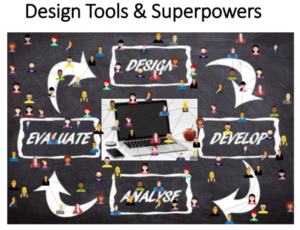
In my opinion, people are the preeminent consideration in the field of education. As I contemplated my instructional design tools and superpowers, I debated a multitude of hardware, software, models, and theories, but ultimately, all of these lead to the same place: the people involved in the practice. In my experience in the field of K-12 online learning, the end-users are diverse, and teachers plus back-end support staff expand the circle further. Initially, one may think of end-users primarily as the learners within courses, but I would argue that course teachers, educational assistants, and even parents/guardians and other family members or support people fall within this broad category. The range of digital fluency (Lalonde, 2019) in a population such as this is staggering, and the resources required to support this are substantial (Beetham, 2015). The overlay and prominence of people on my graphic emphasizes their prominence in my practice. It also represents their diversity, and how messy or challenging the human factor may be at times.
At the same time, learning is dynamic, and in my organization, we constantly have projects and development underway. We follow general processes that align with design thinking, as opposed to formal design models, with an emphasis on collaboration, feedback, and iterative cycles (Brown & Green, 2018). The design process represented in the image above is intentionally simplistic with emphasis on the circular or iterative processes. My organization is largely geographically distributed with remote workers and defined as an online school (School Act, Revised Statutes of British Columbia, 1996) therefore the vast majority of our processes are technologically mediated. I could not extract the general presence of, and even saturation with, technological tools, including an array of hardware and software, represented by the computer placed in the centre of the image. These tools truly are a means to an end, a vehicle to achieve the goal of deep learning (Weller, 2020).
Beetham, H. (2015, November 10). Building capability for new digital leadership, pedagogy and efficiency. Framing Digital Capabilities for Staff – Deliverables. https://digitalcapability.jiscinvolve.org/wp/2015/11/10/framing-digital-capabilities-for-staff-deliverables/
Brown, A. H., & Green, T. D. (2018). Beyond teaching instructional design models: exploring the design process to advance professional development and expertise. Journal of Computing in Higher Education, 30(1), 176-186.
Lalonde, C. (2019, February 22). ETF. Digital Fluency vs Digital Literacy. https://edtechfactotum.com/digital-fluency-vs-digital-literacy/
School Act, Revised Statutes of British Columbia, 1996 (2021). Retrieved from British Columbia Public school policies website: https://www2.gov.bc.ca/gov/content/education-training/k-12/administration/legislation-policy/public-schools/online-learning-policy-general
Weller, M. (2020). 25 Years of Ed Tech. Athabasca University Press.
Hear hear! Alisha.
Beautifully written. I always enjoy reading your blog and taking note of the words you choose. I do agree with what professor Veletsianos said that technology changes fast and that in two or three years, it may have all changed and you will be using new platforms and technology so it is best to focus on the people and methods.
Sam
Hi Alisha,
Thank you for the reminder to include the back-end support staff in the K-12 ecosystem. I completely agree with your statement that “the end-users are diverse, and teachers plus back-end support staff expand the circle further” (Hadley, 2021), and appreciate your inclusion of a broad definition of community as well as the reality of the messiness of digital fluencies. Great post!
Angela