
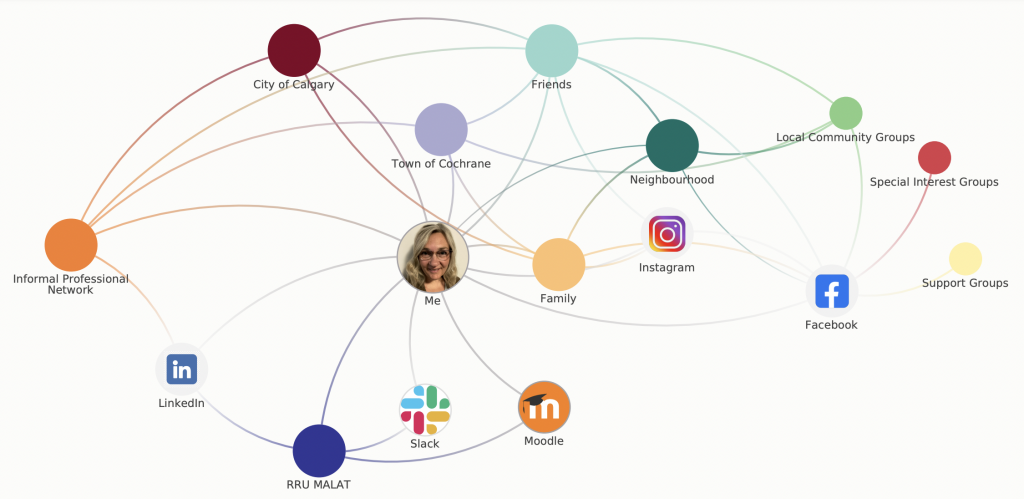
As part of our LRNT 521 course, we have been asked to develop a visual network of where and how we are situated. Through the process of developing this visual, I found that I was having a hard time distinguishing between communities and networks. Upon reflection, I believe that I have a relatively small network that is defined by my desire for community which is evident in this visual representation. Furthermore, there is considerable overlap within and between my community ‘hubs’, which is not surprising given that I tend to keep my connections smaller, purposeful and meaningful. I do have a LinkedIn account, however, I am not very active on that platform so I would say that my network is small in that particular digital environment. On the other hand, my “informal professional network” is much greater in scale (across geographical distance and sectors), yet I would still say that I have some level of individual relationship with each person that I consider within this category.
Dron & Anderson (2014) describe networks as “primary knowledge conduits of the world; throughout our lives we learn from the people that we know” ( p. 131). This statement reflects my view of learning as a lifelong endeavour that takes place in and outside of formal educational boundaries. When I look at my network, even though many of my groups and communities are not places of formal learning, I can say honestly that I have learned (and continue to learn) from each of them. The overlap of my networks can be classified as sub-networks that I can identify based on context and learning needs (Dron & Anderson, 2014, p. 135). These, along with my greater networks and groups are dynamically forming and dissolving and because of that, this visual representation of my networks is a snapshot in time. It would be interesting to revisit and repeat this exercise at some point.
Updated May 9, 2022 for clarity
Reference
Dron, J. & Anderson, T. (2014). Teaching crowds. AU Press. https://doi.org/10.15215/aupress/9781927356807.01
Thanks, Giulia! I have found that most (digital) professional networks live within Twitter and LinkedIn and those are 2 platforms that I have accounts for, however, I am not active on them due to time constraints and interest. The nature of the work I have been involved in in the nonprofit sector allowed me to partner with many organizations across Alberta and Canada, allowing me to grow my network through interactions. Presenting at and attending numerous conferences allowed for more social connectedness with my network, which supported strong relationships, resulting in my informal professional network. Thanks for reading 🙂
Hi Leah! Your blog is looking great! I really enjoyed exploring your visual network map, it is very visually appealing. I approached my network as more of a digital network but really appreciate your angle incorporating “informal professional network”. Awesome work!