Digital Identity and Digital Presence

After reading and analyzing the articles, blog posts, and videos for this Unit, I better grasp the importance and impact of creating an online presence and identity.

As a high school educator, the need to balance public and private is essential to me. Yet there is an increased demand for people to have a more significant digital presence, making this idea of identity a little trickier. As Helen Nissenbaum in Danah Boyd’s article states, it becomes a process to “regain a sense of control in a networked society.” (2011, p.12). 

To regain control, I need to rethink my traditional thoughts about public versus private. Knowing that I will have a visible digital identity, I will research different tools and strategies to help me curate a professional and personal presence aligned with my values that I can control (Boyd, 2011).

Two primary goals came to mind after reading Helen Beetham’s framework for “digital capabilities for learners”: “Digital communication, collaboration, and participation” as well as “Digital creation, innovation, and scholarship” (2015, p.2). 

Goal 1-To be a more collaborative digital citizen

Henry Jenkins’ book “Confronting the Challenges of Participatory Culture” addresses the importance of “participatory culture” in a digital world (Jenkins, 2009). I need to become a more active collaborator online and move away from being a “consumer” to grow my online presence. Participatory culture will allow me to develop a more active role as a “producer”, which ultimately will help my digital footprint develop and grow (Jenkins, 2009, p.12). 

I consider myself flexible and understanding; these are valuable skills as a collaborator. I do not, however, have much knowledge about online collaborative tools. This is an area that I will need to explore and research to grow my digital presence this way.

Goal 2-Creating and sharing educational documents in an open setting. 

Helen Beetham’s framework for Digital Capabilities correlates to the goal I have to share and collaborate as an educator. She has a statement which mentions acting as, “…a digital change agent” (2015, p.2). By working towards sharing resources, I can then take this knowledge and encourage my colleagues and my students to do the same. 

This goal’s ‘Open Setting’ aspect is directly relatable to session at RRU’s Virtual Symposium. He made the connection between the sharing of resources in a regulated way (Creative Commons), leading to more “collaborative, flexible learning.” (Lalonde, 2018). 

So by sharing my resources and ideas through mediums like Creative Commons, I can grow my digital presence, mainly because my name and resources can be searchable and usable. 

To enhance my visibility and presence in this area, I will have to better understand Open Educational Technology (OET) and Open Educational Resources (OER). 

Measuring Success

I believe the ultimate measure of success would be an increased digital presence. Creating an account or space where I can share my resources would be a more tangible measure of growth. As for my collaboration goal, I’d like to create some lessons/breakouts regarding collaborative online tools and practices to share with my colleagues. I can do this through staff meetings or professional development sessions. These efforts could lead to increased effective collaboration and even grow a larger online digital community of teachers in my district, leading to an increased digital presence.

References

Beetham, H. (2015, Nov 10). Building capability for new digital leadership, pedagogy and efficiency. Jisc Building Digital Capability Blog https://repository.jisc.ac.uk/6236/1/Digital_capabilities_learner_profile.pdf 

Boyd, D. (2011). Social network sites as networked publics: Affordances, dynamics, and implications. In Z. Papacharissi (Ed.), A Networked Self (pp. 39–58). New York, NY: Rutledge https://www.danah.org/papers/2010/SNSasNetworkedPublics.pdf 

Jenkins, H. (2009). Confronting the challenges of participatory culture: Media education for the 21st century. MIT Press. https://doi.org/10.7551/mitpress/8435.003.0004 

Lalonde, C. (2018, April 19). Sharing and CC licensing. In E.Childs (Chair), 2018 Virtual Symposium [Symposium].  
Digital Technology Use: The ‘Visitor-Resident’ Spectrum

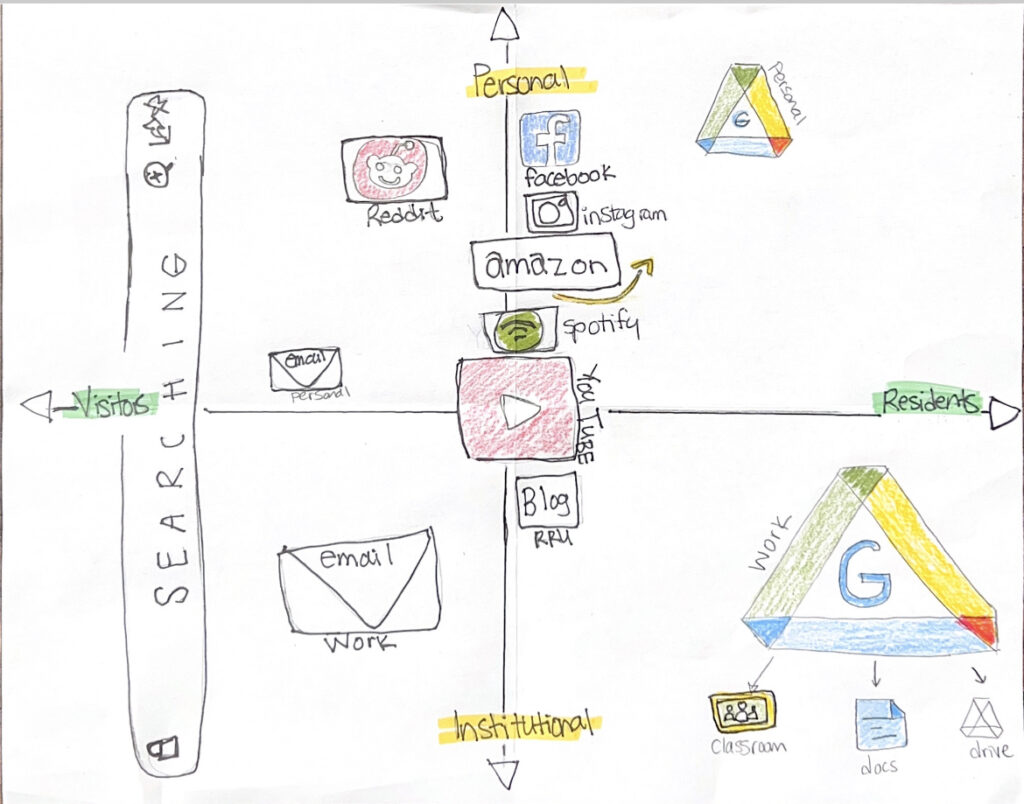
The image above represents a map of digital technology use divided into four quadrants. The idea comes from White and Le Cornu’s assertion that people’s use of the Web consists of ‘Resident’ and ‘Visitor’ mindsets. ‘Visitors’ to the internet use it as a tool and leave a relatively small imprint behind, whereas ‘Residents’ invest time, create relationships, and create a much more visible presence online (White & Le Cornu). 

My map illustrates a more prominent ‘resident’ role in my work life using Google Suite. It is quite literally my ‘home’ when at work. All my classes are on Google Classroom, and most assignments are created or housed in Google Drive.

Socially, my footprint is somewhat less. I have two social media platforms where my privacy settings are quite high, and I only post on rare occasions.

What surprised me most was YouTube. Personally and professionally, I frequently use it and have subscribed to various channels, making me more visible than I realized.

Reflecting on my digital usage and ‘footprint’, I am satisfied with where I am, although I know that this map has captured only a moment in time. The interesting question is, how will this map look in two, five, or ten years’ time?

References

White, D. S., & Le Cornu, A. (2011). Visitors and Residents: A new typology for online engagement. First Monday, 16(9). https://doi.org/10.5210/fm.v16i9.3171

Who am I, and who ‘should’ I be?

I never suspected that I would be questioning my identity after I attended my first virtual symposium (#RRUMALAT). After several sessions, it has become clear that creating a digital identity is more complex than I thought. The first step in my technological journey is asking who ‘should’ I be in this digital world? 

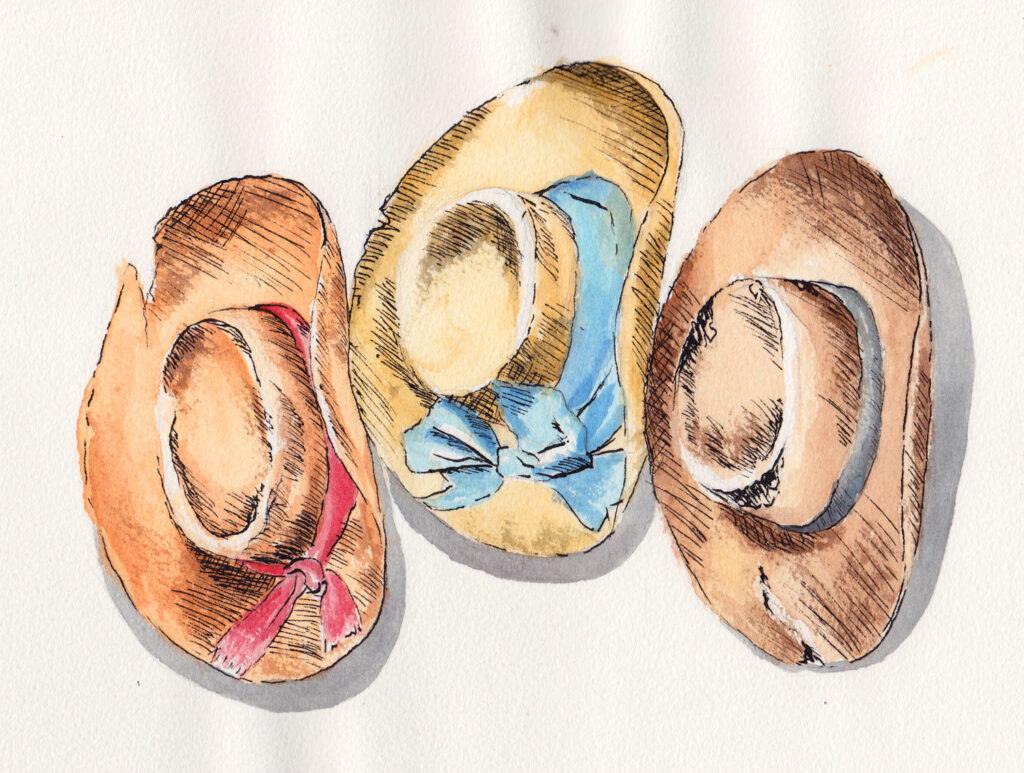
“Hat study” by PermaCultured is marked with CC BY 2.0.

I, like all of us, wear many hats: the Mom hat (a worn baseball cap; comfy and flexible), a teacher hat (a black top hat; great for entertaining, yet requires strength and confidence to pull off), and most relevant to my current blog post, a student hat (a beret; casual yet sophisticated, and requires some practice and patience to place it properly). 

While attending the virtual symposium, I firmly have my student hat on; I am eager to learn and excited to apply what I’ve learned to my practice. Catherine Cronin’s session further substantiated my ideals, stating the idea of “openness” in open education varies across personal preferences and platforms. “Open is not a state…it’s contextual”, she explains, meaning the user/educator decides on what aspects of identity are seen (Cronin, 2017). Her graphic organizer outlining the “4 dimensions shared by educators using OEP” specifically pointed out the difficulty of “balancing privacy and openness”, what she refers to as the “Micro” or digital identity (Cronin, 2017).

I thought to myself, ‘Easy! I am a student; therefore, I will keep my online presence set to student related aspects’, and off I went gathering more knowledge, beret expertly atop my head.

But my decision to share only my student persona was confronted after I listened to Cindy Harris’ session. She argues that a more open approach is the most beneficial. Cindy states that a more genuine, creative presence occurs when multiple parts of your identity are utilized (Harris, 2021). Her box analogy opened up my thinking. By opening myself up and allowing all parts of my identity to show and intermingle, a truer, fuller version of myself can shine through, allowing for a more authentic experience (Harris, 2021).

Although the idea of having all my identities come through is honestly quite terrifying. Am I ready for this? I have been doing pretty good keeping my identities compartmentalized. I am comfortable with choosing which aspects of myself I share in various situations, but I know that Cindy is right. My true self is all my identities: mom, aunt, bike rider, teacher, etc. 

Learning is being uncomfortable; it is about challenging your thinking and ways of doing things. For me, it also requires confidence, trust, and a good support network. I am not there yet, but each course I take and each person I meet in my educational journey will help get me there. 

In the meantime, my beret is awkwardly placed on my head, and all my other hats are well within reach. 

References

Cronin, C. (2017, April 20). Open culture, open education, open questions. In E.Childs (Chair), 2017 Virtual Symposium [Symposium]. https://malat-coursesite.royalroads.ca/lrnt521/recordings/catherine-cronin-choosing-open/

Harris, C. (2021, April 14). The person in the middle of the road: one educators [sic] journey supporting training and education. In E.Childs (Chair), 2021 Virtual Symposium. [Symposium]. https://admin.video.ubc.ca/html5/html5lib/v2.86.1/mwEmbedFrame.php/p/154/uiconf_id/23449276/entry_id/0_zbtpyuj3?wid=_154&iframeembed=true&playerId=kaltura_player_1632766724&entry_id=0_zbtpyuj3

Welcome to your site!

WordPress logo

This is your WebSpace powered by WordPress site. It will be the home for your journey through the MALAT program, and you can customize it to meet your needs and reflect your style.


Use these tutorials to learn more about customizing your WordPress site.