
Photo by Greg Rosenke on Unsplash.
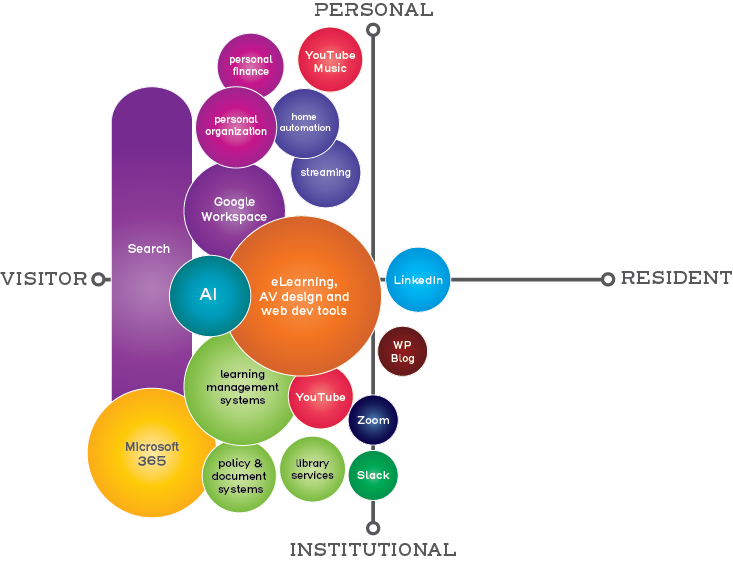
Before creating my technology use map, I hadn’t reflected much on the amount and types of technologies I use daily. Being a bit of a tinkerer and early adopter of new tech, I tend to collect and use technology wherever I can to solve problems and expand my skills. However, it’s obvious from my map that I have a practical approach to technology; I see technology primarily as an instrument. I rarely use technology to engage in networked publics for several reasons. I will go into greater detail in my forthcoming DIPD post, however, my avoidance of social media is intentional due to concerns with data privacy & use, algorithmic bias and underlying incentive structures in the major platforms.
Hi Chris,
Great job on your Map!
I look forward to reading your DIPD and your concerns of the Resident side. I hope to learn and gain comfort with many more digital tools over the next 2 years, so those of you with high technology backgrounds definitely have my ear👂🏻.
Thanks Darren, if you ever have questions about a particular technology, feel free to ask me. I’m more of a generalist when it comes to technology, but I’m always happy to share what I know.
Interesting mapping, Chris. Of course, as I examine yours, I have thoughts around how I would iterate upon my own.
Social media has been a mixed experience for me. It has led to good connections and conversation, both online and in person. Over the years, toxicity has infected the platforms, leading to my ebbing engagement and interest. Once Twitter was acquired, rebranded, and overhauled, it suffered such a rapid decline into toxic chaos that it wasn’t long before I abandoned the platform—even though it meant severing engagement with the hundreds of users I followed.
One of the new social-media platforms that has popped up, Posts, reminds me of early-days Twitter. It is positive, minimal, and currently pretty focused on the tech industry. I am an active user there, but not nearly as active as I was on Twitter. My technology-use map shows a shrinking engagement with social media, which I expect to continue.
Agreed, I’ll go into it in a bit more depth in my DIPD, but similar to you, I used social media more about a decade ago and then became tired of the growing toxicity. The last few years have been particularly negative and I’m concerned it will only get super-charged with the addition of AI.
Interesting to see how we all interact so differently online.
Your explanation for why so much of your map is on the visitor side, how you use it more as an “instrument” resonates with me as I have changed my habits over time and become more wary of privacy, the use of my data, the algorithm, etc.
I guess I am going the same way as Stephen.
Thanks Heidi, not to promote confirmation bias, but this is a great read about the embedded values in technology. It’s one of the articles that got me thinking about the “Move fast and break things” mantra that’s common in big tech companies and what it has done at scale: https://consilienceproject.org/technology-is-not-values-neutral-ending-the-reign-of-nihilistic-design-2/
Hi Chris,
Thank you for your map! I actually thought about identifying personal finances (banking) and streaming sites under personal; however, I felt it did not apply. Now that I see your map, there are more tools I can keep adding to my technology map.
I agree with Stephen that platforms have become toxic over the years. That is why I believe the organization I work for has a strict policy regarding social media. This is why I have very little presence in the digital world. Like you, I feel my “visitor” presecnce is heavier than that of others. I wonder if it’s possible to balance out a digital presence that is effective and safe at the same time.
Thanks Kym, I rehope that more digital communities will evolve to the point where a digital presence can be safe and effective. It’s amazing how the internet could be such a powerful tool for global (and local) coordination and instead it’s driving polarization.
Interesting map and thoughts, Chris. Your map actually looks a lot like my own.
One question I have been pondering of late has been whether our digital presence tends to mimic the traits of our physical presence. In my case. I tend toward being somewhat cautious and reserved in both face-to-face and online interactions. Based on this typology, I might be considered a bit of a visitor within the physical world as well as the online world.
A question for everyone – does your online presence match or diverge from your “real world” persona? And has that changed over time as the internet has grown and changed over the past 30+ years?
Thanks Russ, similar to you, I tend to be more reserved and even introverted in my face-to-face socialization. However, as part of my role, I support thousands of users and regularly collaborate with hundreds of staff, so I needed to adapt this to engage in institutional interactions. Personally, I spend more time and energy with my family and helping my neighbours. If it wasn’t a requirement of my role, I expect my real-world map would be very similar to my tech map.
Over the past 30 years, my personal and digital personas have not changed significantly, except where change was required, which tended to be more transactional situations.
Reflecting on my post, if I consider Dave Cormier’s (2018) proposed tension pair, I get a more holistic perspective with better distribution across the map. I use many tools, digital and analogue, but framing by practice better represents my interests and activities. Looking at my V&R map, it appears that I’m almost entirely socially disconnected, which is inaccurate. I engage in social or collaborative activities, just not reliant on technology-mediated tools.