

A Resident-Visitor typology – Allie Munro
“It is a capital mistake to theorize before one has data.”
~ Sherlock Holmes
Tension Pairs
As we continue our journey and studies into Learning and Technology, we have been asked to use data strategies to visualize the technologies we use today. The specific tension pair we were asked to map was called a visitor and residence, including the personnel and institutional concept. This data visualization aims to provide insights into what technologies we currently use and how they relate to each other. From this visualization, we can see if you use tools in either a professional or personal setting and if you are a contributor within this technology or a visitor (lurker).
Before mapping out the technologies, I assumed what I would see. Let me draw on some literature to rationalize what I expected to see. As Danah Boyd says in her paper Social Network Sites and Networked Publics, it is essential to know your audience; this informs what you can say to ensure your message is understood and provides engagement (Boyd, 2011). Boyd continues to state that it cannot be assumed that we know our audience due to changes in context, which is a direct result of sharing capabilities.
Sharing articles and opinions is not a new concept, but the speed at which they can be shared can be uncontrollable if unintended conclusions occur. Social media platforms allow the sharing of information outside the author’s original intended network. As a result, my opinions and perspectives may be presented to an audience which fundamentally disagrees. I am not concerned with having healthy discussions and debates on contentious issues, but this type of forum is only sometimes present. I would rather avoid the center stage of online conflict in front of my network, which may consist of colleagues and employers.
Due to these concerns, I am a social media lurker, and I expect the mapping to reflect this. Friends and family would call me an extrovert outside of the digital space; this is who I am, and my digital identity is a consequence of the concerns previously provided.

The diagram was created with the Lucid Charts application.
As expected, I used popular social media platforms such as Instagram, Facebook, Reddit, and YouTube in a visitation manner (lurker). I do use some platforms, such as Slack and MS Teams, which are communication tools designated by my employer and have closed networks. The only open network platform I use is Discord, which is out of necessity to engage with gaming communities to collaborate on gaming objectives.
Digging Deeper
When creating this mapping, I felt there was more interesting data to find, but it required me to provide specific data points. I created a new map of the technology using a Likert scale of zero to six for each of the technologies on both the X and Y axes. By narrowing down the data into more discrete data points, I gained a new insight; I am not a lurker on any software for institutional use, which I am sure my employer would be happy to know.

The diagram was created with the app.flourish.studio application
I wanted to gain even more insights, which was to understand how this data is related to frequency of use. To do this, I added another Likert scale data point, identifying how frequently I use these applications. I then presented this data in a Bubble chart to see which software I used most compared to others.
The following two bubble charts compare these technologies regarding usage frequency and are categorized (coloured) by each concept pair: visitation/residence and personnel/institutions.
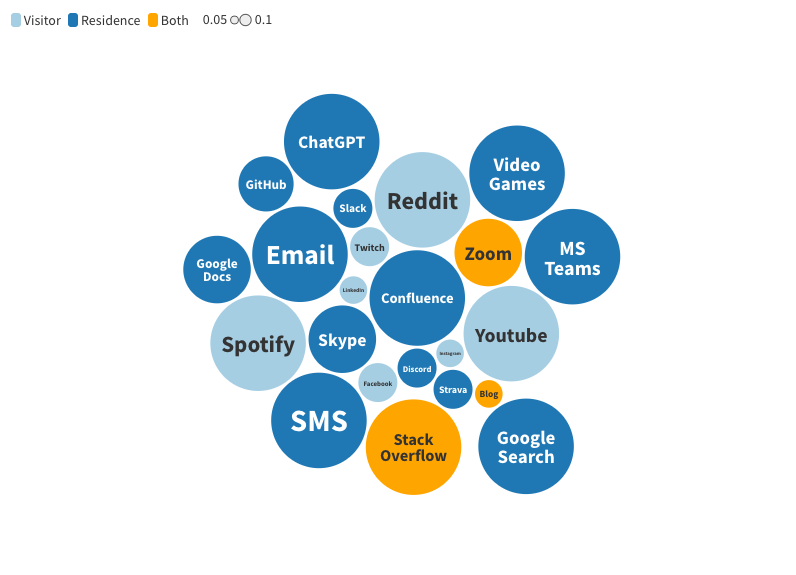

These diagrams were created with the app.flourish.studio application
The technologies I am considered a lurker on also happen to be the applications I use least, with the exception of Reddit, which I have found to be an excellent indicator of news which is not on major outlets; I identify important news and then read it elsewhere. The takeaway here is that more Lurking is not enough; engagement is what drives repetitive use.
Summary of Findings
No matter how you slice it, I am a social media lurker; this is my digital identity. However, this aligns differently with my future endeavours. To further my career, I must become known outside my company and considered an industry expert and thought leader. To do both, I must break down the digital barriers I have crafted. How? My concerns about what I say being taken out of context and dealing with digital restriction are legitimate. However, as my wife always says, I overthink things. Perhaps I am dealing with years of built-up anxiety for no reason.
Further Investigation
Upon completing this thoughtful exercise, we were asked to consider a new tension pair identified by Dave Cormier: Independent/Collaboration and Digital/Analogue (Cormier, 2018). Cormier states that although the visitor/residence tension pair is valuable, it shows how we approach tasks holistically. Cormier uses email as an example: we write a letter, send it, and then wait. The tool we send the letter has changed, but does it serve value in differentiating between digital and non-digital?
Although I see immense value in Cormier’s proposed tension pair, like all other pairs, it identifies a correlation between two related concepts that provide insights when visualized. While the visitor/residence pair helps identify our digital presence, it does not determine how we conduct ourselves, whereas Cormier’s tension pair would but does not identify your digital presence. Each exercise would foster excellent discussion, but each serves its purpose.
Cormier’s tension pair is a great exercise to provide a personnel assessment of how I conduct myself and how I do it. I will perform this exercise as I shape how I engage and conduct myself in this ever-changing digital world.
As I craft my new digital identity in the months and years to come, I will find ways to slowly step off the edge and embrace a world that, I hope, is open to hearing my opinions and perspectives.
Thank you, the reader, for joining me on this journey.
References
Boyd, D. (2011). Social network sites as networked publics: Affordances, dynamics, and implications. https://www.danah.org/papers/2010/SNSasNetworkedPublics.pdf
Cormier D. (2018, March 31). Digital Practices Mapping – Intro activity for digital literacies course. https://davecormier.com/edblog/2018/03/31/digital-practices-mapping-intro-activity-for-digital-literacies-course/
Stevens E. (2023, August 31). 23 Must-Read Quotes About Data. https://careerfoundry.com/en/blog/data-analytics/inspirational-data-quotes/
Love this post Allie, especially the iterative generation of new data points and subsequent analysis. It adds depth to the exercise. It would be interesting to perform the same with the Cormier (2018) tension pair map.
One thing that resonated with me was the concern about “collapsed contexts” as Boyd (2011) referred to them. There are so many issues with framing, cherry-picking of facts, strawman constructs, bad faith arguments and mis/disinformation on platforms that it feels almost impossible to engage in healthy debate in the digital public square. Do you think your goal to become an industry expert and thought leader will help you to achieve the level of influence to transcend the nonsense?
Hey Chris, I sure hope so! I think I will always be up against biased arguments and my own biases. However, I hope that through the MALAT program, I can build my skills in critical thinking to help position my arguments, which include many perspectives, or at least recognize them in my positions. The debate activity will be a great exercise as this is exactly what I expect to experience on more professional social media platforms. I will need to be sure I choose platforms wisely to avoid keyboard warriors and unhealthy debates.